THERE ARE THREE Underground stations close to each other and very close to London’s Euston Road. Warren Street station is 285 yards west of Euston Square station, which is about 376 yards southwest of Euston Underground station.
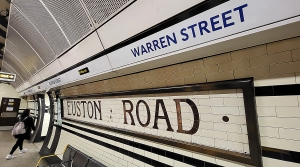
When Warren Street station (on the Northern Line) was first opened in 1907, it was named ‘Euston Road’. An old station name sign on the platform has been retained as a souvenir (see photograph above), and it reads “.Euston Road”. Had this name remained unchanged, there would have been three stations with ‘Euston’ in their names. So, in 1908, no doubt to reduce the possibility of confusion, the present Warren Street station lost its original name and was given its current name.
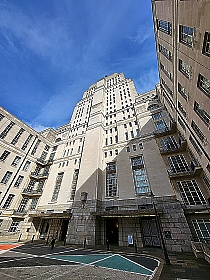
Senate House in London’s Bloomsbury was designed in the Art Deco style by Charles Holden (1875-1960), who also designed many buildings for the London Underground including quite a few stations on the Piccadilly Line. It was once, London’s tallest building.
Senate House was built between 1932 and 1937, and is the administrative centre of the University of London. Currently, there is a small exhibition about the planning of the building on the first floor.
SOUTH KENSINGTON STATION has two street entrances connected by an arcade with a glazed roof. Its subsurface ticket office and foyer gives access to three of London’s Underground Lines: Circle, District, and Piccadilly. But this has not always been the case. People standing outside the southern entrance to the arcade will notice that to its right there is a building faced with the blood red glazed terracotta tiles typical of many London Underground stations. Above the façade are the words “South Kensington Station”, but there is no public entrance to this building.
The arcade used to be the entrance to the station at which passengers could embark and disembark from trains operating on the District and Circle lines, which were part of the Metropolitan Railway. This station was opened in 1868. In 1906, a station on the Great Northern, Piccadilly and Brompton Railway (now the Piccadilly line) was opened at South Kensington. Its platforms are far deeper beneath the surface than those of the District and Circle lines. Lifts inside the building with the red façade carried passengers to and from the Piccadilly line platforms. This building was then the entrance to the Piccadilly Line station, which was separate from that (with the arcade) which led to the shallower subsurface Circle and District platforms.
In the early years of the 1970s, the lifts to the Piccadilly Line were replaced by escalators. Access to these was made from the concourse that serves the District and Circle line platforms, and then the entrance via the building with the blood red façade was taken out of use. So, what had been two stations became one.


 yamey
yamey 