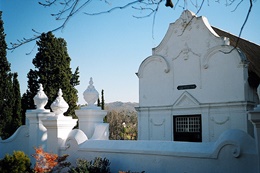
MY FATHER WAS BORN in Cape Town in South Africa. His childhood was spent in the small town of Tulbagh not far from Cape Town. His father had a general store in Tulbagh. The family lived across the yard behind the shop in a house on Church Street.
In 1969, Tulbagh suffered a devastating earthquake. The town’s authorities decided to rebuild the houses in Church Street to make them resemble the original appearance of the sort of houses that Dutch settlers built when they first arrived in the Cape.
Some years after the earthquake, my father paid a visit to Tulbagh. He said that his former home in Church Street in neither resembled the place where his family had lived nor had ever looked like it did after its ‘restoration’ following the earthquake. In addition, he felt that the town looked far smaller than it did when he was a child.
In 2003, I visited Tulbagh with my wife and daughter. We stayed in a bed and breakfast in one of the picturesque houses on the restored Church Street, a few doors away from my father’s childhood home.
We visited the house where my father once lived. It was another bed an breakfast. Had I known it was, I would have booked a room there. The landlady showed us around. She had no idea that her back garden had been part of the yard behind my grandfather’s shop on the next street.
There was a lemon tree laden with lemons growing in the back garden of my father’s former home. We asked our host if we could pick a couple of lemons, one for my father and the other for his only surviving sibling, my aunt Elsa. She agreed.
Before leaving South Africa, wr managed to buy an official school tie as used in Tulbagh High School, where my father studied (in Afrikaans, rather than his mother tongue English) until he entered Cape Town University.
In 2003, it was 12 years since the official ending of apartheid laws. These laws included prohibition of inter-racial intimate relationships. We expected that by 2003 we would have seen, if not many at least a noticeable noticeable number of mixed-race couples. I think that in the one and a half months we spent in South Africa we saw only three. The members of two of the couples were not born in South Africa. It was only in Tulbagh that we met a young ‘white’ Afrikaner with his arm around a ‘black’ African girl. They were both studying at Tulbagh High School.
When we returned to Cape Town, we gave Elsa the lemon that had been growing in the back garden of her childhood home in Tulbagh. She showed little interest in it and put aside.
A day or so later, Elsa was preparing gin and tonic for us at sunset. She need a lemon. Her eyes fell on the lemon that we had brought from Tulbagh. She seized it, and cut slices of it to drop into our drinks. So much for sentimentality!
As for the High School tie, we presented that to my father when we got back to London. He thanked us, then said:
“ I don’t need that. I left the school long ago.”


 yamey
yamey 