
An advantage of wearing a hijab in an airport in a Gulf State

THINGS DID NOT BEGIN well for me when I arrived at Bangalore Airport’s recently opened Terminal 2 prior to boarding an Emirates airline flight to Dubai, where we were to catch another flight to London. We arrived at the airport in good time – before the check-in desks were open. After finding somewhere to sit, I walked to the Chaayos refreshment stall and asked for two cups of south Indian filter coffee. The server must have misheard me and only charged me for one. When this arrived instead of the two, I was expecting, I paid for another cup. While it was being made, I carried the first to my wife. I returned to the stall and picked up the second cup. It was filled to the brim, very hot, and the cup was poorly insulated. Just before I reached where we were sitting, my hand moved slightly, and the boiling hot coffee fell on my palm. This was extremely painful. I dropped the cup and the rest of its contents. I rushed to the washrooms, and after finding a tap that worked, I rinsed my palm in cold water. Meanwhile, my wife managed to get me some ice to put on the scalded part of my hand.
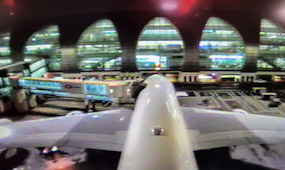
Dubai Airport

After dropping off our baggage and collecting boarding passes (printed on extremely thin paper), we headed for the security check. This involves divesting oneself of anything that contains metal before walking through a metal-detecting arch and then being frisked by a security official. Because the trousers I was wearing were too big, I had to keep one hand on them to stop them falling down. Meanwhile, I was somewhat shocked, and my hand was still smarting after the scalding.

After the frisking, I went over to the conveyor belt that carried our hand baggage and other items slowly through an x-ray machine. After rescuing both my wife’s and my own cabin baggage, telephones, wallets, coats, neck cushion, and my trouser belt, I secured my trousers with the latter. It was then that I realised that my boarding pass was nowhere to be seen. I was horrified – in so many decades of flying, I had never lost a boarding pass.

We reported the loss to the security supervisor – a female officer. She rang for an official from Emirates airline. While waiting for him to arrive, she said to my wife in Hindustani:
“He should not worry. They won’t leave him behind.”
After an agonising wait – actually, it was no longer than about 15 minutes – the official arrived. By then, I was feeling both anxious and extremely upset. The Emirates man explained that I would be issued a new boarding pass at the boarding gate. Not entirely happy with that, we left the security area, and headed for the departure lounges. On the way, we came across an empty baggage trolley, and began loading it with our carry-on bags and coats. As we were doing that, something fell to the ground – it was my missing boarding pass. In an instant my mood of melancholy and apprehension switched to one of immense happiness and relief. I rushed back to the security supervisor to tell her the good news. As the Emirates man was still around, I told him and shook his hand.

The flight to Dubai was pleasant. There was nothing to complain about. At Dubai, we had to pass through another security check. This time, I decided not to remove my belt before passing through the metal detector. Instead, I untucked my shirt and covered my belt with it. Despite there being a large metal buckle on the belt, the detector did not detect it. Nobody stopped me. Meanwhile, passengers’ hand baggage was passing through an x-ray machine so quickly that I doubt there was time to examine the series of x-ray images in any detail – if at all.
After enjoying exorbitantly expensive hot drinks, which I did not manage to spill, we entered a departure lounge dedicated to our flight to London. Before entering the lounge’s seating area, an official examined each passenger’s passport and boarding pass. Most passengers, including my wife and I, had to head for a line of trestle tables. By each of them there was a male or female security official. A few passengers were sent straight into the seating area, bypassing the tables.

The officials standing at the tables first searched the contents of bags – rather cursorily. Then, using an electronic wand, they frisked the passenger. After that, each passenger was asked to present their hands, palms facing upwards. An explosives detector sponge was rubbed on each palm, on the clothing, within the footwear (which had to be removed), on the mobile ‘phones, and other carry-on items. After placing the (re-usable) sponges in a machine, we were allowed to sit down and await the flight. My wife told me that the security lady who examined her was both rude and rough.

This process took quite a while. I sat watching it and gradually, I and my wife became aware of something curious. About a third of the passengers on our flight were women wearing hijabs (Muslim head coverings). This was not surprising in an airport in a Gulf State. What was astonishing was that not one of them had to be searched at the tables. They were allowed to board the flight without having been checked as thoroughly as the other passengers had been. Given that very recently, soldiers wearing hijab were able to enter a hospital in Gaza and attack it with firearms, was it wise to assume that because they were wearing hijab, the passengers on our flight to London were beyond suspicion, whereas all the other passengers – both male and female – needed to be regarded as potential terrorists?

The flight to London could not be faulted. And in case you are wondering, by the time we landed at Heathrow, my scalded palm was neither painful nor inflamed.
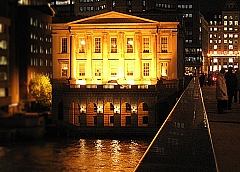
Next to London Bridge

THE PRESENT FISHMONGERS Hall at the northern end of London Bridge was constructed in 1827, following the completion of the London Bridge, which now stands in Lake Havasu City in Arizona (USA). Built in a neo-classical style, the Hall, which faces the Thames and King William Street, was designed by Henry Roberts (1803-1876), assisted by a young architect who would later be known as Sir George Gilbert-Scott (1811-1878).

Recently, the Hall was associated with a horrific act perpetrated by a terrorist Usman Khan (1991-2019). Khan, whom it was believed to have been reformed and rehabilitated from his terrorist leanings, was attending a conference on prisoner rehabilitation arranged by the University of Cambridge at Fishmonger’s Hall on the 29th of November 2019. During the conference, he put on what turned out to be a fake suicide vest. He threatened to blow up the Hall. He did not do that, but instead fatally stabbed two of the other conference delegates (both in their twenties): Saskia Jones and Jack Merrett. The latter had studied at the University of Cambridge. As Khan fled across London Bridge, he was tackled by members of the public before being shot dead by a policeman. What had been intended to be a well-intentioned project, ended up as a national tragedy. It illustrated that although a person’s mind can be programmed to become a fanatic, undoing this programming is far more difficult than most people, even experts, imagine.

Survived in Soho

IN SEPTEMBER 1940, a 17th century church in London’s Soho was destroyed by fire because of aerial bombardment by the Luftwaffe. All that remained intact was the tower at the west end of the church, St Anne’s Soho. Today, the tower still stands and overlooks a small but interesting churchyard.

St Anne’s was completed in 1686 during the period when Soho was becoming urbanised as London grew in a westerly direction. It had been designed either by (more likely) Sir Christopher Wren (1632-1723) or by William Talman (1650-1719), or maybe they collaborated (www.british-history.ac.uk/survey-london/vols33-4/pp256-277). According to John Timbs, writing in “Curiosities of London”, published in 1867, when the church was standing:

“The interior is very handsome and has a finely painted window at its east end.”

Sadly, this no longer exists. The tower, which we see today, was built in about 1806 to the design of Samuel Pepys Cockerell (1753-1827), great-great nephew of the diarist Samuel Pepys, to replace an earlier one that had become unstable.

The pleasant rectangular churchyard that extends from the tower to Wardour Street measures approximately 150 feet by 80 feet. It contains several fascinating memorials, some of which used to be inside the church before it was bombed. Standing near the northern edge of the churchyard is the prominent gravestone for the essayist William Hazlitt (1778-1830), one of my favourite writers, who died in a house in Frith Street, not far from the church. His gravestone bears an extremely lengthy inscription, which might have been composed by a lawyer and poet called Charles Jeremiah Wells (c1800-1879; http://www.lordbyron.org/persRec.php?choose=PersRefs&selectPerson=ChWells1879), who had become a “devoted acolyte” of Hazlitt (according to his biographer AC Grayling). Amongst many other positive attributes, the inscription describes Hazlitt as:

“… The unconquered Champion of Truth, Liberty, and Humanity…”

There is a second monument to Hazlitt, which is attached to the wall of the tower. This has less of an inscription, but includes the words:

“Restored by his grandson February 1901”.

Near to this and also attached to the tower, there is a small rectangular metal plate in memory of the Welsh philosopher David Williams (1738-1816), who founded The Royal Literary Fund in 1790, lived in Gerrard Street, and is buried somewhere in the churchyard.

The most curious memorial in the churchyard is to Theodore, King of Corsica. The monument informs that Theodore died in the Parish of St Annes soon after his release from the King’s Bench Prison in 1756.  This man, Theodore Anthony Neuhoff, who was born in Prussia, disembarked from an English vessel on the coast of Corsica in Spring 1836. He had with him a considerable supply of arms and money. He led the Corsicans in a successful revolt against their Genoese rulers and was crowned ‘King of Corsica’. After a short time of peace, the Genoese returned, and Theodore travelled around Europe trying to seek foreign supplies and aid. His journey took him to Livonia, France, and Holland, where he managed to obtain a frigate armed with 52 guns and an army of 150 men. Sadly, the Neapolitans arrested him and imprisoned him in the north African town of Ceuta. Unable to help his Corsican subjects, he fled to London, where problems with debt landed him in prison (for full story, see: “The Patrician, Vol. 1”, 1846, edited by Bernard and John Burke). His memorial states that after getting into debt, he “registered the Kingdom of Corsica for use of his creditors”.  His memorial was financed by the writer and politician Horace Walpole (1717-1797), whose words about Theodore, who died a pauper, are inscribed on the stone:

“The grave, great teacher, to a level brings

Heroes and beggars, galley-slaves and kings;

But Theodore this moral learn’d ere dead;

Fate pour’d its lesson on his living head,

Bestow’d a kingdom, and denied him bread.”

The bodies of Hazlitt, Williams, and the King of Corsica, are amongst the 60,000 corpses buried in the graveyard, which his why the level of the ground in the churchyard is much higher than the pavement in Wardour Street that runs alongside it.

Hidden from sight because it is below the ground floor of the tower are the ashes of the author Dorothy L Sayers (1897-1957), who was a churchwarden at St Anne’s between 1952 and 1957. I have not yet discovered her connection with Soho.

More recent monuments are also of interest. There is a list of those of the parish, who died in WW1. Beneath that there is one to those who died in active service in WW2, which includes several with probably non-English surnames: Rosenfeld, Grossman, Kosky, and Masser. This monument also remembers those in the parish who died during the Blitz. A small plaque on a post in a flower bed records the names of three young people who were killed on the 30th of April 1999 when the Admiral Duncan pub in nearby Old Compton Street was bombed by a racist homophobe, David Copeland (https://www.bbc.co.uk/news/uk-england-london-47216594). A triangular wooden bench near the monument to the victims bears a plaque that reads:

“This triangular bench represents Brixton, Brick Lane, and Soho, three places brought together by acts of hate, made stronger by acts of love. 17 – 24 – 30 April 1999”.

The three places were all sites of horrific nail bombings that April.

So much for the churchyard, but what about the church? After many years of having used the site of the bombed church as a car park, which I can dimly recall, a new building that contains social housing as well as a small chapel was built in the early 1990s. The new church is entered from Dean Street. Apart from being a site of many historical associations, the churchyard is a peaceful haven in the heart of a normally busy part of central London.

What have we come to?

I FIRST MET MY FRIENDS, the brothers, ‘A’ and ‘B’, at the birthday party of another friend ‘C’. This meeting would have been in March 1965. I know this because the celebrations included watching a matinee performance of the film “Goldfinger”, which had been released in the UK a few months before (in September 1964). We saw the film in the now long-since demolished Odeon Cinema in Temple Fortune, which is on the edge of Hampstead Garden Suburb (‘HGS’), where we all lived. Sadly, one of the brothers died a few years ago, but the other two friends are still thriving.

BLOG PUT 3

Mutton Brook

Since the major London ‘lockdown’ ended and we have become more mobile, having acquired a motor car, we have made several visits to HGS to see ‘old haunts’. One of these places is the series of public gardens (Northway Gardens and Littleton Playing Fields) that run along either side of a stream called Mutton Brook (it is a tributary of the River Brent that flows into the Thames at Brentford in Middlesex). The Brook runs parallel to Falloden Way, a stretch of the A1 road. Flanking the road that separates HGS into two sections, there is a shopping area appropriately and unimaginatively called the Market Place. During my childhood, the section of HGS north of Falloden Way was affectionately known as ‘Across the Jordan’ because many Jewish people live(d) there. I suspect that today, there is a fairly equal distribution of Jewish households in both sections of HGS separated by the A1.

My friends, A, B, and C, and I used to visit the gardens alongside Mutton Brook in our spare time. In those days, but not now, the water in Mutton Brook had a rather unpleasant smell (sewage or something rotting). One of the attractions in the gardens was a putting green open to the public. For a small fee it was possible to hire a putting implement (a putter) and a golf ball. The brothers, A and B, were very competitive, and C was less so. The three of them managed to complete the course in a respectably low number of well-aimed shots. By the time I had reached the second hole, the others had putted their balls into all 18 of the holes on the course. What I have never been able to understand is why  when my ball was within inches of a hole, instead of falling into the hole, it spun around the circumference of the mouth of the hole without falling into the target area. Well, I was never skilled at any ball games, but I enjoyed the company of my friends.

Back in the 1960s, I believe that there were no refreshment areas in either Northway Gardens or Littleton Playing Fields. This has changed. There is a charming Café Toulous near one entrance to Northway Gardens and the Café Gaya in Littleton Playing Fields. Today, we sat at a table under trees near the latter and enjoyed drinking coffee in the shade. The ambient temperature was 31 degrees Celsius.  In one direction, we could see the spire of Lutyen’s St Jude on The Hill Church in the heart of HGS and in the other, a nursery school that shares the same building as houses the Gaya.

There were about twenty children’s push chairs (buggies) parked in front of the two-storey nursery. This came as no surprise because the school was in use. What was remarkable was the presence of three hefty looking security men, two in uniform and one in ‘mufti’. Each of these fellows had walkie-talkies and the two in uniform seemed to be wearing protective (bullet-proof?) vests over their jackets. They were keeping a very close watch on the kindergarten and unlocked its front door when ever there was something to be delivered.

After enjoying our drinks, we asked the Eastern-European lady working in the café about the security guards. In not brilliant English with a marked accent, she replied:

“Security”.

Flippantly, I asked:

“Are the kids dangerous?”

Not seeing the joke, she explained:

“Private Jewish school”,

And then added:

“All private Jewish schools have security.”

How sad it is that nowadays, even kindergartens filled with tiny tots are considered to be at risk from attack. This was never the case when my friends and I knocked golf balls around the now non-existent putting green on the bank of Mutton Brook. What have we come to?