
A teetotal private club by the seashore in Fort Kochi (Kerala)

DURING BRITISH RULE in India, the (white) colonisers formed clubs to which Indians, apart from those who worked in them as servants,  were excluded. Many of these colonial era clubs are still in business,  but now serve as refuges to which (mainly) upper middle class and upper class Indians can escape from the other Indians that surround them in daily life.


One of these clubs is the Cochin Club in Fort Kochi (Kerala). It stands on land close to the seafront. Prior to the establishment of the club in 1914, this land was formerly Schulers Shipbuilding Yard, and later Grieves Beach Yard. It was given to the founding secretary of the club,H Baechtold,  by Volkhart Brothers.


It was only in the 1960s and ‘70s that the club ceased to be exclusively for ‘white’ people. Many of the club’s buildings are fine examples of colonial architecture.  The bar is magnificent, as are the rooms adjacent to it (the lounge-cum-billiards room, the library, and another smaller bar).
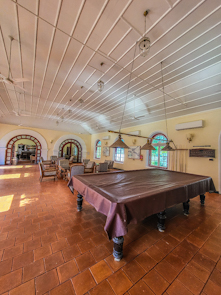
 

Although the bar is a marvellous example of  colonial era design, there is now a problem. In the early years of the club, members and their guests used to enjoy alcoholic beverages at the bar, this is no longer the case. Exactly when alcohol ceased to be available I do not knoe.


For many years, the club has not had a liquor licence, and given the very high cost of such licences in the State of Kerala  there is little likelihood that an  alcohol licence will be purchased by the club. We were told that if a special occ  such as a wedding reception,  takes place within the lovely grounds of the club, whomever is organising it can purchase (at great cost) a temporary booze licence for the day.


Because of the absence of a liquor licence,  the club is often very empty – almost like the famed Marie Celeste. The club has five wonderful, spacious guest rooms, and the income from the guests hiring these is an important source of income for the establishment.  In addition, the club rents out space to other businesses. Currently (January 2026), one of these is a café,  and the other is  a boutique.


Outnumbering the usual number of members and room guests in the club are the white egrets that stride around the grounds in a most proprietorial manner.


Because we are members of a club affiliated to the Cochin Club, we can use their facilities and hire their bedrooms. The Cochin Club is today, as it was in the past, a peaceful place to escape from the hustle and bustle of Fort Kochi,  which seems to increase each time we visit the town.

On the wagon – no longer!

IN THE CENTRE of Warwick, there is a building with superb examples of Victorian decorative terracotta work. High on its façade, in terracotta lettering are the words “coffee” and “tavern” because this edifice began its life as a coffee house back in 1880.

Designed by a Warwick architect Frederick Holyoake Moore (1848-1924), it was constructed for a local manufacturer and philanthropist Thomas Bellamy Dale (1808-1890). He was mayor of Warwick three times and:

“…was a philanthropist in every sense of the word, for his name was connected with the principal benevolent institutions of England, of which he was a generous supporter; as a public man he took a very active part in the sanitary improvements of the borough of Warwick, and in the adoption of the Free Library Act. He was a generous supporter of every useful institution in the town, and, though exceedingly charitable, was most unostentatious in all his benefactions.” (www.mirrormist.com/t_b_dale.htm)

In the 19th century, alcohol consumption was considered to be responsible for the ill-health of poor people and detrimental to their general well-being. Dale built his coffee tavern and hotel to offer an alternative to alcohol and pubs. His establishment had:

“…a bar and coffee room on the ground floor with service rooms at the rear; a bagatelle room, smoke room and committee and club room on the first floor, and rooms for hotel guests on the second floor.” (www.ourwarwickshire.org.uk/content/article/coffee-tavern-warwick).

The place was designed to keep people away from alcohol, “on the wagon”.

Now, all has changed. Today, the building still offers refreshments and hotel rooms, but does something that the late Mr Dale, who encouraged people to become teetotal, would not approve. Customers at what is now named “The Old Coffee Tavern” can now enjoy not only coffee but also a full range of alcoholic drinks. He might be pleased if he knew that when we visited its pleasant lounge decorated with colourful tiled panels, we chose to sip coffee rather than drinks containing an ingredient that did not meet with his approval.

Things go better with Coke

It was the day after the much-loved fimstar Ambareesh died. He was a hero all over the Indian state of Karnataka. To respect him, alcohol sales were forbidden in Bangalore. It was what is called a ‘dry day’. One could not order any alcoholic drink at a bar, restaurant, etc.

So, being unable to order an alcoholic drink, I ordered Coca Cola.

“Coca Cola” the waiter queried, “it’s not available. Today is dry day, sir”

“But Coca Cola is not alcoholic” I protested, adding “Coke, you know”

“Ah, Coke, sir. I can bring you that,”the waiter said, at last understanding what I was trying to order.