
A picture of sunset over the Danube at Novi Sad, now in Serbia, posted on Substack, elicited memories of my visits to Yugoslavia in the 1980s. The following is an excerpt from my book “Scrabble with Slivovitz”, which describes my experiences of extensive travel in the former Yugoslavia during the 1970s and 1980s.
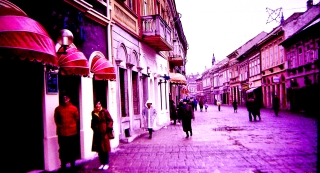
One result of the brief period of friendship between Tito’s Yugoslavia and Mao’s People’s Republic of China, which began in the late 1970s, was that the Chinese supervised the setting up of Chinese restaurants in three Yugoslav cities: Belgrade, Novi Sad, and Sarajevo. My friends in Belgrade rated the one in Novi Sad as being the best of the three. The first time that I went there, I travelled by train with Raša, Dragan, and some other friends to Novi Sad, which is about 100 Km north of Belgrade in the Vojvodina, an administratively autonomous region of Serbia.
The restaurant, the Secuan (Szechuan), served extremely good food. What made it particularly remarkable was that this high quality Chinese cuisine was prepared by Serbians. There was not one Chinese person working in the restaurant; all the Chinese personnel had been recalled to China some years before. However, the people running the restaurant had learnt from them the secrets of Chinese cooking, and they were able to produce dishes, which I am certain that many native Chinese would have found to taste authentic. At the Secuan, they understood the principles that underlie Chinese cooking, and were able to recreate it without having access to supplies of many specifically Chinese ingredients with the possible exception of soy sauce.
We ordered everything on the menu and washed down the food with numerous alcoholic drinks. After the meal, we stepped out into the damp chilled, afternoon air, and wandered around the town centre. When Dragan caught sight of a sign announcing the presence of a ‘Bar London’, he said to me,
“It would be surrealist if you take us for a drink in London.”
So, we descended into the cellar that served as a bar, and drank yet more booze. Then, we returned to the station to catch a train back to Belgrade. By now, I was feeling a little queasy after so much food and drink. The train was crowded and draughty, and we had to stand all the way. Despite feeling unwell during most of the journey, I was not put off the idea of visiting the Secuan on a future occasion.
On one of my many subsequent visits to Novi Sad I travelled with Raša and Dragan in Goran’s car. This was no ordinary car as its handbrake failed to work. Goran and another person were sitting in the front seats. When we had to make a hill start, and there were quite a few of these in Belgrade, the driver, Goran, had to use his two feet to control the clutch and brake pedals, and his neighbour had to lend his left foot to operate the accelerator. We stopped at Stara Pazova, which is half way between Belgrade and Novi Sad, because Dragan said that we needed we needed some ‘benzina’. This was not petrol for the car, but alcohol for us. We entered a café and had a few glasses of pelinkovac, a stiff alcoholic drink made in a factory in the Vojvodina. Luckily, on that day there was not much traffic on the largely straight road along which we were travelling, and we did not encounter any policemen.
Every time that I visited Belgrade, I made a pilgrimage with friends to eat the Secuan, and each time we ordered everything on the menu. Once, I tried the Chinese restaurant in Belgrade. It was fancier looking than the one in Novi Sad, but the cooking was not nearly as good. I see from the Internet that the Secuan still exists, but it is now no longer the only Chinese restaurant in Novi Sad.
If you have enjoyed this extract from my book and/or are curious about a country that no longer exists, you can buy my book from Amazon ( https://www.amazon.co.uk/Scrabble-Slivovitz-Once-upon-Yugoslavia/dp/1291457593/ )

