I HAVE VISITED Bury St Edmunds, a town in Suffolk, many times since my childhood in the 1960s. However, it was not until June 2025 that I first stepped inside the town’s Athenaeum. Located in the heart of the town, this edifice began life in the 17th century. It was converted into an Assembly Room in 1714, and then in 1853, it was modified to become the Athenaeum. Today, it is used for special occasions, such as weddings.
The highlight of its interior is the ballroom designed by Franciss Sandys, who died in the 1820s. .The barrel-vaulted ballroom is the full height of the building. What impressed me was that its beautiful stuccoed ceiling resembled the kind of ceilings designed by the great architect Robert Adam (1728-1792).
WE ENJOY ROAMING around rural England. However, eating in country pubs and restaurants can often be a bit ‘hit and miss’. In June (2025), we visited Flatford Mill in Essex, which has important connections with the artist John Constable and his family. We stopped to buy a drink at a refreshment stall, and asked the young man serving if he could recommend a pub where we could get a good lunch. He told us that The Marlborough in nearby Dedham was good; it is his ‘local’. He said that we should try their shepherd’s pie.
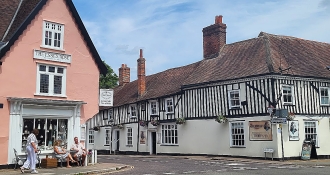
A short drive brought us to Dedham, and The Marlborough was easy to find. Situated on a corner plot almost opposite the parish church, the pub is a half-timbered edifice built mainly in the sixteenth century. Originally, it was built as a clearing house for local wool merchants. Inside the ground floor of the pub, there are many old timber beams to be seen.
Despite it being a hot day, I ordered the shepherd’s pie, which was truly excellent. It was accompanied by beautifully cooked carrots, parsnips, and cabbage. My wife ordered chicken parfait, and that tasted superb. The staf were friendly and the service was impeccable.
I am grateful for the recommendation we were given. Later, when mentioning how good it is to various people we met in Suffolk and Essex, they all knew of the pub and held it in high regard.
HADLEIGH IS A SMALL town in Suffolk (England). Like many towns in East Anglia, it was enriched by the wool trade in mediaeval times. Evidence of this included magnificent, cathedral-like churches and fine civic buildings. Hadleigh is no exception. Its fifteenth century half-timbered market hall (now a part of the town’s guildhall complex) is on one side of a graveyard that separates it from the south side of the large, fifteenth century parish church.
In one corner of graveyard there is a modern sculpture made of metal (mild steel). It depicts a sheep. Created by Benjamin Bramma, it was placed in the churchyard in 2015. That year, Hadleigh celebrated its rich heritage by holding a festival called “The Year of the Sheep”. As part of the festival, forty sheep were herded through the town.
The sculpture is a fitting tribute to the memory of the creatures that once brough wealth to Hadleigh.
DURING THE EARLY 1960s, my parents used to take us to Cambridge, where one of my father’s friends, the late Cyril Sofer, lived with his family. Often, we spent the night before our meeting with the Sofers at Bury St Edmunds. We always slept at the town’s Angel Hotel that faces the park containing the ruins of the monastery attached to the still existing Abbey.
Angel at Bury St Edmunds
This June (2025), my wife and I spent a little time in Bury St Edmunds. The Angel, whose facade is covered with foliage, is still in business. When I used to stay there many decades ago, the bedrooms were equipped with harnesses attached to ropes. These were to enable the occupants to escape from the room during a fire. I mentioned this to the receptionist during our visit in 2025. She had never heard of these fire escape aids, but then, I stayed at the hotel long before she was born.
While looking at the hotel’s facade, I noticed that the writer Charles Dickens had stayed there at least once. The town figures in “The Pickwick Papers”.
While walking in the park opposite the hotel, we came across a sculpture shaped like a teardrop. Placed in 2015, it is a memorial to all victims of genocide. It also records that 57 Jewish residents of Bury St Edmunds were massacred near the spot on Palm Sunday in 1190.
Brief as was our latest visit, Bury St Edmunds offers many interesting things for visitors to discover
IT IS NOT UNCOMMON to see gravestones with inlaid engraved brass images in English churches. Known as ‘monumental brasses’, they began to be used in the 13th century instead of three-dimensional effigies and images throughout Europe to commemorate the dead. These often-elaborate brasses are set in depressions carved in the tombstones where they are placed.
During a recent visit to the Suffolk village of Long Melford, we wandered around inside its enormous 15th century Holy Trinity Church. The long side aisles of this edifice are paved with tombstones, many of which have empty depressions where once there had been monumental brasses. A person looking after the church explained to us that long ago, the brasses had been prised out of the gravestones. This had been done both during the Reformation in the reign of Henry VIII and later by the puritans. Later, when the church had run low on funds, it sold some to a local blacksmith for what was then a huge amount – about £8 and 10 shillings.
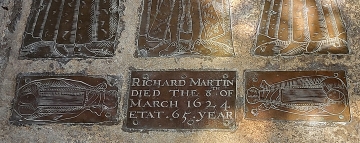
So much for the lost brasses. Fortunately, at the eastern end of the church, several monumental brasses have remained in place – some of them intact, and others damaged. To the south of the high altar, there is a set of intact 17th century brasses commemorating members of the large Martyn family. Included amongst these brasses are two of particular interest – they are Chrism brasses (see photograph above), which commemorate children who died before their mother was “churched” (that is before the mother has gone to church to give thanks to God for the birth of a child). The Chrism brasses depict babies in swaddling clothes. In addition to these brasses, there is another one depicts a brother and sister. The girl is holding a skull, which means that she died before her parents.
Churches in England, and especially that at Long Melford, offer many fascinating insights into how people lived in the distant past. The brasses – those which have gone and those which remain – are fine examples of history on display.
DURING THE REIGN of King Henry VIII, many English churches were vandalised because of the monarch’s divorcing the country from the Roman Catholic Church. Many artefacts were destroyed in churches to erase their connection with the Church in Rome. These included carvings and stained-glass windows. Holy Trinity Church in the wool town of Long Melford in Suffolk was no exception. Above the south entrance to the church, you can see empty stone frames that once contained stone effigies of saints. Much of the 15th century church’s mediaeval stained-glass was also destroyed.
Luckily for us, some of the stained-glass survived. This is because it used to be located in the windows of the clerestory high above the long nave – out of reach of the people sent to destroy it. In recent times, the surviving windows have been restored and placed in the windows lining the north wall of the church. These windows are much lower than those in the clerestory, and are easily viewed from the ground. The windows depict both dignitaries and religious subjects, which were the main targets of the vandals who were destroying religious images.
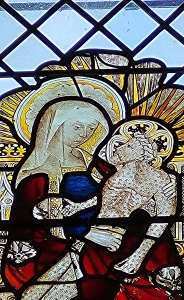
One of the windows is particularly interesting because it shows the Virgin Mary holding the dead body of Christ soon after it had been removed from the Cross. In other words, it is what is known as a Pietà. This subject matter was, and still is, extremely important in Roman Catholic imagery, and had they been able to reach it, those who attacked the church would have certainly wanted to destroy this. A knowledgeable gentleman, who was helping in the church, told us that the pre-Reformation Pietà in the church was an extremely rare survival from the time before Henry decided to break with Rome. What is more is that unlike many images of the Pietà, the dead Christ is shown with his eyes wide open.
The Pietà image in the surviving mediaeval stained-glass is just one of many interesting things that can be seen in the magnificent, large parish church at Long Melford. As the Michelin Guidebooks often say, the place is “worth a detour”.
The town of Eye in Suffolk is twinned with Pouzauges in France. There is a French milestone from the region of France is in the centre of Eye.
Seeing this reminded me of the three months that I attended the University of Chicago Laboratory School in Chicago in late 1963. Every morning before classes began, we used to play a card game called “Mille Bornes” (i.e., ‘1000 milestones’). The game was vaguely educational in that it taught the players a few words of French. We were all obsessed with playing it. When I left the school to return to England, the class clubbed together and bought me a set of “Mille Borne” cards as a farewell gift. although my fellow students at the Lab School were about two years older than me, they made me feel very welcome and were extremely friendly towards me. The same was the case for my class teacher, Ms Alice Flickinger, and the sports teacher, Mr Patlak.






 yamey
yamey 