Subhash Marg, a busy bazaar street in Bikaner (Rajasthan, India), It leads northwest from the 16th century Kote Gate in the heart of the city and runs alongside a railway track.
In the past, this road had been named Jinnah Road in honour of the founder of Pakistan. Still known as Jinnah Road by many of its Muslim inhabitants, in 1967 it was given its new name (Subhash Marg). According to an article published in the Hindustan Times in 2016, neither Muhammed Ali Jinnah nor Subhash Chandra Bose ever visited Bikaner.
We ate an uninspired non-veg lunch at the Muslim run Simran Restaurant on the road. On the bill, its address was given as “Subhash Marg (Jinnah-Road)”, and that was 57 years after the street’s name was changed.
Street name changes are not uncommon in India, but usually the old names of a thoroughfare are remembered better than the often-forgotten new names
THE ALIPORE JAIL used to house political prisoners, whom the British regarded as a threat to their rule of India. The inmates included freedom fighters such as the future Sri Aurobindo, Jawaharlal Nehru, and Subhas Chandra Bose. The prison has been restored and is now a museum. In December 2024 and for the first few days of 2025, several exhibitions that are part of the Bengal Biennale have been held in some of the jail’s buildings. One of these, which I found extremely interesting and well curated, is called “Kali: Reverence and Rebellion”.
Kali is a Hindu goddess. I will not try to explain her exploits and great importance to Hindus, but will outline the subject matter of the exhibition by quoting from the website of the Biennale (www.bengalbiennale.com/):
“Divided into sections, the exhibition traces Kali’s pervasive influence across the subcontinent. It explores Kali and her cohorts of the divine feminine. Born from Durga’s angry, darkened brow as she battles the asuras Chanda and Munda, Kali decapitates the demons and assumes the form of Chamunda. Within these depictions, she is seen alongside Durga, the primordial force, as well as the ten Mahavidyas that emerge to subdue Shiva.”
Subhas Chandra Bose image
In addition to the wonderful array of images on display, which can be enjoyed without any knowledge of Kali, what fascinated me was the connection between Kali and the fight of Indians for independence. The website explained:
“During the nationalist period, Kali was invoked as a symbol of rebellion by Aurobindo Ghosh and Subhash Chandra Bose to urge their followers to fight against imperialist forces.”
In connection with this, two images fascinated me. One of them depicts Kali who has cut off her own head and she holds it in her left hand while blood shoots out of her cut neck and into the mouth of her self-decapitated head. Painted in about 1840, this image shows what Kali did after either she was unable to obtain Shiva’s blood, or she had been deprived of her conjugal rights. Known as Chinnamasta, this avatar of Kali is often shown with one foot on the chest of a god (Shiva) or standing above a copulating couple.
Elsewhere in the exhibition, there is an image of Subhas Chandra Bose created during the twentieth century. It shows the freedom fighter, Bose, standing decapitated and holding his own head in his left hand. He is standing above a group of decapitated heads. Blood pours down from his head and it falls onto a map of India on which the words “Jai Hind” (‘Victory to India’) can be seen. The image is a politicisation of the depiction of Chinnamasta.
Apart from a wonderful selection of Kali images created by Indian artists, there are a few made by early Europeans who visited India and wanted to record their experiences and to attempt to understand Hinduism. All in all, the exhibition was very well worth viewing. It was so popular with visitors to the jail that a security guard was present to regulate the number of viewers at any one time, to prevent overcrowding.
Subhas Chandra Bose (1897-1945) is probably the most famous Indian to have spent time in Nazi Germany. Less well-known is Ayi Ganpat Tendulkar (1904-1975), who spent much longer in Germany than his illustrious compatriot. While studying in Paris, he married Sasha Alexandra Passini in about 1924. Soon after this, the marriage ended, and Tendulkar began studying in Berlin. He married one of his professor’s daughters – Eva Schubring. In 1933, after Hitler had come to power and Tendulkar had divorced again, he began a close relationship with the screenwriter Thea Von Harbou (1888-1954). Thea had just divorced her second husband, the great film director Fritz Lang (1890-1976) – one of my favourite film directors. The relationship between Tendulkar and Von Harbou was very close, and had Hitler’s racial laws (against marriages between ‘Aryans’ and others) not been enacted, there is a good chance that they would have married.
Tendulkar returned to India just as WW2 broke out. There, he met and fell in love with Indumati Gunaji (died 2006). From the start, her family were against the relationship, and Indumati ran away from home to live with Tendulkar. Both were followers of Mahatma Gandhi – she more than he. Soon, Tendulkar, who had published anti-British articles in Berlin and elsewhere and was under suspicion because of his long stay in Germany, was imprisoned by the British. Meanwhile, Indumathi helped the villagers where she lived. Her life was not easy, and she missed Tendulkar greatly.
Eventually, Indumathi and her family, who were concerned about her and her romantic attachment to Tendulkar, became reconciled to some extent. Her father, a Gandhian, suggested that they ask Mahatma Gandhi what he thought of the relationship. His reactions to the situation were far from simple, as is revealed in the pages of “In the Shadow of Freedom” by Laxmi Tendulkar Dhaul – the daughter of Indumathi and Tendulkar.
Ms Dhaul’s well-researched book is a fascinating read. It covers the extraordinary lives and relationships between Tendulkar, Indumathi, and Thea Von Harbou, both in Germany and in India – before and after independence. Despite some unfortunate errors missed by the proofreader, this is an un-put-downable book. It opened my eyes to the interesting subject of Indians living in Nazi Germany as well as Gandhi’s rather intriguing views on the purpose of marriage.
SUBHAS CHANDRA BOSE (1897-1945) was, along with Gandhi, one of the most important fighters for the independence of India. Without doubt, the activities of Bose and their consequences were one of the main reasons that the British left India in 1947. A one time president of the Indian National Congress, he later parted ways with it.
Before 1940, Bose was placed under house arrest in Calcutta by the British. In 1940, he escaped and made his way to Nazi Germany, where he arrived in 1941. The German authorities were prepared to cooperate with him to bring about the downfall of the British Empire in India.
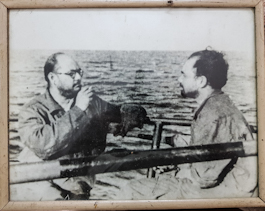
After the surrender of Singapore to the Japanese, Bose and his colleague Abid Hassan Saffrani (1911-84), who was studying engineeringin Germany and anti-British, were placed on a German submarine in early 1943. It took them to Madagascar, where they boarded a Japanese submarine that took them to Japanese occupied Sumatra. Then, they proceeded to Singapore, where Bose persuaded captured Indian troops to fight the British to gain independence for India. It was during this time that Abid Hassan Saffrani coined the salutation ‘Jai Hind’.
Bose led his Indian National Army on an ill fated military expedition to enter India via Burma. In 1945, Bose was killed in an air accident in Japanese held Taiwan. Abid Hassan Saffrani returned to India and after Independence served his country as a diplomat.
The photograph shows Bose with Abid during their journey on the German submarine in 1943. (Bose is on the left with spectacles)The print I saw is in the possession of a nephew of Abid, who lives in Hyderabad.
Some days before I met Abid’s nephew, we met a lady in Calcutta. After spending an evening with her, I expressed my interest in the anti-British activists, who lived in Calcutta. Hearing this, she revealed that she is related to one of them. We asked which one. She told us that her grandfather was Sarat Chandra Bose, the brother of Subhas Chandra Bose who helped Subhas to escape from Calcutta in 1940. We were amazed to hear this.



 yamey
yamey 