Seeing the world inside out

THE ARTIST RACHEL Whiteread (born in Essex in 1963) sees the world from an original perspective. Her sculptures depict the spaces contained within or around objects. One of her sculptures currently on show in an exhibition in London’s Tate Britain Gallery illustrates her approach well.

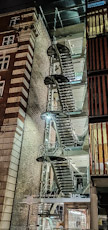
The artist has made a plaster cast of the space enclosed by the staircase in the building housing her studio. When you look at the artwork carefully, it can be seen to consist of sections of plaster, rather than one single piece. I am guessing that what Whiteread did was to make plaster casts of parts of the staircase, its walls, and ceiling, and then assembled them to create what is effectively the shape of the space enclosed by them. The result is something that at first glance makes one think of staircases, but after a few moments realisation, you notice that it is not what it first seemed to be.

One of the artist’s first and maybe best known works was created in October 1993. Called “House”, it was a plaster cast of the interior of a whole house, which was about to be demolished, on Grove Road in the East End of London. I remember going to see this unusual artwork during the short time it existed; it was tragically demolished by the local council in January 1994.

In addition to large projects such as described above, Whiteread has created many smaller works, such as plaster casts of the insides of containers (e.g., hot water bottles) and the spaces surrounding objects (e.g., chairs and doors). However, it is the larger works like the staircase and the house that I prefer.

Some people may criticise Whiteread’s work as being, to quote Hans Christian Andersen, the stuff of “Emperor without clothes”, but that is a simplistic view of her creations. What artists like Whiteread (and other much criticised artists such as Picasso) make us do, is to see and consider things in a new way – you might say “with new eyes”.

Almost hidden from view

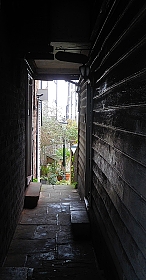
A GAP BETWEEN the houses almost opposite the long-established La Gaffe restaurant (opened in 1962) on Hampstead’s Heath Street leads into an alley lined on one side of a wall covered with overlapping planks of timber, i.e., clapboard. Steps lead down from the alleyway to a small sunken paved square surrounded by houses, some of which are 18th century.  This almost hidden nook is called Stamford Close. The name derives from the now-demolished Stamford Lodge, where John Constable and his family were briefly lodgers in 1823 after they had left their rented accommodation on Hampstead’s Lower Terrace, where they lived between 1821 and 1823.

According to Christopher Wade, in the 1930s, six old cottages were condemned and the close was considered to have been:

“…a miserable dark square – a black spot.”

Today, the square is far from miserable, and many would kill to own a house there. I am not sure how practical this would be as far as shifting heavy shopping and luggage is concerned. Also, parking cars is not possible close to the houses. Despite these disadvantages, this square would be a lovely place to live.

Lift your eyes

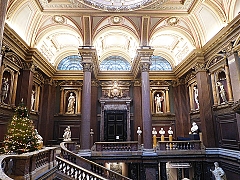
IT IS TEMPTING to concentrate on the wonderful collection of exhibits in Cambridge’s Fitzwilliam Museum, but you should spare some of your attention for the magnificent decoration of some of its galleries. Look up from the paintings and display cases to see superb ceiling decorations above you, and also around you when using the grand staircase. You are sure to be amazed.

The museum is housed in a neo-classical edifice initially designed by George Basevi (1794-1845), architect of London’s Grosvenor Square. After Basevi’s death, the planning of the structure was completed by Charles Robert Cockerell (1788–1863). Built to house the collection bequeathed to the University of Cambridge by Richard FitzWilliam, 7th Viscount FitzWilliam (1745-1816), the present museum was opened to the public in 1848. Over the years since then, the museum has been enlarged by adding newer buildings and now it is home to about 500,000 artefacts.

Years ago, I remember reading (I cannot remember where) a comparison of a museum in the USA designed by Ludwig Mies van der Rohe (1886-1969) with another one, the Guggenheim in Manhattan, designed by Frank Lloyd Wright (1867-1959). Both buildings are elegant but that by Mies Van der Rohe modestly allows the exhibits to grab the viewer’s attention more than the architecture, whereas the unusual design of Wright’s building competes with the artworks for the viewer’s attention. The internal decoration of the older galleries of the Fitzwilliam are sufficiently eye-catching to be able to compete with the exhibits housed in them, but somehow, they hardly do this. That is why I am asking you to take your eyes off the exhibits if only to glance briefly at the décor of the galleries,