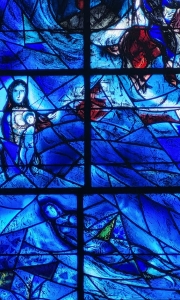
IT IS NOT EVERY day that when one walks into a remote English country church, you are confronted by set of stained-glass windows that were designed by a famous Jewish early Modernist artist. At Tudely, near Tonbridge in Kent, the church’s stained-glass windows were designed by none other than the famous artist, Marc Chagall (1887-1985). I have visited the church several times, and each time I am even more amazed than on previous visits.
You might be wondering why windows designed by an artist as famous as Chagall are in a small, isolated parish church. To discover the reason for their presence, you should get a copy of my book “An Alphabetical Tour of England”, and read about the tragic event that led to the creation of these fascinating windows. The boo is available from Amazon sites such as:https://www.amazon.co.uk/ALPHABETICAL-TOUR-ENGLAND-Adam-Yamey/dp/B0FVV6JLZ7/
IN THE 1980s, there was a shop that sold a variety of products imported from Communist Albania, which was then ruled by the Stalinist dictator Enver Hoxha and, after 1985, by his successor Ramiz Alia. I visited it once or twice. Although it had a few items of interest, it was quite expensive. The shop, which had closed by 1990, was in Betterton Street, which leads from Drury Lane to Endell Street, which is not far from the Seven Dials.
Yesterday (20th of June 2024), we walked along a part of Endell Street and then into Betterton Street, on our way to the Garden Cinema (in Parker Street). We watched a completely weird, arthouse film called “Daisies”, which was made in Communist Czechoslovakia in 1966. Despite being awarded a Czech film prize in 1966, it was banned by the censors in 1967.
Returning to Endell Street, we spotted three buildings of interest. The first of these is on the southeast corner of Endell Street and Shorts Gardens. It bears a commemorative plaque that reads:
“Zepherina Veitch (1836 -1894) Dame Rosalind Paget (1855 – 1948) Pioneering midwives trained at the British Lying-in Hospital, founded 1739 and sited here, 1849 – 1913.”
The tall Victorian building, to which this plaque is attached, is red brick with white stone facings. Between 1849 and 1913, this place housed a hospital for married women in the last month of pregnancy. A website concerned with former hospitals (https://ezitis.myzen.co.uk/britishlyingin.html) related:
“The staff consisted of two physicians and two surgeons who practiced midwifery, a Matron skilled in the same, a chaplain, an apothecary, nurses and ‘other inferior servants’. Women were admitted in the last month of their pregnancy – they were only permitted to stay for three weeks – and needed a letter of recommendation from a subscriber (patients were not charged by the Hospital) and an affidavit of their marriage and their husband’s settlement.”
Adjoining the former lying-in hospital, there is an edifice made with layers of bricks that vary in colour and white stone trimmings. It has Victorian gothic features, and its Endell Street facade bears an inscription, which reads:
“Lavers and Barraud Stained Glass Works”
This firm was founded in 1858 by Nathaniel Wood Lavers (1828–1911) and Francis Philip Barraud (1824–1900). When Barraud (of Huguenot descent) became dissatisfied with the firm’s designs, he was recommended to hire Nathaniel Westlake (1833-1921) as a designer. Westlake’s knowledge of mediaeval art and skills in the pre-Raphaelite style of art brought fame and fortune to the firm in the 1860s. In 1858. He became one of the firm’s partners, and in 1880, he became the firm’s sole owner.
A building on the corner of Betterton Street and Endell Street, across the road from the former stained glass works bears a plaque that informs the viewer that in this house, number 20 Endell Street, Westlake resided in the 1880s. His firm continued in business until his death.
So, today, neither the lying-in hospital nor the stained-glass works are still operating, and the Albanian shop has long gone. However, one place that would have been in business when those two places were functioning, is still in business: The Cross Keys Pub. Established in 1848, this pub has a baroque Victorian façade. The interior of this long narrow hostelry is most people’s idea of a real old-fashioned pub. A long bar with brass fittings runs along one side of the saloon, The walls are covered with numerous paintings and prints and several glass cases containing stuffed (taxidermy) fish. All manner of things, including a brass instrument and an archaic diver’s helmet, are suspended from the ceiling. Yet, despite this great amount of assorted ‘clutter’, the pub has a cosy atmosphere. When we dropped in for some mid-afternoon refreshment, there were a few other customers – mostly elderly local people. Although in the heart of the city, the pub has a rustic feeling about it. I suspect that workers and other staff from the stained-glass factory used to pop into the Cross Keys for liquid refreshment. But I wonder if many of those associated with the lying-in hospital -staff or patients – were patrons.
After dallying in Endell Street, we walked the short distance to the Garden Cinema in Parker Street to see the Czech film. If you have not been to this cinema, you are missing a treat – it is a truly independent, art-house cinema (see www.thegardencinema.co.uk).
DURING THE REIGN of King Henry VIII, many English churches were vandalised because of the monarch’s divorcing the country from the Roman Catholic Church. Many artefacts were destroyed in churches to erase their connection with the Church in Rome. These included carvings and stained-glass windows. Holy Trinity Church in the wool town of Long Melford in Suffolk was no exception. Above the south entrance to the church, you can see empty stone frames that once contained stone effigies of saints. Much of the 15th century church’s mediaeval stained-glass was also destroyed.
Luckily for us, some of the stained-glass survived. This is because it used to be located in the windows of the clerestory high above the long nave – out of reach of the people sent to destroy it. In recent times, the surviving windows have been restored and placed in the windows lining the north wall of the church. These windows are much lower than those in the clerestory, and are easily viewed from the ground. The windows depict both dignitaries and religious subjects, which were the main targets of the vandals who were destroying religious images.
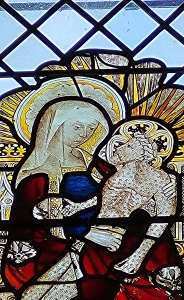
One of the windows is particularly interesting because it shows the Virgin Mary holding the dead body of Christ soon after it had been removed from the Cross. In other words, it is what is known as a Pietà. This subject matter was, and still is, extremely important in Roman Catholic imagery, and had they been able to reach it, those who attacked the church would have certainly wanted to destroy this. A knowledgeable gentleman, who was helping in the church, told us that the pre-Reformation Pietà in the church was an extremely rare survival from the time before Henry decided to break with Rome. What is more is that unlike many images of the Pietà, the dead Christ is shown with his eyes wide open.
The Pietà image in the surviving mediaeval stained-glass is just one of many interesting things that can be seen in the magnificent, large parish church at Long Melford. As the Michelin Guidebooks often say, the place is “worth a detour”.
IN THE YEAR 991 AD, the Anglo-Saxons fought a battle with Viking invaders in Maldon (Essex). The Vikings, who often raided for looting and plundering rather than conquest, won. Rather than continue to struggle with the Vikings, the Anglo-Saxon king Æthelred the Unready was advised by the Archbishop of Canterbury to pay them off. He paid the Vikings an enormous sum of money, which satisfied them.
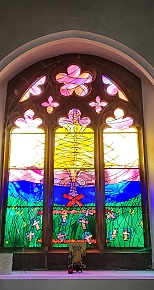
Recently, we visited the church of St Mary the Virgin in Maldon. It stands on a small hill that overlooks the mudflats and rivulets of the Chelmer River where the battle was fought. In its north wall there is a striking, colourful modern stained-glass window. Designed by Mark Angus, it was installed in 1991to commemorate the 1000th anniversary of the Battle of Maldon. It is a great addition to an otherwise unremarkable church.
There is a lovely parish church in Long Melford, Suffolk. Called Holy Trinity Church, it is a fine example of the perpendicular gothic style, completed in about 1484. Some of its windows contain old pre-Reformation stained-glass. A tiny circular piece of stained-glass above the north door of the nave depicts something unusual. It is hard to see with the unaided eye, but if you can manage to see it properly, you will notice something interesting. Known as the Hare Window, it depicts the heads of three hares and three hare’s ears. Each hare appears to have the usual two ears, but each of the three ears on the glass are shared by a pair of hares.
Although unusual, the three hare motif is not unique to Long Melford. Another example, a ceiling boss with three hares sharing three ears can be found in the Chapter House of the Church of St Peter and St Paul in Wissembourg, France, and another on a bell at Kloster Haina near Kassel in Germany (http://www.chrischapmanphotography.co.uk/hares/page3.htm)



 yamey
yamey 