Picasso in Liguria: from Genova to Guernica

During a visit to the monumental Staglieno Cemetery in Genova, I was surprised to see several gravestones bearing the name ‘Picasso’.
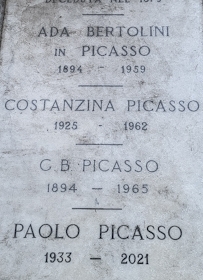
In Staglieno Cemetery

The artist Pablo Picasso, creator of the famous “Guernica” image and many other artworks, was born in Malaga, Spain, and died in Mougins, France.

After seeing the Picasso name commemorated in several places within the Staglieni Cemetery in Genova,  I became curious, and did a little research on the Internet.

I found out that Picasso is a family name that is typically found in the Italian province of Liguria, in which Genova is situated. The artist Pablo Picasso’s maternal great-grandfather, Tommaso Picasso, moved from Liguria to Spain in about 1807. The name Picasso is only part of the artist’s full name, which is, hold your breath: Pablo Diego José Francisco de Paula Juan Nepomuceno María de los Remedios Cipriano de la Santísima Trinidad Ruiz y Picasso. Ruiz & Picasso were respectively his father’s and mother’s surnames.

Whether or not the Picassos who are intermediate in the cemetery in Genova are closely, or even remotely, related to the famous artist I have yet to discover.

So far, all that I can conclude is that in the case of Pablo Picasso one can say it is a case of ‘from Genova to’ Guernica’
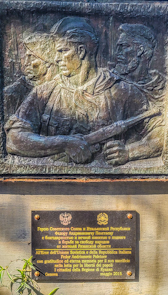
A Soviet soldier buried in Genova (Genoa)

The Cimitero Staglieno in Genova contains a remarkable collection of funerary sculpture. But I will not  write about this now. Instead, I  am going to concentrate on only  one memorial – something I was not expecting to see in this cemetery.

The monument is in part of the cemetery dedicated to those who were killed in WW2. The bodies of these unfortunate people are either in the graveyard or commemorated there because their remains were cremated, or otherwise disposed of, by the Germans in their various camps for prisoners, including concentration camps. The monument that attracted my attention has its inscription both in Italian and  Russian. It is the grave of Fyodor Andrianovič Poletaev (1909-1945).

In Stglieno Cemetery

Fyodor’s biography is described in detail at https://it.wikipedia.org/wiki/F%C3%ABdor_Andrianovi%C4%8D_Poletaev, but I will summarise it here.

He was born in  the Ryazan Oblast in Imperial Russia. At the outset of ww2, he was called up to join the Red Army.

In June 1942, Fyodor was captured by the Germans and became a prisoner of war. After being transferred from one POW camp to another, he arrived in July 1944 at  a concentration camp at Tortona, near Genova. He escaped from this camp, and then joined a group of Italian partisans fighting in the Appenine Hills. He died fighting in a battle at Cantalupa. He was buried in the Staglieni Cemetery in Genova, where his monument can be seen.

Thus, a labourer from the Sovie Union ended up a hero in Italy.