ON CHRISTMAS EVE (2024), we visited the Victorian gothic St Paul’s Cathedral in Kolkata (Calcutta). There was a creche (Nativity scene) in the garden. Unlike other such cribs we have spotted in the city, in which all the human characters look European, all of the (lifesize) models in the St Paul’s creche depict Indians. The three kings look like Rajput maharajas, a small boy near the crib is wearing kurta pyjamas, a shepherd carrying a lamb sports a turban, Joseph is wearing a dhoti, and Mary is dressed in a blue sari.
This beautifully made ensemble illustrating happenings in Bethlehem, where there was no room at the inn, is lacking one person. There was no baby Jesus to be seen. The model of Mary seems to be looking adorably at an empty patch of ground. I wondered whether someone had stolen the model of Jesus. We asked a gardener what had happened to baby Jesus. He replied: “It’s Christmas Eve. Jesus has not been born yet. He’ll come tonight.
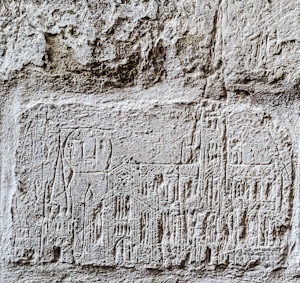
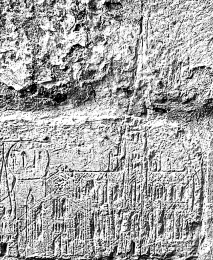
I HAVE WRITTEN ABOUT this before, but because I found it so interesting I will write about it again. In August 2024, we revisited the picturesque village of Ashwell in Hertfordshire on our way between London and Cambridge. Apart from being an extremely attractive place, its parish church of St Mary ccontains an intriguing image scratched into the internal surface of the north wall of the bell tower.
The image is a drawing of London’s old St Paul’s Cathedral, which was destroyed during the Great Fire of London (1666). By comparing this picture with other pre-1666 drawings of the old cathedral, it can be seen to be an accurate depiction of the long since destroyed edifice. It is likely that the drawing in Ashwell was scratched into the wall sometime before 1930s, when the old cathedral was modified by Inigo Jones.
Above the image of the old cathedral, there are some inscriptions recoding plagues that occurred during the 14th century, including what is known as the Black Death.
Apart from the drawing and the inscriptions described above, the church contains a few other inscriptions, which have been partially deciphered.
For the information of those visiting the church, it is near to Day’s bakery, where delicious snacks can be purchased. The village also contains a small museum, part of which is housed in a half-timbered building. However, for me, the highlight of the village is the drawing of old St Paul’s Cathedral in the church.
CLOSE TO POSTMANS PARK in the City of London, there are two restored items on the pavement of the street called St Martin’s Le Grand. One of these would have been commonly seen all over the City a few decades ago. The other is rarer.
One of the objects is a restored Police Call Post. Free to use, these slender items topped with a red, light signal could be used by members of the public to call a police station. If a police station wanted to call the policeman on the beat, the red light would flash to attract his (or her) attention. Fortunately, I never had cause to use this service. Designed and made in the early 1930’s by British Ericsson, these telephone posts were decommissioned in the 1960s because of the availability of mobile police radio transmitters and receivers. Most of these posts were sold during the 1980s, but eight remain in the City. These have been carefully restored by Rupert Harris Conservation Ltd, and are now protected heritage items. According to the company’s website (https://rupertharris.com/products/police-call-posts-1):
“A few examples of similar posts exist in Westminster and throughout the country, but those differ slightly in design and colour. The Westminster models bear a Royal crest above the front ‘POLICE POST’ panel, and are painted dark blue.”
Ony a couple of days ago, I noticed one of the Westminster models at Piccadilly Circus outside of what was once the magnificent Tower Records shop.
Standing close to the Police Call Post near Postman’s Park, there is a Victorian post box (pillar box). Painted black rather than the usual red, it resembles other Victorian post boxes I have seen in London (e.g., on Ladbroke Grove) and in Fort Kochi (India). A plaque on the black post box (near the defunct Police Call Post) states that this kind of pillar box was designed by John Penfold in 1866, and that this particular example commemorated 500 years since Brian Tuke (1472-1545), the first Master of the Post, was knighted by Henry VIII in 1516. It stands outside the building that was the GPO’s headquarters from 1894-1984. Unlike its neighbour the Police Call Post, this venerable letter box is still in use. Within a short distance from the much-visited St Pauls Cathedral, these less well-known sights and the nearby Postmans Park (see: https://adam-yamey-writes.com/2023/05/21/self-sacrifice-remembered/) are well worth investigating
IT IS A SURPRISINGLY tiring climb to reach the summit of Primrose Hil, just north of London’s Regents Park. Yet, it is well worth making your way to the top, which is 210 feet above sea level and considerably high than much of the rest of London.
From its lofty peak, you get to see a wonderful panorama of central London and its environs. One thing struck me as I stood on the hill on New Years Day 2022. In one field of vision, without moving my eyes, I saw both St Pauls Cathedral and the Shard that stands next to London Bridge station. The former was consecrated in 1697 and the latter, the glass clad Shard was completed in 2013. Thus, in one view, I was able to see just over 300 years of history. And with all of the construction cranes that can be seen from aloft, it seems that history continues to be made, for better or for worse.
MANY ENGLISH CHURCHES REMAIN closed much of the day since the outbreak of the covid19 pandemic. During our recent roving around the countryside, we have found this to be the case and as a result have not been able to enjoy exploring the often interesting historic and architectural features within country (and urban) churches.
Drawing of Old St Pauls Cathedral in the church at Ashwell
When we arrived in the attractive Hertfordshire village of Ashwell near the town of Baldock that lies between London and Cambridge, we were pleased to discover that the Church of St Mary’s (Ashwell) was open. Despite the dustiness created by building works that were in progress, this church contains much of interest. In fact, the builders have uncovered remains of structures that existed possibly prior to the present church’s construction in the 14th century. These remains were revealed to us by a kindly lady, ‘M’, who helps run the church’s administration. She pulled aside some heavy plastic sheets to reveal where the builders had dug beneath the floor.
After viewing the excavations, M drew our attention to the west end of the nave, beneath the bell tower. The north wall of this section of the church has graffiti scratched into its wall. This is not the work of modern vandals but that of people living as long ago as the 14th century, a time of plague, pestilence, and much mortality (the so-called Black Death was at its peak from 1347 to 1351).
Some of the graffiti is in the form of inscriptions in Latin. According to a useful booklet, which we bought at the church, “Ashwell Church. Mediaeval drawings and writings. A Guide” by David Sherlock (publ. 1978), the inscriptions when translated include the following (to quote but a few):
“Just the first plague was in 1349”
“In 1349 there was plague and in ‘50”
“1000, three times 100, five times 10 [i.e. 1350], a pitiable, fierce violeny (plague departed); a wretched populace survives to witness (to the plague) and in the end a mighty wind, Maurus, thunders this year in the world 1361.”
Maurus refers to St Maur (512- c584), a disciple of St Benedict of Nursia. St Maur’s feast day was the 15th of January before 1969 and is now the 22nd of November. According to an article in the Irish Times (16th of January 1998):
“The late 1300s in Ireland were remarkable for the abundant rainfall, and also for a succession of fierce storms which caused frequent and widespread devastation in countryside. One of the worst of these, St Maury’s Wind, occurred on January 15th, 1362, and caused great damage, particularly in Dublin.”
These storms were most likely to have been the same as those recorded on the wall of Ashworth Church.
Fascinating as the inscriptions are, even more interesting is a drawing incised in the wall close to them. Although it is not known when it was drawn, it was probably before 1630. It is a detailed sketch of the old (pre 1666, Fire of London) Gothic St Pauls Cathedral in London. It depicts the old church before Inigo Jones re-faced it in 1630. The drawing includes the spire, which was destroyed by lightning in 1561. One authority has suggested (tentatively) that the drawing might have depicted Westminster Abbey, but this is unlikely even though Ashwell Church was under the control of the Abbott of Westminster until The Dissolution of the Monasteries in 1540. The drawing in Ashwell has many resemblances to illustrations of the old St Pauls made in about 1550 by the Flemish Anton Van den Wynegaerde (1525-1571), and in 1616 by the British artist John Gipkyn (active 1594-1629). It is unlikely that whoever drew the image in Ashwell would have seen either of these pictures.
In addition to the image of St Pauls and the plague inscriptions, there are many other examples of mediaeval graffiti in the church at Ashwell. If our cousins in Baldock had not recommended us to visit nearby Ashwell, we might never have seen the fascinating graffiti described above. It was particularly poignant to see the souvenirs of plague that occurred so long ago during the current era of plague that is disturbing our lives so much.




 yamey
yamey 