
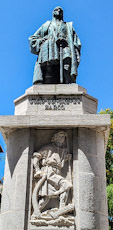
MOST VISITORS TO central Funchal in Madeira will pass, and probably notice, a bronze statue high up on a square based plinth outside the Bank of Portugal and the Golden Gate Grand Café. It depicts Joao Goncalves Zarco, who began the Portuguese settlement of Madeira in the 15th century. Very few people who pass this statue will know that it was created by a Madeiran sculptor, Francisco Franco (1885-1955). His older brother Henrique Franco (1883-1961) is one of Madeira’s most famous painters.
Both brothers studied at the Lisbon School of Fine Arts. They also spent time in Paris. Henrique returned to Madeira where he painted many of his pictures. Many of them are of Madeirans and scenes of the island. His paintings are beautifully executed and visually pleasing. Although the influence of Cezanne can be detected, Henrique did not seem to have affected by the innovative trends that were occurring in Western art during the 20th century.
Francisco visited Mussolini’s Italy in the 1920s and was impressed by the way that the state produced sculptures, which promoted the ethos and aims of the regime. He returned to Portugal, and began creating sculptural works that boosted the image of his country. Many of his important works were created for the Salazar government, which began in 1932.
Until our second visit to Funchal, I had never heard of the Franco brothers. Today, the 8th of May 2023, we visited a small museum in Funchal. It contains a fine collection of the works of both brothers. The museum contains many fine paintings by Henrique and sculptures by his brother, including a bust of Portugal’s former dictator Salazar. A video showing in the museum seems to suggest that far from being hostile to the Salazar dictatorship, Francisco was happy to create sculptures for it and its institutions.
Francisco attended an industrial school in Funchal. Its building is next to the museum. Over its main entrance is a carved stone sculptural frieze created by Francisco. The edifice now houses the Escola Secundaria de Francisco Franco, which opened in about 1976. Within its entrance lobby, we saw a bas-relief depicting the sculptor.
Although it is not one of Funchal’s main tourist attractions, the Museu Henrique e Francisco Franco deserves to be better-known.

 yamey
yamey 