
A Hungarian pensioner at Kings College Cambridge

DURING A RECENT VISIT to Cambridge, we spent some time in the magnificent chapel of King’s College. It is difficult to avert one’s eyes from the masterpiece of gothic fan-vaulting that forms the ceiling of this edifice, but it is worth doing so because the chapel is filled with other wonderful things. These include a painting by Rubens, another by Gert van der Lon, and yet another by Girolamo Siciolante de Sermoneta. The brass lectern that stands in the choir was made in the early 16th century and is surmounted by a small statue of King Henry VI. There are many other items of great historical interest to be seen including the stained-glass windows, which have survived since the 16th century. Interesting as all of these are, what caught my attention was something in a small side chapel – The Chapel of All Souls.

This chapel was converted in the 1920s to house a memorial to those members of King’s College (academics, students, choristers, and servants) who died during WW1. The names of those who perished are listed on engraved stone panels on one wall of the small chapel. Amongst these names is that of the famous poet Rupert Brooke (1887-1915). 
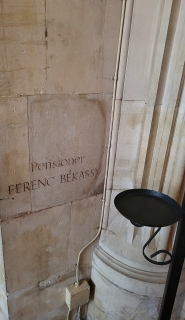
On another wall of the chapel, separate from the list of names, I spotted an inscription carved into the stone. It reads:

“Pensioner Ferenc Békassy”

Ferenc Istvan Dénes Gyula Békássy (1893-1915) was a Hungarian poet born in Hungary. In 1905, he was enrolled at Bedale’s School in Hampshire. In 1911, he began studying history at King’s College Cambridge. He was what is known as a ‘pensioner’. In Cambridge University usage, this word was used for a student, who has no scholarship and pays for his tuition as well as his board and lodging. During his time at the college, he was elected a member of The Apostles and courted the same woman as Rupert Brooke. He composed poetry both in Hungarian and English.

Just before the outbreak of WW1, Ferenc returned to Hungary, where he enlisted as a hussar in the Austro-Hungarian Army. On the 22nd of October 1915 he was killed in action whilst fighting the Russians in Bukovina. He was buried on his family’s estate in Hungary.

After the war, the memorial in King’s College Chapel was established. Because it was considered objectionable for the name of an enemy soldier to be listed amongst those who fought and died for Britain, his name was not included on the memorial. Instead, it was placed on another wall nearby.

Though separated from Rupert Brooke’s name by a few feet, this small chapel serves as a memorial to two great poets, who were killed in their prime.
Honey for tea and death in Greece

THE SHORT-LIVED POET Rupert Brooke (1887-1915) lived outside Cambridge in the nearby village of Grantchester, where he rented a room in The Old Vicarage between 1909 and 1912. In May of 1912, Brooke was sitting in the Café des Westens in Berlin and feeling nostalgic about his life in Grantchester. He put pen to paper and composed his poem “The Old Vicarage, Grantchester.” Clearly fed up with Berlin, the poet begins the final verse of his poem with:

“God! I will pack, and take a train,        

And get me to England once again!       

For England’s the one land, I know,      

Where men with Splendid Hearts may go;                

And Cambridgeshire, of all England,     

The shire for Men who Understand;      

And of that district I prefer        

The lovely hamlet Grantchester…”

The final verse ends with the famous lines:

“The lies, and truths, and pain?… oh! yet          

Stands the Church clock at ten to three?     

And is there honey still for tea?”

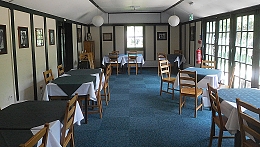
Inside the old pavilion at the Orchard in Grantchester

Having recently visited Grantchester, I can sympathise with Brooke’s desire to return to this charming village whose meadows run along the bank of the winding River Cam. The parish church of St Mary and St Andrew contains structures created as early as the 12th century, but most of the building dates from the 14th and 15th centuries. The west tower is mainly early 15th century. The clock on it no longer stands at ten to three, but it was stuck at that hour during the era when Brooke was in Grantchester.

The Orchard, which lies across the High Street from the church and between it and the meadows by the river, was planted in 1868. Before moving into the Old Vicarage, Brooke had lodged in a house in The Orchard. In 1897, a group of Cambridge University students asked Mrs Stevenson of Orchard House if they could enjoy tea under the blossoming trees. Thus began The Orchard Tea Gardens, now a popular haunt of students and tourists. Because of the unreliability of the English weather, a wooden pavilion was built at the end of the 19th century. In case of rain, tea drinkers could sit in the pavilion and enjoy their tea without getting soaked. Rupert Brooke was one of those, who used this place often. The Orchard’s website (www.theorchardteagarden.co.uk/history-new/) noted:

In taking tea at the Orchard, you are joining an impressive group of luminaries including Rupert Brooke (poet), Virginia Woolf (author), Maynard Keynes (economist), Bertrand Russell (philosopher), Ludwig Wittgenstein (philosopher), Alan Turing (inventor of the computer), Ernest Rutherford (split the atom), Crick and Watson (discovered DNA), Stephen Hawking (theoretical physicist, cosmologist and author), Jocelyn Bell (discovered the first pulsar) and HRH Prince Charles (future King of England). There is a list of some of the famous people who have visited in a separate page on our web site, and there are photographs of many of them on the walls of the Rupert Brooke Room.”

The Rupert Brooke Room was constructed later than the pavilion. The famous visitors included several noteworthy Indians including Jawaharlal Nehru, Salman Rushdie, and Manmohan Singh. There is a whole host of other well-known personalities who have taken tea at The Orchard including a group of Cambridge students, who achieved notoriety for their involvement in espionage for the Soviet Union: Anthony Blunt, Guy Burgess, John Cairncross, Donald Maclean, and Kim Philby.

As for Brooke’s question “And is there honey still for tea?”, I forgot to ask during our far too brief visit to The Orchard.  Brooke was commissioned into the Royal Naval Volunteer Reserve force at the outbreak of WWI. In early 1915, he set sail with the British Mediterranean Expeditionary Force. In late February, he developed a serious infection following an insect bite and despite the efforts of surgeons on a French hospital ship moored near the Greek island of Skyros, he died. He was buried in an olive grove on the island. In the churchyard of St Mary and St Andrew, Brooke’s name in carved on the church’s simple war memorial.