
Exhibits in an exhibition at a famous landmark in Kolkata

FROM AFAR, THE VICTORIA Memorial in Kolkata looks almost magical. However, inside it is pompous and overbearing (and not particularly beautiful), just as the British must have seemed to many Indians before their country was freed from the British Empire.


Visitors to the Memorial can explore the ground floor and the one above it. Much of the upper floor is dedicated to an exhibition of photographs and facsimiles of documents relating to the exploits of those who fought to make India independent.  Naturally, better known individuals such as Gandhi, the Nehrus, and Subhas Chandra Bose figure in this show. But they are outnumbered by lesser known freedom fighters. One of these is Shyamji Krishnavarma (1857-1930).  Many of you reading this might well be wondering why this man deserved to be includefacsimilesexhibition.


Like several other freedom fighters,  Krishnavarma went to London to become a barrister.  He returned to India and made a fortune working for the rulers of some of the Princely States.  Then, he returned to London. In 1905, when Bengal was partitioned  he conducted his own campaign against British rule in India.
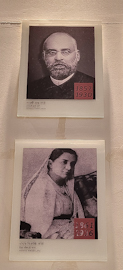
 

Above: Krishnavarma,  below: Madame Cams

Amongst the many things he did in addition to starting an anti-British newspaper, Krishnavarma purchased a house in Highgate (northwest London), which he converted into a hostel and meeting place for Indians studying  in London. It was named India House. Soon, it became a meeting place for Indians who wanted to rid India of the British. I have read that amongst the revolutionary activities carried out in India House was experimentation in bomb making. Amongst those associated with India House was VD Savarkar (1883-1966). In 1910, he was arrested by the British and spent several terrible years in the Cellular Prison in Port Blair (Andaman Islands). Amongst Savarkar’s many achievements was the development of Hindutva.


In 1907, Krishnavarma migrated to Paris. Later, until his death  he resided in Geneva. Unlike Gandhi and his followers, Krishnavarma and his colleagues (including Madame Cama) did not believe that India could become free by relying only on non-violent protest.


I first became interested in Krishnavarma when visiting Mandvi in Kutch (part of Gujarat). Shyamji was born in Mandvi, and his ashes are kept at a memorial centre a few miles outside the town. The centre includes a full size replica of Highate’s former India House. Seeing this building standing on its own in a flat sandy semi-desert landscape intrigued me, and got me interested in Krishnavarma.  I became so fascinated that I wrote a book about Krishnavarma and what happened in and around his India House. The book is called “Indian Freedom Fighters in London (1905-1910)”, and is available from Amazon (e.g., https://www.amazon.co.uk/INDIAN-FREEDOM-FIGHTERS-LONDON-1905-1910/dp/0244270716/ ).


The exhibition at the Victoria Memorial includes several photographs and documents relating to Krishnavarma and his India House. I had seen some of these elsewhere, but a few were new to me.


Although the Victoria Memorial is not one if my favourite things in Kolkata,  I  am pleased we visited if only because there were exhibits related to Krishnavarma.  In addition,  I was pleased to see several paintings by Thomas Daniell (1749-1840) and one by an artist I like very much : John Zoffany (1733-1810). Both of these men spent several years living and working in India.

A house in the desert

TWO YEARS AGO, we first visited Kranthi Teerth close to Mandvi in Kutch, once an independent kingdom and now a part of the Indian state of Gujarat. Kranthi Teerth is a memorial to Shyamji Krishnavarma (1857-1930) who was born in Mandvi. A brilliant Sanskrit scholar and a barrister, Shyamji became disillusioned with the British and by 1905 was advocating that India should become completely independent of the British Empire.

In 1905, Shyamji bought a large house in Highgate (North London). He converted this into a centre and hostel for Indians studying in London, a place where they could eat Indian food, meet fellow countrymen, and discuss affairs related to India. He called the place ‘India House’. The house still exists in Highgate but is now divided into flats.

Shyamji’s India House in Highate, not to be confused with the building with the same name in the Aldwych, rapidly became a centre for anti-British, anti-colonial activity until its demise by the end of 1909.

In 2009/10, a monument was created near Mandvi to commemorate the long forgotten pioneer of the Indian independence movement, Shyamji Krishnavarma. The monument includes a life size replica of the house in Highgate, which was once ‘India House’. The interior of the replica makes no attempt to copy whatever was inside India House back in the time of Shyamji. Instead, it contains portraits of numerous freedom fighters including some of those who either visited or lived in the house in Highgate when it existed as India House. There is also a collection of portraits of some of the heroes of the Great Rebellion, or First War of Indian Independence, that occurred between 1857 and ’58. One might question one or two omissions amongst the portraits (eg Jawaharlal Nehru and Gokhale), but there is a large selection of freedom fighters remembered here. Apart from the feisty Madame Bhikaiji Cama and Shyamji’s wife Bhanumati, there are no other ladies commemorated.

When I first saw the replica at Kranthi Teerth, which looks very incongruous standing tall in the flat sandy semi desert landscape, I became fascinated by its history. When we returned to London, I began researching the story of India House and its exciting contribution to the independence of India. Last year, I published a book about it: “Ideas, Bombs, and Bullets”. The title encapsulates what happened in India House: ideas were discussed; experiments in bomb making were undertaken; and guns were packed ready to be smuggled into British India.

It was interesting to revisit the portraits on display in the replica of India House after having researched my book. At our first visit, most of the persons portrayed meant nothing to me. However, seeing them again, having learnt about them while writing my book, felt rather like meeting old friends!

Yesterday, we revisited Kranthi Teerth and met Hriji Karali, whose ideas led to Narendra Modi’s encouragement of its construction. I presented the senior officials at Kranthi Teerth with a copy of my book. They appeared to be very pleased because until then they had not seen anything in English about Kranthi Teerth and the person it commemorates. My wife and I were given a warm welcome.

Apart from the replica of house in Highgate, there is a simple but spacious gallery where the irns carrying the ashes of Shyamji and his wife are reverentially displayed. These were brought to India from Geneva, where Mr and Mrs Krishnavarma died in the 1930s, by Narendra Modi in 2003 while he was Chief Minister of Gujarat.

I always enjoy visiting places more than once because each successive visit I discover more about them and thereby appreciate them with greater keenness. This was certainly true of our second visit to Kranthi Teerth.

“Ideas, Bombs, and Bullets” by Adam Yamey is available from:
Lulu.com
Pothi.com (best for purchasers in India)
Amazon
Bookdepository.com
Kindle

Picture shows setting of the replica of India House at Kranthi Teerth