
Imported from India

IN THE FIFTEENTH century, the Portuguese made an important set of discoveries, which were kept a closely guarded secret. These discoveries brought great wealth to Portugal. The Portuguese navigators found routes from Portugal to India via the Atlantic Ocean and the Cape of Good Hope. By using these, they were able to transport spices and other valuable commodities from Asia to Portugal directly. Prior to the discovery of this sea route, goods from India and further east arrived in Europe via Egypt and the former Ottoman Empire. This overland route undoubtedly added various middle-man costs to the goods.

Once the Portuguese began sailing in the Indian Ocean, they successfully created a monopoly over trading in this area. However, after a period of uninterrupted use of the Indian Ocean, competition arrived in the form of mainly Dutch and British trading vessels.
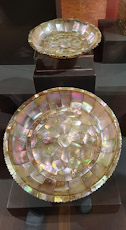
Mother of pearl bowls from India

Madeira was one of the places that the early Portuguese ships called in at during their voyages. This was brought home to me during a visit to Funchal’s superb Museum of Sacred Art. In two of its rooms we saw religious artefacts – sculptures and two mother of pearl bowls – which were labelled as having come from India. There were others that came from ‘Portuguese Asia’. One item, a beautiful inlaid tortoise shell box, came from Japan.

Unlike the religious sculptures we have seen in old Portuguese churches in Goa, which often feature Indian looking faces, those in the museum had European facial appearances. An exception is a 16th century carved panel depicting St Francis Xavier asleep on the Island of Shangchuang. He is accompanied by two saints – one Indian and the other Chinese.

Seeing these beautiful old sculptures and other objects, which were made in Asia and then brought to Madeira, helped make the history of Portugal’s former pioneering navigational achievements a little more vivid for me.

Baby Jesus with bangles

DURING SEVERAL TRIPS within the ex-Portuguese colony of Goa on the west coast of India, we have visited churches and other Christian religious establishments built under Portuguese rule. The Portuguese arrived in India several centuries ago, and finally left their colonies in 1961 when they became incorporated (or annexed) into India. One of the aims of the Portuguese was conversion of their Indian subjects to Christianity. Many of the conquered people became Christian, and many churches and seminaries sprung up in the occupied territories. We have visited quite a few of these.

In most of the churches we have seen in Goa as well as in the recently opened Museum of Christian Art in Old Goa, we have noticed that depictions of angels saints, and Christ himself have facial (and other) features that are typical of Indian physiognomy. This is not too surprising as many artefacts in the churches of Goa were created by Indian artists.

When we visited the Museum of Christian Art in Old Goa, we saw two depictions of Baby Jesus lying on what looked just like typical Indian ‘charpoys’ (traditional Indian beds). The Holy Child in each case is a tiny doll. What fascinated me is that the dolls were wearing the sort of tiny bangles that are often worn by small Indian babies. One of the tiny models of Jesus was also wearing earrings.

Moving away from Christian sculptures and paintings, which have incorporated Indian characteristics, day to day Christian worship in India often incorporates features with origins in Hindu ritual practice. One example is the use of flower garlands (‘malas’), which is just as common in Christian settings as it is in Hindu settings.

Christianity was introduced to India not only by the Portuguese, but by others including St Thomas (apocryphally), and various European invaders. However, despite its foreign origins, India was not only affected by the Christian religion but has also made its mark on it.