WARE IS AN ATTRACTIVE small town on the River Lea in Hertfordshire. Coaches travelling between London and Kings Lynn passed through Ware because it was on the route of the Old North Road (now followed approximately by the modern A10). The parish church of Ware, St Mary the Virgin, is large and spacious as befits the size of the town. Much of what we can see today was built over several centuries, from the 12th to the 15th. It was the church’s stone font that attracted my attention.
The octagonal font is believed to have been donated to the church in 1408 by the then Lord of the Manor, Thomas Montagu (1388-1428), Earl of Salisbury. Each of its eight sides contains fine bas-relief carvings. Many of them depict saints connected with birth, baptism, and childhood. For example, ther is a carving of St Christopher carrying the young Jesus across a river. Most of the faces on the carvings are in remarkably good condition considering their age and that they were in place long before the iconoclastic activities of Protestants took place. The church’s guidebook mentioned that in the 1540s, the faces of the statues were attacked, but fortunately the workmen, who might well have been men of Ware, responsible for defacing did a “token job”, only defacing the faces of the Virgin and St Margaret because they could be seen by people entering the church. Luckily for us living in the 21st century, these workmen managed to protect what is an attractive piece of church art.
IN 1975 I WENT to the town of Prizren in Kosovo, which was then part of the former Yugoslavia. I visited an old church in the town. Once, its internal walls had been covered with frescos. However, they had been badly defaced up to a certain height above ground level. Above that height and on the ceiling, they were intact. When the Ottoman soldiers arrived in Prizren, they used their spears to destroy the frescos, but only did so as far as they could reach. Being lazy, they did not use ladders to reach the higher parts of the church. So, the frescos beyond their reach survived.
In England, both the Dissolution of the Catholic religious establishments by Henry VIII, and later the defacement of churches by Oliver Cromwell and his followers, resulted in the destruction of many fine works of religious art. During a recent visit to Suffolk, we saw a few fine artefacts, which like the frescos in Prizren, have survived.
Bardwell
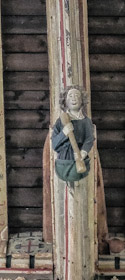
In accordance with Cromwell’s decree, many of the 15th century carved wooden angels that overlooked the nave of the parish church in Bardwell were destroyed. But, a few were left intact. Why was that? Did the workmen lose interest, or were they not paid enough? Who can say? And why was some of the 14th century stained glass left intact? Again, nobody can remember.
Over in the sleepy little town of Eye, the Parish Church contains a wooden rood screen containing beautifully painted panels that should surely have been destroyed by Cromwell’s iconoclastic vandals. Were they covered up with, say, wood panelling before the wreckers arrived, or were they removed and hidden? Luckily for us, these wonderful mediaeval paintings have survived.
Near Eye, there is a tiny church with a thatched roof in the village of Thornham Parva. It contains a rectangular wooden frame containing several mediaeval paintings that were created the 14th century. It was once the retable of an altar. Most likely, it was originally part of an altar in the Dominican Thetford Priory, which was dissolved during the reign of Henry VIII.
It is most probable that when the priory was dissolved, the retable was rescued by a Catholic family who put it in their private chapel. It passed through two other families before it was donated to the church at Thornham Parva in 1927. It is a rare surviving example of 14th century British religious painting. Interestingly, there is another series of painted panels in the Musée Cluny in Paris that resembles the Thornham Parva retable. Comparison of detailed aspects of these two sets of paintings suggests that they were both painted by the same team of artists, and were originally designed for the same location – most probably Thetford Priory.
In the space of three hours, we visited the churches at Bardwell, Eye, and Thornham Parva. All three contain artefacts of great interest and beauty which survived the religious upheavals orchestrated by Henry VIII and later by Cromwell. Once again, touring around in England has opened our eyes to its treasure house of history.
IN THE FIFTEENTH century, the Portuguese made an important set of discoveries, which were kept a closely guarded secret. These discoveries brought great wealth to Portugal. The Portuguese navigators found routes from Portugal to India via the Atlantic Ocean and the Cape of Good Hope. By using these, they were able to transport spices and other valuable commodities from Asia to Portugal directly. Prior to the discovery of this sea route, goods from India and further east arrived in Europe via Egypt and the former Ottoman Empire. This overland route undoubtedly added various middle-man costs to the goods.
Once the Portuguese began sailing in the Indian Ocean, they successfully created a monopoly over trading in this area. However, after a period of uninterrupted use of the Indian Ocean, competition arrived in the form of mainly Dutch and British trading vessels.
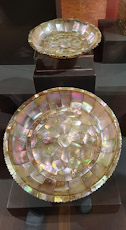
Mother of pearl bowls from India
Madeira was one of the places that the early Portuguese ships called in at during their voyages. This was brought home to me during a visit to Funchal’s superb Museum of Sacred Art. In two of its rooms we saw religious artefacts – sculptures and two mother of pearl bowls – which were labelled as having come from India. There were others that came from ‘Portuguese Asia’. One item, a beautiful inlaid tortoise shell box, came from Japan.
Unlike the religious sculptures we have seen in old Portuguese churches in Goa, which often feature Indian looking faces, those in the museum had European facial appearances. An exception is a 16th century carved panel depicting St Francis Xavier asleep on the Island of Shangchuang. He is accompanied by two saints – one Indian and the other Chinese.
Seeing these beautiful old sculptures and other objects, which were made in Asia and then brought to Madeira, helped make the history of Portugal’s former pioneering navigational achievements a little more vivid for me.


 yamey
yamey 