
Clouds on windows
Glass panels reflecting summer sky
A sight indeed

Clouds on windows
Glass panels reflecting summer sky
A sight indeed
I ENJOY VIEWING sculpture displayed in the open-air. Seeing sculpture ‘al-fresco’ is for me much more pleasant than viewing it in a gallery. From time to time, the Royal Botanic Gardens at Kew hosts outdoor sculpture displays. In the past, I have seen exhibitions of works by Henry Moore and Dale Chihuly. This year (2024), there are several sculptures by Marc Quinn dotted around the gardens. Quinn, who was born in the UK in 1964 is an adventurous creator, whose works sometimes give rise to controversy. I do not believe that the collection of his works now on display in Kew will give rise to much, if any, controversy.

Except for several bronze sculptures depicting larger than life bonsai trees, which have been placed in the Temperate House, the rest of the sculptures are made in highly reflective stainless steel. Appropriately for their setting, these sculptures are derived from the shapes of plants, leaves, and flowers. Because they are so reflective, they reflect the plants and trees growing near them. This helps to camouflage them, or make them seem as if they are merging with the surrounding vegetation. Although they contrast dramatically with their surroundings, their reflective nature softens the contrast when viewed from certain angles.
When I see sculpture next to nature, I often feel that however well the artwork has been created, it often palls when compared to what Nature has created. Quinn’s work at Kew has this effect, but somehow, probably because it reflects the plants around it, the comparison between what he created and what has been growing naturally is not too marked, and did not disturb me.
A visit to Kew Gardens is always enjoyable, and seeing the place with Quinn’s work in situ was a good experience. The exhibition will continue until the 29th of September 2024.
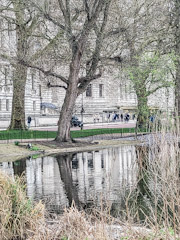
What is it that attracts us to reflections in stretches of water such as lakes, rivers, and ponds?
When the water surface is completely still, the reflection is almost, if not completely, perfect. This is fascinating but not as exciting as when the water surface is not smooth. In this case, the reflection is not perfect; it is usually distorted in an interesting way. And because the water is not still, the reflection changes constantly, making it more interesting than when the water surface is smooth and mirror-like.
Why is it that I like these imperfect reflections? I wish I could tell you.

Tied up by the bank
Reflect-ed on the water
She waits for trippers
I DOUBT THAT Auguste Rodin (1840-1917) would have ever imagined that a copy of his sculpture “The Kiss” (created 1901-1904) could have ended up being displayed bound up in one mile of string. Situated in the lower ground floor foyer of London’s Tate Britain gallery, that is what can be seen currently (August 2022). The British artist Cornelia Parker (born 1956) decided to wrap-up/tie-up a replica of “The Kiss” as described. You might wonder why. I cannot tell you, but make the observation that we all perceive things differently. And one of the skills that has united artists over the centuries is that they can express to other people the way they perceive and understand the world they observe. Rodin’s bound sculpture stands close to the entrance of an exhibition dedicated to works by Ms Parker, which runs until the 16th of October 2022.
The exhibition consists of artworks of varying sizes including visually dramatic installations, each large enough to fill a spacious room in the gallery. All the works are labelled. These labels explain how they were created and the concepts, some of them with political aspects, that the artist intended to express. When I look at works of art, I am primarily stimulated by their appearance and the visceral emotions they evoke in me. I am less interested in the concepts being portrayed and the artist’s explanations. Therefore, amongst the exhibits in the Parker exhibition, it was the installations that both interested me and excited me most.
The installation “Thirty Pieces of Silver” consists of domestic silver plate items that were squashed beneath a steam roller. Each piece is suspended above the ground by fine threads attached to the ceiling. They are arranged in thirty separate groups and lit from above. The shadows of the silver objects are projected on the floor below them. This delicate-looking installation’s name is taken from the 30 pieces of silver, which Judas received for betraying Jesus.
A spectacular installation, “Cold Dark Matter: An Exploded View”, is housed in another room. Parker arranged with the Army School of Ammunition to use Semtex (as used by terrorists) to blow-up her garden shed (filled with tools and other stored objects). Then, all the fragments were recovered, and one by one they were suspended from the ceiling of the gallery in such a way that the ensemble resembles a still from a film made whilst the shed was exploding. In the middle of all the suspended debris, there is a single light bulb shining. This throws the distorted shadows of the blackened fragments onto the gallery’s walls.
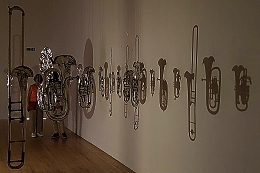
In another room, there was an installation, which also made effective use of reflections projected on to its walls. “Perpetual Canon” consists of a collection of silvered brass instruments, which have been flattened. Each of them is suspended from the ceiling by a fine thread, and they are arranged in a circle which surrounds a centrally located light. The light throws shadows of the instruments onto the four walls surrounding them. Like the two previously described works, this provides a very effective and intriguing visual experience.
Another installation, “The War Room”, impressed me least amongst this category of Parker’s works on display. One of the last rooms in the exhibition houses an installation called “Island”. This consists of a common design of garden greenhouse. Its floor consists of worn floor tiles that used to line the corridors of The House of Commons. The glass panes are covered with white dots made from cliff chalk. They are related to Parker’s reaction to Brexit. Contained within the glasshouse, there is a light whose brightness pulses like that of a lighthouse: increasing gradually, and the slowly diminishing. This causes the shadows of the dots and the frame of the greenhouse to be projected on to the walls of the room containing it. Like the light producing them, the intensity of the shadows pulsates gradually.
As already mentioned, the exhibits’ labels explain what Parker is trying to express. Interesting as that is, it was the visual impact of these installations that impressed me most. Parker, like all great artists, has interesting ideas expresses them most imaginatively and effectively.

clouds with buildings coalesce
architecture and nature:
glory of sky

 yamey
yamey 