
INDIA FASCINATES ME. One aspect of this fascination is the ever-present fusion of the present and the past. Almost every Indian I have met embraces at any one moment both unscientific ideas and beliefs, which date back many millennia, and the concepts of today’s world. As the writer Pavan K Varma put it in his book ‘Becoming Indian’:
“The mistake one should never make is to accept the amiable Indian as a monolith. He is a most well-adjusted split personality, capable of living simultaneously and effortlessly on two mutually opposed planes. He can make a quantum leap from one epoch to another without showing any strain.”
This ability to decompartmentalise the past and the present is well exemplified in some artworks I saw at an exhibition organised by Bombay’s Sakshi Gallery, and showing at London’s Mall Gallery until 8 July 2026.
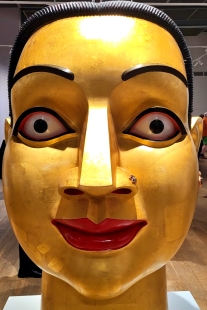
The works to which I am referring are sculptures by Ravinder Reddy, who was born in 1956 at Suryapet, Andhra Pradesh (southern India). Each of his sculptures on display at the Mall Gallery are larger than life sized female heads. Each of them is stunningly attractive and although not completely lifelike, very engaging. They are adorned with what recalls traditional south Indian decoration. They look like traditional images, yet at the same time, there is something contemporary about them. As an article (www.astaguru.com/blogs/legacy-of-artist-ravinder-reddy-influencing-future-generations-257) by Yungming Wong noted aptly:
“Reddy’s work is a rare phenomenon because it fuses tradition and innovation together … [His] sculptures often contain strikingly modern interpretations of traditional forms … His famous busts, for instance, advance classical portraiture to new heights by super-sizing the heads to monumental proportions. This exaggeration gives the sculptures grandeur and presence and leads the viewers’ eyes to the face that is the ultimate icon of humanity. In this sense, he connects the timelessly traditional approach of portraiture to the contemporary sensitivities for his works to be relevant in their local and global contexts.”
Although the show at the Mall Gallery contains excellent paintings and sculpture by other Indian artists, all of them well worth seeing, it was Reddy’s work that kept engaging my eyes. It was not merely the great size of his works, but their alluring presence, which grabbed my attention. Although products of the present, they suggest age old traditions of southern India. More than anything else on display at the exhibition, Reddy’s artworks exemplified what fascinates me about life in India: it occupies a space in which the past and present overlap, in which one exists inseparable from the other.
 yamey
yamey 