Loads of balls to defend the city walls

THE WALL SURROUNDING the fort of Jaisalmer is about three miles in circumference.  It encloses a warren of narrow streets and small squares and is home to several thousand residents.
 

Balls on the walls

It was during the reign of Akhai Singh, 1723 to 1762, that people began leaving the town around the fort to establish homes within it. They began laying out streets and mohallas (neighbourhoods) within the well defended fort. This continued until 1891. Why it should have stopped in 1891, I  do not know yet. Suffice it to say that this fort, like that at Carcassonne in France, is one of the few forts in the world that is still home to a settlement of local people. It is a “living fort”, not a museum.


The fort and its contents form the main tourist attraction of Jaisalmer.  Like Venice in Italy, it feels as if the tourists outnumber the locals. Many of the buildings in the fort cater to the tourist trade: guest houses, shops, and eateries. And there are plenty of men who are keen to guide you around the fort for a modest fee. However, the services of a guide would spoil, rather than enhance, the pleasure of exploring this attractive place. The best way to enjoy the fort and the richness of its ornate, yellow sandstone buildings is to lose yourself in the maze of narrow streets.


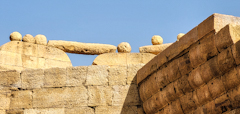
The fort’s construction commenced in about 1156 AD. You do not need to be particularly observant to notice that upon many of the fort’s outer walls there are heavy-looking stone balls and roughly hewn stone cylinders.  These were placed, ready to be rolled down on enemies attacking the fort at close range. The fort has been attacked several times over the centuries. But I  hope that it will not be attacked again. In the unlikely event that another assault  will be planned, I  am pleased to report that the stone balls are already in place.


The wonderful dwelling of a Dewan in Jaisalmer

 ONE OF THE REASONS for our visit to Rajasthan in 2024 is connected with one of my wife’s ancestors: Laxmidas Sapat (also written as ‘Sampath’). He was my wife’s great great grandfather on her mother’s side. Trained as a barrister in London’s  Middle Temple   he was Dewan (Chief Minister) of Jaisalmer between from 1903 for about six years. After that, he became Chief Justice of Jodhpur.


As yet, we have not discovered where Laxmidas resided in Jaisalmer.  But today (8th of December 2024), we have just visited the spectacular haveli (mansion) that was constructed for one of Laxmidas’s predecessors: Mohata Nathmal, who was Dewan between 1885 and 1891. The haveli is called Nathmalji ki Haveli and it was built in 1895.


The facade of the edifice, built in the Rajput style, is a riot of intricately carved yellow sandstone. One interesting detail is a carving depicting a steam engine and a bicycle. I wonder whether this was carved because Nathmal was interested in what was then modern technology. An online article (https://www.rajasthanbhumitours.com/blog/rajasthan-tourism/nathmal-ki-haveli-a-symmetrical-marvel-of-jaisalmers-heritage-architecture/) discusses the haveli in detail and gives another explanation:

“One of one of the most fascinating aspects of the façade is the addition of contemporary aspects, such as bikes and also a European-style heavy steam engine, which were unheard of in Rajasthan at the time. These makings mirror the interested and forward-thinking minds of the craftsmens who created the haveli, mixing conventional themes with contemporary motifs that were brand-new to Jaisalmer in the 19th century.”

Whatever the reason for the presence of these carvings, the facade is a showpiece of the skill of the two brothers who were commissioned to erect the building. Today, visitors can enter the haveli to view and purchase the goods in the shops that occupy the building. The rooms within the mansion have wall paintings that were created in the 19th century, and there are also a few framed historical portraits, including one of King Edward VII of England.

I am pleased that I have seen the home of one of the Dewans of Jaisalmer. I would be even happier if I could discover where Laxmidas Sapat resided during his time as Dewan of Jaisalmer.

Tassels attached to trucks on the highway

 THE ROAD FROM Jodhpur to Jaisalmer is called a highway and tolls are levied along the way. In fact, most of the way it is a two-lane road without a central divider. The country through which we travelled from Jodhpur to Jaisalmer is for the most part as flat as a pancake The sandy landscape contains many trees and succulent plant bushes.  As one gets further and further away from Jodhpur,  villages and settlements become few and far between. Apart from agriculture,  there is no other industry.  However, as you get closer to Jaisalmer,  the countryside becomes filled with wind turbines and electricity pylons.


Although we did not encounter much traffic, we did meet a variety of animals using the roads: cattle, goats, sheep, horses, peacocks, and camels. Drivers are careful to avoid hitting them, often crossing over to the wrong side of the road to bypass them.


We stopped for a light lunch (vegetarian) at an isolated, small, unpretentious wayside eatery (a ‘dhaba’). The menu was in Hindi script only, and the waiter asked my wife to write down (in Hindi) the items we wanted. In addition to us, there was a family from Assam eating in the dhaba. The stuffed parathas we ate were well made and the buttermilk was refreshing.


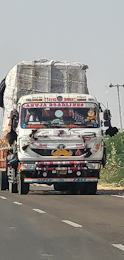
Most of the trucks we saw on our way had tassels attached. Often, they are black, as we have seen all over India during past travels. However  some of the trucks we saw in Rajasthan sported coloured tassels, hanging from the rear. Those readers unfamiliar with India might be curious about the purpose of these usually unattractive tassels. In my book “CORACLES AND CROCODILES: 101 TALES OF INDIA”, I have written about these tassels, which flutter in the wind as the truck speeds along the highway.


Even if the scenery is not spectacular,  I  enjoy travelling by road in India. All along the way, there are scenes of rural life to be seen. For example, today we passed through a village in which piles of red chillies were out drying alongside the roadway. And often the country folk can be seen going about their daily routines dressed in traditional garb, whose design is centuries old. These fleeting glimpses of rural life enhance my enjoyment of India.

[The book mentioned above is available from Amazon: https://www.amazon.com/CORACLES-CROCODILES-101-TALES-INDIA/dp/B0DJZ6DMYB ]

Hot chillies and an act of charity

MY WIFE AND I CAN tolerate and enjoy spicy Indian food. Yet, once in a while, a dish can have such an excess of hot chillies that eating it is less than pleasurable. 

Last night (4th of December 2024), our autorickshaw driver, ‘M’, recommended that we try a Muslim restaurant that is popular with ‘local people’ in Jodhpur. On arriving at the place, Beli Chicken, we were directed to one of its several rooms. It was the one where men accompanied by women plus or minus children  could dine together. It was the Family Room. Another room, the restaurant’s largest, was reserved for men only.


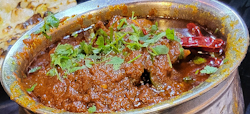
Lal maas

We ordered the restaurant’s speciality, fried chicken,  and Mutton lal maas (a red meat curry, a speciality of Rajasthan). The chicken was perfect. It was some of the best fried chicken I have ever eaten. The lal maas had a good flavour but contained an excessive amount of fiery red chillies. The meat was easy to enjoy, but the sauce was almost painful to eat. By mopping it up with a paratha, it became more enjoyable.  When we had eaten most of the meat  we asked the waiter to have the left overs packed up. We thought that M or his family might appreciate it.


As we set off from the restaurant, M said he needed to make a short detour to see an “uncle” (an elderly acquaintance,  rather than a blood relative). This uncle turned out to be a poor old man squatting on a low concrete divider in the middle of a busy road. In front of him, there were a few remains of kebabs and other scraps of food.  We stopped next to him, and M handed the old man our packed food. The uncle put his hand to his heart to express his gratitude.

I was touched by the charitable action of our kind autorickshaw driver.

Pavilions next to a lake built by a Mughal emperor

THERE IS A GARDEN by the shore of the Ana Sagar (lake) in Ajmer, Rajasthan. Originally laid out in the early 17th century by the Mughal Emperor Jahangir, it is now a public garden.

A baradari

In 1637, Emperor Shahjahan had five marble pavilions constructed in the gardens next to the lakeshore. Known as ‘baradari’, four of them are still intact. During the British occupation of India, these edifices were used to house the Commissioner of Ajmer and some of his officials. After Independence, the baradari were restored to their original forms after dismantling structures that had been added to convert them to dwellings.

For a modest admission fee, visitors can enter the park and enjoy views of the lake from the lovely baradaris.

Catastrophic usage of kettles in the Blue City

 WE ARE STAYING IN a charming guest house in the heart of the old part of  Jodhpur (the aptly named ‘Blue City’) in Rajasthan.  Our comfortable bedroom is supplied with an electric kettle, tea bags, and instant coffee sachets. However, unlike many places where we have stayed all over the world, there are no sachets of powdered milk.


One morning while enjoying breakfast on the roof, we chatted with Mr Munni, the owner of the guest house.  He told us that he was about to add other ‘goodies’ to the rooms, including toothbrushes, fruit, and snacks.

 When we asked him why there were no milk powder sachets, he told us the reason. Normally,  when making a hot beverage with milk powder, hot water is poured from the kettle into a cup  which already contains a teabag or coffee powder along with the milk powder.


But things can go wrong as Mr Munni has discovered. He has found that some of his Indian guests were putting water and the milk powder INTO the kettle, and then boiling this mixture.  This wrecks the kettle. He told us that since he opened the guest house a few years ago,  he has had to replace 50 kettles because of ignorance about the correct use of milk powder.


So, this is why Mr Munni no longer provides his guest rooms with powdered milk. On reflection, most Indians probably do not have electric kettles to make tea in their homes. When they make tea, they usually use a saucepan and boil the tea together with fresh milk and water.

PS we have stayed in many places in India, but this is the first time we have encountered this kind of kettle problem!

Royal memorials in gardens near Jodhpur

MANDOR IS A FEW MILES out of Jodhpur. It was the capital of Marwar kingdom until the founding of the city of Jodhpur in the mid-15th century AD. After that, Mandor remained the place where members of the royal house of Jodhpur were cremated. It was also where the cenotaphs commemorating the rulers of Marwar were erected. These beautiful, intricately designed, red sandstone structures are now part of a well-manicured park known as Mandore Garden.

Part of a cenotaph

High above the group of cenotaphs, there are the ruins of Mandore’s fort. And near to these memorials, there is an important Hindu temple and a lovely octagonal tower: the Ek Thamba Mahal. This structure with latticed window apertures might have been where ladies could watch ceremonies without contravening the conventions of purdah.

A morning in Mandore Park, the abode of many monkeys, is well worthwhile. At 7 pm, the monuments are lit up, and this is a highly recommended sight, so we were told.

PS a cenotaph is a monument to someone whose remains are buried or disposed of elsewhere

Dining with a view of the fortress in Jodhpur

 THE MEHRANGARH FORTRESS rests on massive rock overlooking the city of Jodhpur in Rajasthan.  At night the walls of the fort are brightly illuminated and can be seen from many places in the city. The older districts of Jodhpur  cling to the lower slopes of the rock upon which the fort rests. To take advantage of the splendid views of the fort, many restaurants in the old parts of the city are located high above street level on rooftops. Some of these eateries are as much as five storeys above street level, and none of them have lifts to reach them.

A restaurant is at the TOP

 One rooftop restaurant, which we have visited twice, is on the second floor of an old building. Called Indigo, we have eaten excellent Rajasthani meat dishes there, and were looking forward to visiting it a third time today (the 3rd of December 2024).

 At about 4 am. on the 3rd of December, I  awoke briefly and noticed that there was no electricity in the hotel and the alley next to it. By 7 a.m., the electrical supply had been restored.  At breakfast,  which is always served on the fourth floor rooftop of our guest house,  Mr Manu, the owner of the place, told us that there had been a fire in the kitchen of the Indigo restaurant,  which we had begun to enjoy. Burn marks were clearly visible from our guest house’s rooftop.

The reason the power had failed early in the morning was that the Indigo restaurant is located close to an electricity transformer, and the authorities were concerned that the fire might spread ⁷to it. Luckily,  it did not.

 After breakfast, we decided to walk to Indigo to offer our sympathy to its charming owner. When we arrived, we found his wife and a few other women seated in the restaurant’s ground floor courtyard. Each of them had very sad expressions on their faces. I felt that it was like visiting the bereaved soon after a loved one had passed away. They asked us to sit with them, and soon after that, the owner arrived.  We told him how sorry we were about the disaster which had befallen him and his family. I believe that he appreciated our brief visit.


Had the fire not happened,  we would have eaten all the rest of our evening meals at Indigo during the remaining few days of our stay in Jodhpur. I hope that Indigo will recover soon and that anyone who happens to read this and is visiting Jodhpur will eat at this excellent restaurant.

An ambassador from England in Ajmer

AFTER MANY FRUSTRATING months of waiting and much travelling to follow him from place to place, the English diplomat Thomas Roe (c 1581 – 1644) finally got an audience with the Mughal Emperor Jahangir. Roe had been sent to India by King James I to establish a formal trading relationship.

Roe meeting Jahangir

 The meeting took place in the Mughal fort in Ajmer in 1618. At first, he had to communicate with the Emperor from outside the fort. Eventually, he was granted an audience with Jahangir within the fort. The meeting took place in the Diwan-i-Khas, the structure within the fort, where audiences were granted to important persons. The result of Roe’s meetings with Jahangir was an agreement that the British East India Company would have exclusive rights to establish factories (trading establishments) in Surat and other places.

 Yesterday (30th November 2024), we visited the Diwan-i-Khas in which Roe had discussions with Jahangir. The fort is well-preserved and now serves as a museum. The rooms in the fort house collections of sculptures, coins  paintings, inscriptions, weapons, and textiles. The museum is simply laid out, and the exhibits are lit well.

It was curiously moving to visit the place in which Roe met Jahangir. I am not sure why we felt that way, but maybe it was because we had previously read about Thomas Roe and his exploits in India.

Stepping down to the water in the well

WATER STORAGE TANKS and wells are subject to changes in the water level. In small wells such as are commonly found in England, a bucket and winch system allows the water gatherer to reach the water in the well. In India  where water tanks and wells can be quite large, occupying a substantial area of ground, another system is used to allow users to get to whatever level the water has reached. The walls of the sides of the tank/reservoir/well are lined with a series of staircases, which are used to reach the water. Often the sets of steps lining the walls of the so-called stepwells are arranged in attractive geometric patterns.


At the Toorji stepwell

Since first seeing a (disused) beautiful stepwell in the ruins of the medieval city of Vijayanagara at Hampi in Karnataka thirty years ago, I have been fascinated by stepwells. I have seen many while travelling around Gujarat,  and was pleased to find one near our guest house in Jodhpur (Rajasthan). It’s name is Toorji ka Jhalra Bavdi.


The Toorji stepwell was built in about 1740. Its construction was ordered by the Queen Consort of Maharaja Abhay Singh. Back in those days, ladies of the royal family often commissioned the building of  water tanks and wells. The Toorji stepwell was used mostly by women, who traditionally did household chores including the fetching and carrying of water.


Toorji stepwell is constructed with the rose red sandstone of Jodhpur.  It is decorated with carvings of various sizes. Nowadays, as with so many interesting places all over the world,  it is a popular location for taking ‘selfies’ and for posing for photographs. Despite this, it is a stepwell worth seeing and is a remarkably tranquil spot surrounded by a maze of narrow, busy streets and lanes.