Only one airport,  only one flight

THE FORMER FRENCH colony,  now a Union Territory of India,  Pondicherry,  has its own small domestic airport. It is just over 3 miles from the city centre (as the crow flies). However, because of the traffic and the winding nature of our route, it took almost 30 minutes to reach the airport.   


After we had booked a flight from Pondicherry to Bangalore,  our daughter, who had taken the same flight twelve months earlier,  warned us that the airport at Pondicherry had limited resources but no refreshment facilities.


Prior to arriving at the airport,  I wondered if it would be even more rudimentary than the tiny airport at Khandla (in Kutch, Gujarat). Even that airport has a refreshment kiosk. With these thoughts in mind, and armed with a bag full of snacks and soft drinks, we headed off to Pondicherry Airport.


To my great surprise (and relief), we found that the passenger terminal at Pondicherry Airport is housed in a large, airy, well-ventilated, modern, comfortable, cylindrical building. And it has a refreshment kiosk, which sells only soft drinks.


The airport was first opened in 1989, and used for two years. However, lack of financial success caused it to be closed in 1991. After reconstructing the airport and its runways, it was reopened in 2012. The new terminal was inaugurated in 2013. Currently, Indigo Airlines operates flights to and from this airport. There is one daily flight : Bangalore to Pondicherry to Hyderabad, and another from Hyderabad to Bangalore via Pondicherry.  We took the latter. The propellor plane on which we flew was an ATR 72-600 (built by a French company, ATR), which can carry 78 passengers.


What I particularly liked about the airport is that instead of reaching the aircraft by an air-bridge or on a bus  we simply walked across the tarmac from the terminal to the ‘plane.


As we drove from Pondicherry to the airport, Shiva (our taxi driver) casually remarked about Pondicherry:

“Only one airport,  only one flight.”

Demolished thrice but still standing and fully used in Pondicherry

FIRST THE DUTCH demolished it in 1693. Then, it was replaced on the same site,  only to be demolished again in about 1730. Once more, a new one was constructed on the same site, and this was then demolished by the British in 1761. The current version of this building, the Immaculate Conception Cathedral in Pondicherry,  was completed in 1791, and is still in use today. Regular Roman Catholic services are held here in the Tamil, French and English languages.


Today (3  February 2025), while waiting for a nearby shop to open, we sat quietly in the cool aisle of the Cathedral. After a while, some beautifully dressed people entered. They walked up to the front of the church close to the high altar, and posed for photographs.  It was obvious that amongst them was a just married couple. The bride was wearing a sari, had flowers in her hair, and a luxuriant flower garland around her neck.


As they walked away from the altar towards the open west door, they passed us, and my wife asked them if they had just married. They accepted our congratulations and asked us to join them. We did and as we stood next to the newlyweds,  who had just married in another church, the four of us posed for photographs. Then, the bride asked us to bless them by touching their foreheads.  We were moved by this request.


The marriage party went on their way, and we crossed the road to enter the huge bookshop that had just opened.

The hammer and sickle near the seashore in Pondicherry

THE LETTERS ‘CITU’ stand for the Centre of Indian Trade Unions, which was founded in 1970. Its ‘logo’ includes the hammer and sickle, a symbol first used on some Chilean coins as early as 1894. However, it became widely recognised after 1917 when it was used as a symbol during the Russian Revolution, and long after it was over.


Today, I  spotted a small street stand erected in Pondicherry by the CITU.  It is located on the corner of Rue du Bazar St Laurent and Beach Road (Goubert Avenue),  which runs along the seafront. It has three white hammer and sickles, each on a red background. One of these symbols faces in the opposite direction to the other two.


Now, here is what interested me. Two of the Communist symbols decorate the stone supports of a short table or bench. Running along the length of the bench and slightly above it, there is a row of religious images. Four of them depict Hindu deities,  three of them are images of Christianity,  and one, showing two mosques and the Holy Koran, is connected with Islam.

I suppose that this might reflect the fact that local members of the CITU are adherents of these three religions.  But, I  am only guessing.

A café with a history on the seashore at Pondicherry

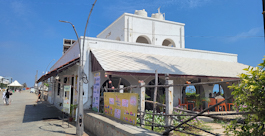
BEACH ROAD RUNS alongside the seafront of Pondicherry.  It is just over 1.3 kilometres in length. There are many buildings lining the landward side of the road (its west side), including hotels, restaurants, a memorial to BR Ambedkar, the lighthouse and the Customs House. However, there is only one  on the seaward side, close to the seashore.  Today, this building with a veranda on its sea facing side is a pleasant refreshment outlet called Le Café.  It stands a few metres south of the tall statue of Mahatma Gandhi,  also on the seaward side of Beach Road. 


The café contains some historical photographs of Pondicherry. One of them shows the long pier that commenced where Gandhi now stands. The pier was irreparably damaged during a terrible storm in the early 1950s, probably 1952. All that remains of it are some wooden stumps projecting from the sea some considerable distance away from the shore. Where Gandhi stands today was Place de la République when Pondicherry was a French colony. 


There has been a building on the site of Le Café since at least the end of the 17th century, as can be seen on a map published in 1793. For many years, the building housing the café was the Port Office of Pondicherry.  It can be seen quite clearly in a photograph taken before 1870. Then, it had only a single storey. A small upper storey has been added since then.


Sometime after the pier was polished off by the storm, the building was remodelled to serve as a café.  Run by a state managed concern, food and non-alcoholic drinks can be obtained here at reasonable prices. In the intense heat of midday and the early afternoon,  the veranda of Le Café is a pleasant place to relax in the breezes that pass through it.

A famous leader of France standing in a hallway in Pondicherry

DURING OUR RECENT (January 2025) stay in Pondicherry,  we passed an interesting looking doorway several times but it was always closed. Above the doorway are the words “Foyer du Soldat”, and these are superimposed on the French tricolour (red, white, and blue).


On the last day of January, we passed the doorway yet again and this time it was open. Through the doorway I saw what looked like a life-sized statue of General Charles de Gaulle.  We crossed the road and entered the building. In the hallway, the large statue,  which stands on a plinth with small white plastic wheels, is labelled “Charles de Gaulle”. High above his head, there is a framed photograph of French President Emmanuel Macron. His photograph was not the only one. There were others depicting several past Presidents of France, including: Mitterand, D’Estaing, Sarkozy, and Chirac.


Next to these portraits, there is one of Georges Montout, who has eight medals pinned to his chest and is described as “Fondateur du Foyer du Soldat de Pondichéry”.


Foyer du Soldat institutions were set up to provide French soldiers with a link between the battlefront and visions of the peace that would reunite a soldier with his family. “They help men to fight, to live, to hope.” (https://www.iwm.org.uk/collections/item/object/31176). Another source (https://www.loc.gov/item/99613500#:~:text=Les%20Foyers%20du%20Soldat%20was,such%20as%20music%20or%20films)  revealed:

“Les Foyers du Soldat was one of the three official welfare organizations; the Red Cross and the Y.M.C.A. were the other two. They set up canteens for soldiers to go to while on leave, providing a place to sleep, relax, eat, bathe; they even provided entertainment such as music or films.”


Many men of Indian origin living in French colonies such as Pondicherry fought for France during wars including the two World Wars.  A French monument to those Indians who died can be seen near the seafront in Pondicherry.  The city’s Foyer du Soldat was restored in 2010. It is housed in a colonial building, but I do not yet know when it was first established in Pondicherry. 


When we stepped inside the hallway of the Foyer, there was a meeting in progress in its adjoining assembly hall. Although it was built to serve soldiers from Pondicherry as well as local veterans of wars fought for France, I imagine few of those who fought in these campaigns are still living.

A French photographer in a former French colony and Julia Margaret Cameron

JULIA MARGARET CAMERON (1815-1879) was a Victorian photographer, who pioneered artistic photography.  Rather than using her cameras to attempt to slavishly reproduce reality in her prints, she used cameras and processing techniques to produce an artistic interpretation of her subject matter. It has been said that some of the images she created influenced a few of the Pre-Raphaelite painters, who were amongst her friends. 


In Julia’s honour, there is an annual prize for women photographers: The Julia’s Margaret Cameron Award. One of the winners of the award in 2024 is the French photographer Muriel Pénicaud. Born in 1955, she served in the French government as Labpur Minister from 2017 to 2020. A self taught photographer, she began taking photographs when she was 11 years old.


There are two exhibitions of Muriel’s work currently (January and February 2025) showing in the former French colony of Pondicherry in the south of India. One of them is at the Kalinka gallery in Kasturba Gandhi street, and the other is at the more centrally located ‘The Spot’: a bar-cum-restaurant (it serves good food).


The majority of Muriel’s photographs on display are in black and white. One of the few coloured ones show a red shoe lying beneath a pile of discarded shoes in drab colours. This image is the photographer’s reaction to the piles of murdered victims’ shoes that can be seen at the Auschwitz concentration camp.


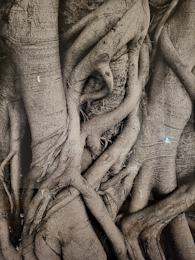
What Muriel achieves in most of her images is the conversion of a mundane sight, say a tree trunk or a bird’s plumage, into a work of art. Without resorting to tricks of focusing and experiments with processing, as did Julia Margaret Cameron, Muriel, like Julia did, transforms the ordinary into the visually extraordinary in  subtly delicate ways. She creates a new way of looking at the world by making her subject matter look intriguing.  She deserves a prize that honours the pioneer of artistic photography: Julia Margaret Cameron.


You can read more about Julia Margaret Cameron in my book “Between Two Islands: Julia Margaret Cameron and her Circle.” This book (also Kindle) is available from Amazon,  e.g., https://www.amazon.co.uk/gp/aw/d/B0BZFCVLX9/  

LIBERTÉ ÉGALITÉ (MAYBE) FRATERNITÉ IN A FORMER FRENCH COLONY

PONDICHERRY IN SOUTHERN India was a French colony between about 1674 and 1954. This picturesque city is still divided into White Town, where the French lived, and Black Town, where the Tamils and other Indians resided.  The segregation of Europeans and non-Europeans persisted after the French Revolution  of 1789. It was during (or soon after) this historic uprising that  the motto ‘Liberté, Egalité, Fraternité’ came into existence. However, it was during a visit to the lovely church of Notre Dame des Anges in White Town that we discovered that the motto might not have applied to the Non-European inhabitants of the Pondicherry colony.


Within the neoclassical church, there is an informative panel outlining the church’s history.  The present edifice was constructed in 1855, but the parish is older. It was established by Capuchin monks in the seventeenth century. In 1699, the Capuchins established a Tamil Christian community. Soon, the Jesuits took over the Tamil community, and the Capuchins began a parish for Europeans and “Eurasians” (people with both Indian and European heritage). The Capuchin church of Notre Dame des Anges served Europeans and Eurasians, but not Tamils, who attended another church.


In 1887, almost 100 years after the French Revolution,  Archbishop Lauennen decreed that Notre Dame des Anges was for the exclusive use of Europeans and Eurasians. So much for the ‘égalité’ and ‘fraternité’, which was so dear the the French.


In 1984 Fr. Dusseigne, of the Société des Missions Étrangères de Paris (M.E.P) was the last M.E.P. Parish Priest, to serve the parish. He served until 2007, and was the last of a long line of Capuchin priests to lead the parish.


Dusseigne was succeeded by Fr. Michael John Antonsamy, who was the first Indian priest to lead the parish. Although he was the first Indian parish priest, I  have not yet discovered when non-Europeans began to be allowed to worship in this church in White Town.


Near the church, there is small walled cemetery where Capuchin monks have been buried. The earliest person to have his tomb there died in 1703. Sadly, the graveyard was closed, but we managed to see the well maintained funerary monuments through gaps in the locked gate.

  Colour bars were common in European colonies in Asia and elsewhere. Some of the clubs and schools founded by the British in India forbade entry of Indians even until several years after independence. So, one should not be surprised that colour bars existed in churches such as St Marie des Anges.  But what amazed me somewhat is that even after the French Revolution,  racial inequalities were not frowned upon in a French colony such as Pondicherry.