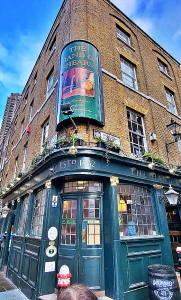
The Hand and Shears pub near London’s Smithfield Market is a delightful, old-fashioned drinking hole. It was granted a licence in 1552, but may have been in existence before that date. The building housing the pub was constructed in about 1852, and its interior has hardly changed since then. Apart from selling booze, the pub used to be a place where meetings were held, as well as coroner’s inquests.
The pub’s name derives from the that the building in which it is located was used by cloth merchants to settle arguments and other matters relating to their business.
Its centrally positioned bar serves customers in each of four rooms surrounding it. The rooms are separated from each other by partitions, but all of them face the bar which they surround. We visited the pub on a weekday at lunchtime. Many local business people were enjoying a sociable pint or two while chatting amongst themselves.
The Hand and Shears is what I believe a pub should be.
PANTON STREET RUNS between Leicester Square and Haymarket. The Tom Cribb pub, formerly known as the ‘Union Arms’, stands on the corner of Panton Street and Oxendon Street. The pub’s name commemorates a boxing champion Tom Cribb who lived from 1781 till 1848. A small plaque on the exterior of the pub commemorates another boxer, Bill Richmond (1763-1829).
Tom Cribb pub
Richmond was born into slavery at Richmondtown on Staten Island, New York. After witnessing Richmond’s fighting talent during a brawl at a tavern during the American War of Independence, a British commander arranged for his freedom, and took him to Yorkshire in England in 1777. There, he was educated and met his wife, Mary, while he was working as a cabinet maker. By 1795, Richmond and his family had moved to London, where he worked as an employee of Thomas Pitt, 2nd Baron Camelford (1775-1804), who happened to be a boxing enthusiast. According to Wikipedia:
“On 23 January 1804, Pitt and Richmond attended a boxing match featuring experienced boxer George Maddox. After Maddox won the bout, Richmond spontaneously challenged Maddox to a fight, which Maddox accepted. When the fight took place, Maddox defeated Richmond in nine rounds.”
Despite this, after Pitt died, Richmond took up professional boxing, and fought with many of the champions of the time, often winning these contests.
In 1805, after Richmond had defeated the Jewish champion Youssop and Jack Holmes ‘the coachman’, he challenged the great Tom Cribb, but lost. For many years Richmond and Cribb held grudges against each other. However, as the two men got older, they became friends. Often, they used to meet and converse in Cribb’s favourite pub, the Union Arms on Panton Street. It was in this pub on 28 December 1829 that Richmond spent the last evening of his life, relaxing with Tom Cribb. It is this that is recorded on the plaque outside the former Union Arms, now the Tom Cribb pub.
EGLOSHAYLE FACES WADEBRIDGE across the River Camel. The Earl of St Vincent pub is hidden away up a hill behind Egloshayle’s St Petroc church. It is housed in a building built in the 17th century as a boarding house for masons. Later, it became a pub. One of its many guests was Admiral Sir John Jervis (1735-1823). When we visited the pub in May 2022, I wrote the following about it:
“The interior of the pub has timber roof beams and a delightful feeling of times long gone by. It is a great example of many people’s idealised vision of a typical ‘olde worlde English’ country pub. Soon after entering the dimly lit establishment, and your eyes adjust to the low light levels, it becomes evident that the pub is full of clocks, mostly differing in design. Most of them appear to be in working order, but not many of them show the same time. A great number of them chime at least once an hour, but not all at the same time. This being the case, there is usually at least one clock chiming at any given moment. This produces a lovely background symphony of chimes. I asked one of the pub’s staff why there were so many clocks in the pub. She replied:
“Some people like children. We like clocks”
Later, I asked the landlady about the clocks. She told me that when they took over the pub some years ago, there was no clock in it. She and her husband bought one clock for the pub, and this became the start of their collection. From then onwards, they could not stop buying timepieces. She told me that there are over 200 clocks in the pub and winding them up every day is quite a huge task.Apart from the fascinating clocks, the pub can be recommended for the delicious, excellently prepared, unpretentious food that can be eaten there.”
In 2023, when we returned to Cornwall, we were looking forward to eating at the eccentrically decorated Earl pub. However, it had closed by then. In September 2025, we noted that the pub had re-opened, and we booked a Sunday lunch there. Apart from a few clocks outside the pub, there were no clocks within it. The pub had been tastefully renovated. I asked what had happened to the clock collection, and the new publican told me that he had got rid of them. That was a shame, but the food we ate was far better than what I remember eating when the pub was filled with clocks and owned by two ageing sisters, who have, sadly, died since our last visit. The Sunday roast lunch was excellently cooked by the publican, who does the cooking.
PARBOLD IS A village about 16 miles northeast of the centre of Liverpool. In 1742, the Douglas Navigation, a canal that links Wigan and Liverpool, became operational. It carried stone, coal, and other goods to Liverpool from where they could be shipped to Dublin. The canal passes through the centre of Parbold, and led to the mining of coal in the area. In turn, this led to an increase in the village’s population. With the arrival of the railway in 1855, Parbold became more easily accessible to Manchester and Wigan. This resulted in wealthy inhabitants of these towns coming to live in Parbold. And in the 1960s and 1970s, new housing estates were built in the area. Despite this, Parbold remains a charming place to visit.
Parbold mill
Parbold Hall, which was built in the 1750s, housed a Benedictine School. This institution was the forerunner of the leading Roman Catholic Ampleforth School, which opened in North Yorkshire in 1802. Soon after that, the boys studying at Parbold Hall were moved to Ampleforth, and the Parbold school was closed. Currently, the hall is privately owned, and let out for weddings and holiday accommodation.
One of Parbold’s main attractions is the tall, conical tower that was once a windmill. It stands next to the canal, and replaced a water mill that no longer exists. A website published by West Lancashire Borough Council related that the tall mill:
“… replaced the water cornmill which once stood near the Douglas bridge in Alder Lane. The windmill in its turn was superseded in the middle on the 18th century by the present mill which was originally worked by a steam engine and produced compound cattle foods until its closure in 1985.”
Part of the former mill is now an art gallery. Next to it, there is a pub appropriately named The Windmill. It opened in 1794 to serve both the growing traffic along the newly opened sections of the Leeds to Liverpool Canal and the farmers delivering grain to the neighbouring windmill. It soon became a meeting place for locals. Today, it incorporates a restaurant in addition to the usual bars.
The most interesting sight in Parbold is on a hill overlooking the village and the fields around it. Looking like the top third of a wine bottle, it is a stone monument known as both the Reform Pillar and the Parbold Bottle. It was erected by local worthies to replace another structure, which commemorated the passing of The Reform Act in 1832. The Act made great changes in the electoral system by changing constituency boundaries; creating new constituencies in areas that had been hitherto unrepresented in Parliament; and extending the franchise, giving the vote to all men owning houses over £10 in rateable value. It was the beginning of the path that led eventually to universal suffrage in Great Britain. As a result of the Act, Lancashire gained 11 new Members of Parliament. The bottle-shaped monument was badly damaged by a gale in 1942, but was restored in 1958. A short path leads from a busy main road to the Bottle from which lovely views can be obtained. The monument itself, although interesting, is not a thing of beauty.
Today, Parbold is mainly residential and a popular place for those wishing to walk along the canal or to go fishing. And apart from The Windmill pub, there are several other places where refreshment can be obtained.
EVERY PUB HAS its own characteristics. Some of these establishments are more distinctive than others. The Ship and Shovell pub in Craven Passage near to Charing Cross station distinguishes itself from all other London pubs by being housed in two separate buildings separated by a public thoroughfare.
The two houses that house the pub’s two halves were built in the early 1730s, but have been modified since then. Until 1998, one building was The Ship pub and the other, facing it, was a separate establishment, The Shovell pub. Shovell either refers to coal workers who laboured in the area, or to Admiral of the Fleet Sir Cloudesley Shovell (c1650 –1707), who died at sea near the Isles of Scilly. In 1998, the two pubs were united when their two separate underground cellars were connected to each other with a common kitchen.
So, after 1998, what had once been two pubs became one but housed in two separate buildings. As a sign outside one of the parts of the pub reads, The Ship and Shovell is:
“The only London pub in two halves”
When I next visit it, I will have half a pint in one half and another half in the other half.
THREE YEARS AGO, I published a book about west London past and present. In it, I made a brief mention of a pub, the Windsor Castle, which is near to Notting Hill Gate. This is what I wrote in the book:
“At the western end of Peel Street, there is another pub, The Windsor Castle. Unlike the Peel Arms, this is a working establishment, now popular with the locals, most of whom are definitely not poorly paid labourers. The hostelry was originally built in about 1826, and then remodelled in 1933. The pub contains much of its original late Georgian building fabric and is a Grade II listed place.”
A tiny door
Although the pub is a mere 5 minutes’ walk away from our home, where I have been living for more than three decades, I only entered it for the first time today, the 24th of August 2025. On entering, we were given a warm welcome by the pub’s manager before we sat at a table in the shade of a tall tree that overlooks the hostelry’s enclosed garden.
Within the pub, the furnishings look quite old. A notice on the wall draws the attention of visitors to some very low doorways in the wooden screens that divide the interior into separate rooms. The notice relates that in the seventeenth, eighteenth, and nineteenth centuries, families ran pubs. The children of the landlord and landlady used to work in the pubs, delivering food and drinks. They would enter and exit the areas where the customers were enjoying food and drinks through the tiny doors such as still can be seen at the Windsor Castle, closing the doors behind them. The pub’s patrons were not allowed to use these little doors. They had to stay in the sections of the pub that were reserved for their social status: the public bar, the private bar, the sherry bar, and so on.
Just as I had never entered the Windsor Castle before, I had never seen these tiny doorways in any of many pubs I have visited.
THERE IS A PUB in London’s West End called “The Cock and Lion”. It is located in Wigmore Street and was established in 1786. Its sign is a large golden lion with a tiny golden cock standing on its back. I wonder what this signifies.
Is the lion Great Britain and the cock France? If this is the case, why is the emblem of the once traditional enemy and rival of England perched on the back of an emblem of Britain? Does anyone know the meaning of this combination of bird and beast?
WE ENJOY ROAMING around rural England. However, eating in country pubs and restaurants can often be a bit ‘hit and miss’. In June (2025), we visited Flatford Mill in Essex, which has important connections with the artist John Constable and his family. We stopped to buy a drink at a refreshment stall, and asked the young man serving if he could recommend a pub where we could get a good lunch. He told us that The Marlborough in nearby Dedham was good; it is his ‘local’. He said that we should try their shepherd’s pie.
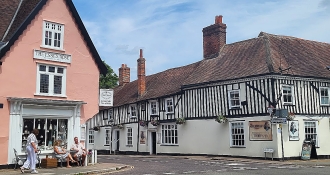
A short drive brought us to Dedham, and The Marlborough was easy to find. Situated on a corner plot almost opposite the parish church, the pub is a half-timbered edifice built mainly in the sixteenth century. Originally, it was built as a clearing house for local wool merchants. Inside the ground floor of the pub, there are many old timber beams to be seen.
Despite it being a hot day, I ordered the shepherd’s pie, which was truly excellent. It was accompanied by beautifully cooked carrots, parsnips, and cabbage. My wife ordered chicken parfait, and that tasted superb. The staf were friendly and the service was impeccable.
I am grateful for the recommendation we were given. Later, when mentioning how good it is to various people we met in Suffolk and Essex, they all knew of the pub and held it in high regard.



 yamey
yamey 