
I might look old
But I still carry out my job
Please give me your mail

I might look old
But I still carry out my job
Please give me your mail
PETER WILSON WAS born in the English county of Dorset in 1968. In the 2012 Olympic Games, he won a gold medal in a shooting event.

To celebrate Britons who won gold medals in the 2012 Olympic Games and Summer Paralympics, the Post Office painted several letter boxes with gold-coloured paint. It was originally planned to be a temporary measure, but as the public gave it much approval, the boxes have remained gold,
Peter Wilson’s Olympic achievement is celebrated by a gold letter box that stands in Sherborne, in Dorset. It can be found on Cheap Street. A plaque attached to it is there to remind people why the letter box is gold rather than the usual red.
THEY STAND SIDE by side on a pavement outside a post office on the sloping Avenida Zarco in central Funchal. There are two sets of them. In each pair, one is painted red, the other is blue. They are postboxes (letter boxes). These cylindrical mailing boxes have a familiar look about them, especially if you live in England.

Having seen several old British style post boxes in various places in India, seeing these boxes in Funchal aroused my curiosity. I looked at their bases. The two red boxes had no manufacturer’s marks. However, both the blue ones had the following on them in English: “Cooperative Industrial Society”. This suggests that at least these two boxes were made in the UK. It appears that many Cooperative Industrial Societies have existed. So just by looking at them, it cannot be said exactly where these boxes were made. In any case, it seems that these items were imported from the UK.
As for the two colours – red and blue – there are two postal methods/speeds in Portugal. Red boxes are for normal mail, and blue for priority or express mail.
I VISITED INDIA at least 50 times over the last 29 years. It was not until this trip (2022-2023) that I began noticing letter boxes of historic interest. I spotted three of interest in Bangalore, and now I have found one outside the post office in Fort Kochi in Kerala.

Painted green with some gold coloured details it is hexagonal with a decorative top. Between the words “Post” and “Office”, there is a British royal cipher with the lion and unicorn. Beneath this is a V and a R entwined, a logo I have seen on Victorian letter boxes in the UK.
The old letter box, now sealed up so that nothing can be put in it, stands close to the verandah at the front of the post office. Within the verandah, there is a panel giving some information about postal services in the former Kingdoms of Cochin and Travancore
Postal services began in the Kingdom of Cochin in about 1864. It was known as the Anchal Service. The letter box described above might have been an Anchal post box originally, although it is unlikely.
According to an article (https://englisharchives.mathrubhumi.com/news/offbeat/last-anchal-runner-of-kerala-passes-away-1.3462681#:~:text=Anchal%20Post%20was%20the%20postal,on%20which%20bells%20were%20attached):
“Anchal Post was the postal service system started and existed during the Kingdom of Travancore to transfer official letters and documents. The post man of this system was called anchal pillai. He used to run carrying the dispatches in a bag with a stick on his other hand on which bells were attached.”
He used to run eight miles a day. People were required to make way for this important courier, and not to impede his progress. The last surviving anchal pillai, Kannan Chapli, died aged 90 in 2019.
The post office outside which stands the historic letter box is on Ridsdale Road opposite the east end of the church of St Francis (Church of South India), and was constructed in May 1928. At that time, Fort Kochi was in the Kingdom of Cochin. In 1949, it and its neighbour, The Kingdom of Travancore, were integrated into India and merged to form the State of Thiru-Kochi. In 1956, this state was renamed Kerala and its postal service became incorporated into the Indian Post system.
Interestingly, the post box outside the Fort Kochi post office bears the intertwined V and R. The information panel has a drawing of an anchal letter box. Similar in shape to the Victorian post box, the one in the drawing bears a different logo and the words “Travancore Anchal” and something in Malayalam script. If I am not mistaken, Cochin, unlike Travancore, became a British Protectorate. In which case it might well have become part of the British Indian postal system. This could explain why the historic letter box in Fort Kochi has a British logo instead of that used in the Anchal system. There might also have been Anchal boxes in the Kingdom of Cochin, but I am uncertain about that.
Today, letters are posted in a simple red cylindrical letter box not far from the historic one. The Victorian letter box is one of a huge number of interesting historic survivals that can be seen whilst wandering around Fort Kochi.
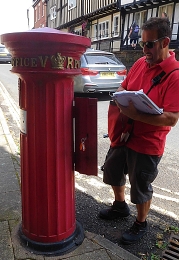
In Britain, posting boxes for letters and small packages are sometimes referred to as ‘pillar boxes’
While visiting the town of Warwick, famous for its castle, we spotted a letter box that is truly a pillar box.
This post-box (pillar box) is shaped like a classical pillar. It was made in cast-ron in 1856 and is one of two of this design in the town of Warwick. They are still in use.
 yamey
yamey 