THIS IS AN EXTRACT from my latest book, “Walking West London”, which can be downloaded in its entirety (as a pdf file), free of charge and with no strings attached, from: https://adamyamey.co.uk/walking-west-london/ (just click on the green button, labelled “Download”). The sample below relates to the street market on Portobello Road:
NO LONGER A COUNTRY LANE (PORTOBELLO)
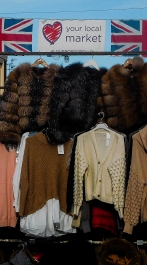
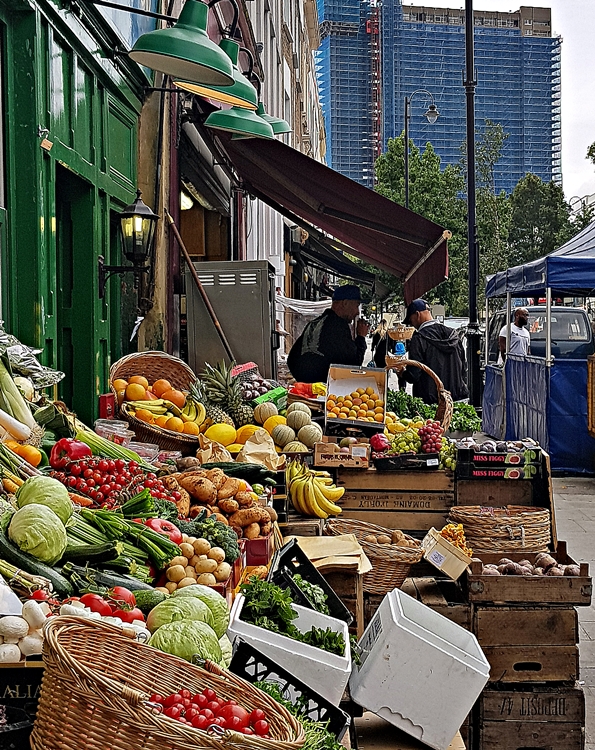
Lovers of street markets, whether they be searching for antiques, bric-abrac, jewellery, telephone covers, clothing, snacks, cafés, flowers, fruit, or vegetables, will enjoy browsing the diverse stalls and small shops that line Portobello Road. This street, which used to be called ‘Portobello Lane’ runs from Notting Hill Gate to just south of the main railway line that begins at Paddington Station. In days gone by, it ran from the gravel pits at Notting Hill Gate to the now long-since demolished Portobello Farm,which stood roughly between Orchard Close and Blagrove Road in NorthKensington.
Before the mid-19th century Portobello Lane, as it was then called, was to quote the historians Florence Gladstone and Ashley Barker (writing in1924):
“‘… one of the most rural and pleasant walks in the summer in the vicinity of London’, and within living memory it led ‘through fields to Kensal Green … cornfields and meadow land on each side … ‘”
Well, Portobello Road is no longer bucolic. It is lined with buildings along its entire length. Currently, it begins with a short section that leads off Pembridge Villas. It is here that you can stop for a drink at the Sun inSplendour pub, which was built in the early 1850s. After running a few yards westwards, Portobello Road heads off in a north-westerly direction, which it maintains with barely any deviation for the rest of its length. Number 22 was the first London home of the writer George Orwell. He lived there as a lodger in the winter of 1927.
After crossing Chepstow Villas, the road slopes downwards and soon after this the market area commences. On most weekdays, much of the market is dedicated to daily domestic needs, mostly food. On Fridays and Saturdays, the number of stalls and the variety of goods on offer increases dramatically. In normal times (i.e., when there is no pandemic), Portobello Road is choked with crowds of people from all over the world, especially on Saturdays.
In the 1860s, the Metropolitan Line (now the ‘Hammersmith and City Line’) was built. It crosses Portobello Road close to the Ladbroke Road station, which was originally known as ‘Notting Hill’ station. Rail access probably accounted for the urban development of what was once ‘Portobello Lane’. The market in Portobello Road probably began operating in the second half of the 19th century. Until the 1940s, it served people’s daily needs. Then, in the 1940s, traders selling anything from junk to antiques began trading along the road, alongside the purveyors of daily requirements, and that has how it has remained.
The architecture of Portobello Road is far from distinguished. Much of it is ‘bog standard’ Victorian suburban sprawl, but this is hardy disturbing as the eye has plenty of other things to distract it along the multicultural, bustling, colourful, sometimes quirky market street.
Next, I will point out several things worth noticing if you can take your eyes off the shops, the buskers, and the stalls in the market. The Electric Cinema on Portobello Road was first opened in 1910, making it one of the oldest still working cinemas in the UK. It was one of the first buildings in the area to receive a supply of electricity. It has an Edwardian façade. Despite having been closed for several short periods during its lifetime, it still shows films. Since its extensive repairs in 2000, it has become a luxurious space in which to watch films. It is near to Talbot Road that leads to the church of All Saints.
The Victorian church was built between 1852 and 1861 …
END OF SAMPLE. If you have enjoyed it, please download a copy of my book to learn more about London west of Park Lane.


 yamey
yamey 