
Marilyn, Mao, and more at Milton Keynes

ONCE AGAIN, THE MK Gallery at Milton Keynes has put on a superb exhibition. Until 29 June 2025, there is a show of artworks by the artist and film maker Andy Warhol (1928-1987), who was born in the USA. Best known for his multiple portraits of figures such as Marilyn Monroe and Mao Tse Tung and Pop Art images, there is much more than this on display at the MK.

The first room of the show contains work that Warhol created in the 1950s and early 1960s. Like artists such as Picasso and Hockney, whose creative lives began with works that were not as experimental and novel as their later works, Warhol’s earlier, less revolutionary, images show that he was a competent draughtsman capable of producing highly acceptable ‘straightforward’ compositions. It was interesting to see his earlier works because they are rarely displayed in public galleries. And it is always nice to see how an artist who is best known for his or her more extraordinary creations began his or her creative output.

The exhibition includes many of Warhol’s Pop Art images including those of Marilyn and Mao, but also there are several of his portraits of other figures. These include the artist Basquiat, the politician Barry Goldwater, Marcel Duchamp, Joseph Beuys, Muhammad Ali, and Liz Taylor. What I found interesting was that amongst the portraits on display, there were a few of the British artistic couple Gilbert and George. As the exhibition booklet related:

“The British artistic duo Gilbert and George , like Warhol, explored the interplay between personal and public identity, often blurring the lines between performance and art.”

Warhol’s portraits of this couple reflect their own graphic artistic style.

Other images on display relate to the Cold War and to the electric chair. The images on display in the show include drawings, prints, posters, and photographs (often adjusted to create interesting artistic effects). There are also exhibits relating to Warhol’s prolific output of films. He made about 600 of them. It would have been interesting to have been able to see extracts from some of them.

In brief, this is an exhibition that is worth travelling to. Apart from being beautifully displayed alongside helpful information panels, it is worthy of a visit to be able to enjoy seeing this artist’s rarely seen early works.
AMAZING SCULPTURES AND COLLAGES BY A BRITISH POP ARTIST

HUMOUR, IMAGINATION, PLAYFULNESS, wit, social criticism, and creativity – these are all words that can be applied to the works of the artist Peter Blake, which are on show in a superb exhibition at the Waddington Custot gallery in London’s Cork Street until the 13th of April 2024.

Blake was born in 1932 in Dartford (Kent). He studied art at Gravesend Technical College, and then at the Royal College of Art in Kensington. He is a leading British exponent of Pop Art, which, according to Wikipedia:

“… is an art movement that emerged in the United Kingdom and the United States during the mid- to late-1950s.The movement presented a challenge to traditions of fine art by including imagery from popular and mass culture, such as advertising, comic books and mundane mass-produced objects. One of its aims is to use images of popular culture in art, emphasizing the banal or kitschy elements of any culture, most often through the use of irony.”

One of Blake’s most familiar works is the album sleeve for the Beatle’s LP “Sgt. Pepper’s Lonely Hearts Club Band”, which he designed along with Jann Haworth, his wife between 1963 and 1979. I wonder how many Beatle’s fans know that Blake was involved with making the image on this.

The exhibition at Waddington Custot is dedicated to Blake’s sculptural works. There has not been one during the last 20 years. Although there are many of his sculptures in the gallery’s three interconnecting rooms, many of his ingeniously witty collages are also on display. Employing images from comics, old books, and other printed matter, these collages are so carefully assembled that unless one looks at them closely and extremely obliquely, it is difficult to realise that these artefacts are not prints but collages.

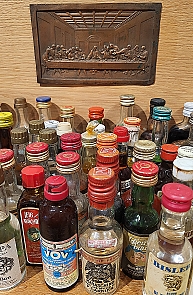
The sculptures are with only a very few exceptions, wonderful assemblages or tableaux constructed with found objects. For example, one of these is a shelf overloaded with miniature booze bottles, all positioned beneath a miniature image of Leonardo da Vinci’s depiction of the Last Supper. There are several model sailing boats, on which Blake has placed plastic models (toys) of people expressing a range of behaviours. Other sculptural assemblies are more complex and need to be seen rather than described. I mentioned ‘exceptions’ at the beginning of this paragraph. This refers to four objects – they look like large stones (one of which is a carved stone head) – which Blake called “Found Sculpture”. Each of these is mounted on its own plinth. By doing so, the artist has ‘elevated’ these natural objects to the status of ‘fine art’, and as the gallery’s hand-out said, they challenge:

“… conventional notions of artistic materials …”

I loved the exhibition. Every exhibit is both interesting and beautiful … and great fun. As the show’s hand-out correctly stated, Blake’s sculptures are:

“… by turns quirky, endearing or engaged with conceptual concerns.”

His creations:

“… offer starting points for imagined narratives, each with a glimmer of Blake’s typically gentle, English sense of humour.”

And this is quite correct. Skilfully conceived and executed, Blake’s works provide nourishment for both the eye and brain in a delightfully digestible form.  If you view the exhibition with an open state of mind, you are bound to gain great enjoyment from it.

Pop Art on show in a gallery in Bombay

DURING THE FEW DAYS we have been in Bombay, we have visited 10 art galleries. With one exception, the exhibitions have been both beautifully displayed and contained exciting works of art. The exception is an exhibition of Pop Art being held at the recently constructed Nita Mukesh Ambani Cultural Centre in the Bandra Kurla district of Bombay.

The spacious gallery occupies parts of four floors of a glitzy cultural centre-cum-shopping mall. To view the exhibition, one needs to book a time-slot, and part with 800 Rupees (about £8) per person. When we visited on a Sunday afternoon, the few visitors to the gallery were vastly outnumbered by security personnel and charming, but seemingly poorly informed, young ladies who are employed to provide information about the exhibits.

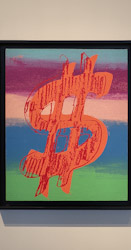
The flyer for the exhibition promises the visitor the opportunity to see works by 12 exponents of Pop Art. However, the majority of the items were creations of Andy Warhol. Almost my favourite piece was a large creation by Robert Rauschenberg.

Each of the very spacious, well-lit galleries had surprisingly few artworks. Of the four galleries, I thought that the one on the third floor was best. It contained, amongst a few other things, the Rauschenberg, and a work by Claes Oldenburg, and yet more Warhol images.

Would I recommend making a visit to this exhibition? Probably, I would not. If you are familiar with Pop Art it offers little to add to what you already know and/or like. If you are not familiar with this kind of art, I am not sure that the exhibition would provide you with much if any insight. And at 800 Rupees per person, you might be better off buying a decent book about this exciting era of art.