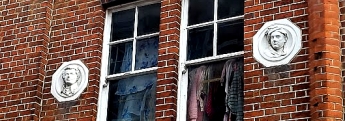
Heads on a wall
They are looking downward to the street
Lifeless indeed

Heads on a wall
They are looking downward to the street
Lifeless indeed
MACBETH STREET IS a short thoroughfare in Hammersmith. It runs from Kings Street to the A4 dual carriageway. We often walk along it to reach the pedestrian subway beneath the busy A4. There is an architecturally unexciting building on Macbeth Street, which I would not have stopped to look at had I not noticed two memorial plaques affixed to it.
One of the plaques bears the words:
“This stone was laid To the Glory of God on June 28th 1930 on behalf of the South Street Mission by Mrs Alfred Goodman. Mission superintendent Sister Lizzie”

The other plaque reads:
“To the Glory of God on June 28th 1930 on behalf of the Shaftesbury Society by Sir Charles JO Sanders KBE. Treasurer L(?) Goodman Esq”
The South Street Mission was founded in 1901 by Sister Lizzie, who died in 1949. In 1909, the South Street Mission brass band was formed, and was active until the mid-1950s. According to a website about streets in Hammersmith (https://edithsstreets.blogspot.com/2016/11/riverside-north-of-river-and-west-of.html):
“South Street Mission Hall. This was run by Sister Lizzie as a women’s refuge. South Street Mission Brass Band was active from around 1910s through to the 1950s. The building now appears to be operated as a church centre probably through St.Paul’s church. It also appears to have links with the Shaftesbury Society and the St.Barnabas movement operating as a centre for the homeless and a night shelter for street sleepers.”
As for the Shaftesbury Society, according to Wikipedia:
“In 1872 the social reformer Lord Shaftesbury established the Emily Loan Fund to enable young women flower sellers to support themselves. Later, in 1914, the Ragged School Union merged into the Shaftesbury Society, becoming fully subsumed under the title of the Shaftesbury Society in 1944.”
“Whos Who 1938” has an entry for Sir Charles JO Sanders. He was an important civil servant involved in shipbuilding matters. The reference to him includes his philanthropic work:
“… a well known worker amongst the poor in all kinds of religious, social, and philanthropic work, Chairman of Council of Shaftesbury Society and Ragged School Union, 1918, 1919,1929, 1930, 1936 and 1937, Treasurer since 1933.”
As for Sister Lizzie, I have not been able to discover more about her.
Today, the building is used by various religious groups including the ‘House of Worship’ and the ‘Sword of the Spirit – Int. Prophetic Ministries’.
I guess that the memorial plaques, which caught my eye, were placed when the present building was built to replace an earlier version.
GEORGE FREDERIC WATTS (1807-1904) was a prolific, highly acclaimed Victorian artist. Visitors to London’s Kensington Gardens can easily admire one of his works, a sculpture called “Physical Energy”. Standing across the Serpentine from a sculpture by Henry Moore, Watts’s sculpture is a bronze casting of a version of it that was sent to South Africa as part of a memorial to Cecil Rhodes. One of Watts’s less prominent works, and quite a curious one, can be seen in Postman’s Park, which is a few yards north of St Pauls Cathedral in the City of London. It is the Memorial to Heroic Self-Sacrifice.
The memorial consists of a wall covered with rectangular plaques, made with ceramic tiles commemorating heroic deeds carried out by ordinary people. For example, one bears the words:
“Frederick Alfred Croft. Inspector aged 31. Saved a lunatic woman from suicide at Woolwich Arsenal Station but was himself run over by a train. Jan 11, 1878”.
And many other examples of great bravery by civilians are recorded on the wall, which is protected by a canopy with a decorative fringe.

The artist Susan Hiller (1940-2019) was born in Florida (USA) and died in London. Apparently, she was surprised by how few people noticed the memorial in Postman’s Park, let alone read the tragic plaques. I am one of the few, who have done so. So, as soon as I got near to an artwork displayed in a temporary exhibition in the Tate Britain art gallery, I knew it was based on the plaques in Postman’s Park. The piece consists of 41 photographs of plaques on the Memorial, which have been arranged on a wall by Susan Hiller. In the centre of this artistic array that she has called “Monument 1980-1”, she has placed a plaque which consists of a stretch of tiling on which the words “Strive to be your own hero” have been crudely written with black paint.
Susan Hiller’s interesting version of GF Watts’s Memorial is one of several intriguing exhibits in an exhibition called “Material as Message”, which was still being installed when we visited it in March 2023. There is yet one more exhibit to be unveiled. Hiller’s exhibit interested me because I am familiar with Postman’s Park, but the other exhibits were equally fascinating both visually and conceptually.
 yamey
yamey 