The station where Gandhi landed in England in 1931

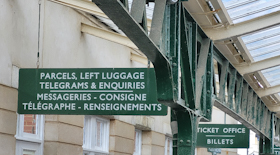
WHEN MAHATMA GANDHI came to England in 1931, he disembarked at Folkestone in Kent. In those days there boats docked alongside a pier, and then boarded trains at a station on the pier. The pier has long since ceased to be used to service cross channel and other passenger boats, but it and the station have been preserved and converted into a tasteful leisure amenity.

A more detailed history of the pier and its station is available here: https://gujarat-travels.com/2021/10/24/where-mahatma-gandhi-set-foot-in-england-in-1931/

A café with a history on the seashore at Pondicherry

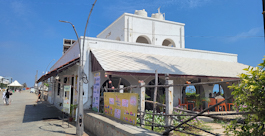
BEACH ROAD RUNS alongside the seafront of Pondicherry.  It is just over 1.3 kilometres in length. There are many buildings lining the landward side of the road (its west side), including hotels, restaurants, a memorial to BR Ambedkar, the lighthouse and the Customs House. However, there is only one  on the seaward side, close to the seashore.  Today, this building with a veranda on its sea facing side is a pleasant refreshment outlet called Le Café.  It stands a few metres south of the tall statue of Mahatma Gandhi,  also on the seaward side of Beach Road. 


The café contains some historical photographs of Pondicherry. One of them shows the long pier that commenced where Gandhi now stands. The pier was irreparably damaged during a terrible storm in the early 1950s, probably 1952. All that remains of it are some wooden stumps projecting from the sea some considerable distance away from the shore. Where Gandhi stands today was Place de la République when Pondicherry was a French colony. 


There has been a building on the site of Le Café since at least the end of the 17th century, as can be seen on a map published in 1793. For many years, the building housing the café was the Port Office of Pondicherry.  It can be seen quite clearly in a photograph taken before 1870. Then, it had only a single storey. A small upper storey has been added since then.


Sometime after the pier was polished off by the storm, the building was remodelled to serve as a café.  Run by a state managed concern, food and non-alcoholic drinks can be obtained here at reasonable prices. In the intense heat of midday and the early afternoon,  the veranda of Le Café is a pleasant place to relax in the breezes that pass through it.

THE ONLY REMAINING VISUAL EVIDENCE OF A CREEK IN WEST LONDON

IN MY BOOK about west London, “Beyond Marylebone and Mayfair: Exploring West London”, I described a stream that used to flow through Hammersmith. It was located where part of Furnivall Gardens now stands today. I wrote:

“… Furnivall Gardens, a pleasant open space created in 1951, and named after a distinguished scholar of English literature and an important pioneer in the sport of rowing, Dr Frederick James Furnivall (1825-1910) … Before WW2, the area of the park was covered with industrial buildings including the Phoenix Lead Mills, which stood east of The Creek, an inlet of the Thames that was filled-in in 1936.

In earlier times, The Creek, which extended as far inland as today’s King Street, was centre of Hammersmith’s flourishing fishing industry. Writing in 1876, James Thorne described The Creek as follows: ‘… a dirty little inlet of the Thames, which is crossed by a wooden footbridge, built originally by Bishop Sherlock in 1751 … the region of squalid tenements bordering the Creek having acquired the cognomen of Little Wapping, probably from its confined and dirty character.’

The Creek, an outlet of the now largely hidden Stamford Brook, is long gone, but there is a storm outlet in the bank of the Thames close to where The Creek emptied into the river. This can be seen from Dove Pier at the western end of the Gardens.”

Today, the 25th of February 2024, we were walking past Furnivall Gardens along the riverside path. It was low tide. A wide, not too clean, beach lined the river. At one point, the beach was interrupted by what looked like the mouth of a small stream. This was lined on both sides with wooden fencing. The stream, which issued from below the riverside walkway ended abruptly in an archway that was filled by a sturdy door or dam. The position of this sluice gate in relation to the nearby Dove pub, Dove Pier, and Furnivall Gardens is correct for what must have once been the mouth of Hammersmith’s erstwhile Creek. I had noticed the archway with the heavy-looking door many times before, but today, because of the low tide, it was the first time that I could clearly the remnants of the mouth of the Creek. I suppose that there is some leakage from the now covered-up Creek that causes the appearance of the mouth of a small stream when the tide is out.

My illustrated book about West London is available as a paperback and a Kindle from:

The road to Wigan Pier and …

WIGAN PIER WAS made famous by the author George Orwell, who published his “The Road to Wigan Pier” in 1936. Recently, we were staying in Widnes (Cheshire), which is not far from Wigan, a town that was in Lancashire when Orwell wrote his book. So, we decided to see Wigan Pier for ourselves.

A quick glance at a map reveals that Wigan is not on the sea, which is where most piers are to be found. The town is inland, and the so-called Wigan Pier is neither a pier nor on the seaside. It is on a part of the Leeds and Liverpool Canal in central Wigan. It was originally a landing stage where locally mined coal was loaded onto barges.

The name ‘Wigan Pier’ might have originated when a train carrying excursioners to the seaside was delayed at Wigan and they saw a structure that looked like a pier, as the following (from http://www.wiganarchsoc.co.uk/content/Projects/WiganPier.htm#Folklore )  described:

“…not long after leaving Wallgate Station, an excursion train from Wigan to Southport, was delayed on the outskirts of Wigan and passengers saw a long wooden structure that reminded them of Southport Pier. This structure would have been the 1,050 yard long wooden gantry … It was built in the late 1880s and carried a double line of rails from Lamb and Moore’s Newtown Colliery high across the River Douglas, the canal and the Wigan to Southport Railway line, to Meadows Colliery by Frog Lane … It certainly would have been easy to see this wooden gantry from a train heading towards Southport.”

I cannot say whether or not this is the true origin of the name, but it is a good story.

We took a road to Wigan Pier and after going around the town’s one-way system and several roundabouts, passing a huge Asda store a couple of times, we arrived at a series of old warehouses labelled Wigan Pier, and parked next to the canal. The Orwell visitor centre, which we were led to believe existed, is no more. A passer-by, with whom we chatted, told us that any memorials to Orwell and his book had disappeared a few years ago. Likewise, the collieries: these have been closed down long ago. Where they were there are housing estates, factories, and shops.

The warehouses close to where the coal used to be loaded many years ago, were inaccessible. They are being redeveloped to create a leisure ‘hub’. This will include (according to hoardings surrounding the old buildings): a beer tap house; conferences; live music; canal tours; festivals; a food hall; and an ‘artisan deli’. I am not sure what is meant by an artisan deli, but whatever it is, I am sure that should George Orwell ever make his way back along the road to Wigan Pier, he would be truly astonished by it.

Out to sea without stepping off land

THE FIRST TIME I visited Southend in Essex was in about 1960. I was invited to go there on a day trip with my best friend, his younger brother, and their father, who was a senior official in London Transport. We went by car, stopping on the way at several London Transport bus garages, where we saw a few vintage busses. I remember two things about Southend on that first visit. First, we ate fish and chips. It was the first time I had sampled this cuisine because my parents were too snobbish about food to have been seen dead in a fish and chip shop. I have enjoyed fish and chips ever since that time in Southend. The other thing that sticks in my mind was travelling along Southend Pier in a special train that carried passengers almost to its furthest point from the seafront. It was not until the 11th of February 2022 that I made my second visit to Southend.

Southend Pier

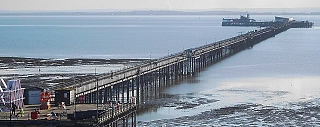
Southend Pier is the longest pleasure pier in the world. It is 1.34 miles (2.16 kilometres) in length. The present pier, which replaced an earlier wooden one built in the early 1830s, was completed in the late 1880s. it was opened to the public in 1889. At about this time, the single-track railway running along it was also ready for use. It was extended by 1898. The trains were then electrically operated. In 1978, the electric railway was closed. By 1986, it had been re-opened using trains that were driven by diesel engines. It was on one of these that we took a return trip this February.

I enjoy piers. They provide a way of going out to sea without leaving land and without risking seasickness. In addition, like the one at Southend, most of the piers in England are visually satisfying when viewed from the shore. At the sea end of Southend Pier, there are various structures ranging from painted wooden shacks to the beautiful contemporary-style Royal Pavilion, opened in 2012. Despite being a complete contrast to the other constructions on the end of the pier, it enhances to visual attractiveness of the area.

Although the pier was not the primary reason for our excursion to Southend, it certainly enhanced our enhancement of the place as did our lunch at a local fish and chips shop.