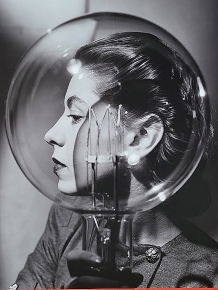
AT TATE BRITAIN in London, there is an exhibition of photographs taken by the highly talented Lee Miller (1907-1977), which is showing until 15 February 2026. We visited it today, 15 October 2025. There is a vast number (about 250) of Miller’s photographic works on display. And there was a vast number of people looking at them. Plenty of the images are quite small, and viewing them was not easy because of the crowd of other visitors.
After leaving the exhibition, I looked at the catalogue that has been prepared for it. Many of the exhibits are reproduced well in this huge volume. Whereas in almost all other exhibitions, viewing the actual artworks in ‘real life’ is far more satisfactory than seeing them in a catalogue. I felt the reverse was the case with the Lee Miller show. With the catalogue in your hands, you cans get close to the images, and enjoy them for as long as you wish without being disturbed by others around you.
Unless you are a Member of the Tate, you need to pay about £20 (per person) to see the exhibition. The catalogue costs £32 (paperback). In the case of this exhibition, but not most others, I would suggest buying the catalogue without purchasing an entry ticket. It is a case of see the book, not the exhibition.
THE NEWPORT STREET Gallery, which is in a side street not far from Lambeth Palace and the Garden Museum, was opened in October 2015. Housed in a building originally built in 1913 as a theatre carpentry and scenery production workshop, these spacious premises are used to display selections from the huge number of works that have been collected over the years by the artist Damien Hirst. The current exhibition, which has been curated by Damien’s son Connor Hirst, is called “The Power and the Glory”, and is showing until 31 August 2025.
The walls of the rooms in the gallery are lined with photographs of atomic and hydrogen bomb test explosions (‘mushroom clouds’ etc.), as well as of the devastation that the former caused in Hiroshima and Nagasaki. Although many of the photographs are beautiful as works of art, they are grim reminders of the horrific destructive forces unleashed by detonating nuclear bombs. However, as the curator explained, many of the photographs have been composed in such a way that the viewer is unaware of the destruction going on beneath the picturesque clouds.
While the walls of the rooms are lined with photographs, the rooms contain many beautifully shaped (mostly shaped by nature) pieces of rock. They include a selection of so-called ‘scholar’s rocks’. These have been collected in China since the Song Dynasty (960-1279 AD), and appreciated for their inherent beauty. Most of them were found either in caves in Guandong province or at Lake Tai or in the Lingbi region. Amongst the collection of scholar rocks, there are some Japanese ‘water stones’, which are often shaped like mountains and waterfalls.
The stones are intrinsically beautiful and provide an interesting contrast to the photographs surrounding them. However, although the rocks and photographs served different functions, when displayed together as they are at the Newport Street Gallery, they cannot help becoming interlinked in the viewers’ minds. I could not help thinking that these rocks could easily have been similar to the fragments of buildings destroyed by the bombs at Hiroshima and Nagasaki.
THE FIRST ROOOM of the Tate’s exhibition of photographic images of Britain in the 1980s, “The 80s Photographing Britain”, was disappointing. There were too many small photographs, which would have been far easier to appreciate by seeing them in a catalogue or book. However, the other rooms of this show, which is on until 5 May 2025, contain many photographs that are often interesting as well as artistic. As the Tate’s website explained, during the ‘80s:
“… photography was used as a tool for social change, political activism, and artistic and photographic experiments.”
It continued to say that the visitor to the exhibition will:
“See powerful images that gave voice and visibility to underrepresented groups in society. This includes work depicting the Black arts movement, queer experience, South Asian diaspora and the representation of women in photography.”
After my initial disappointment in the first room of the exhibition, I soon began enjoying the exciting range of pictures on display in the rest of the show. During most of the 1980s, I was working as a dentist in a small, rather conservative provincial district in Kent, and was largely unaware of the social changes that were going on around me. So, now, many years later after having seen the exhibition at the Tate Britain, it has only dawned on me what had passed me by while I was concentrating on looking after the dental health of some of the inhabitants of the Medway Towns.
Would I recommend seeing this show? My answer is ‘yes’, but hurry because it is ending soon.
WHILE SORTING THROUGH some old photographs, I came across some I had taken during my first visit to Paris. It was 1968 and I was 16. I travelled there with my parents on the overnight Silver Arrow, a train that was put on board a ferry to cross the English Channel. We stayed in a hotel on the Ile St Louis. Everything about the city both enchanted and amazed me.
Paris Gare du Nord
The photograph included in this post was taken through the window of my compartment in the Silver Arrow as soon as the train pulled into Paris Gare du Nord.
I have visited Paris many times since 1968, but it was during my first visit that the city impressed me most. Although the photographs I found brought back happy memories, I have no great yearning to visit Paris again in the near future.
JULIA MARGARET CAMERON (1815-1879) was a Victorian photographer, who pioneered artistic photography. Rather than using her cameras to attempt to slavishly reproduce reality in her prints, she used cameras and processing techniques to produce an artistic interpretation of her subject matter. It has been said that some of the images she created influenced a few of the Pre-Raphaelite painters, who were amongst her friends.
In Julia’s honour, there is an annual prize for women photographers: The Julia’s Margaret Cameron Award. One of the winners of the award in 2024 is the French photographer Muriel Pénicaud. Born in 1955, she served in the French government as Labpur Minister from 2017 to 2020. A self taught photographer, she began taking photographs when she was 11 years old.
There are two exhibitions of Muriel’s work currently (January and February 2025) showing in the former French colony of Pondicherry in the south of India. One of them is at the Kalinka gallery in Kasturba Gandhi street, and the other is at the more centrally located ‘The Spot’: a bar-cum-restaurant (it serves good food).
The majority of Muriel’s photographs on display are in black and white. One of the few coloured ones show a red shoe lying beneath a pile of discarded shoes in drab colours. This image is the photographer’s reaction to the piles of murdered victims’ shoes that can be seen at the Auschwitz concentration camp.
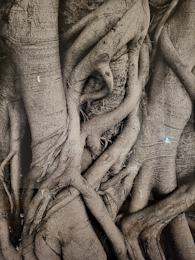
What Muriel achieves in most of her images is the conversion of a mundane sight, say a tree trunk or a bird’s plumage, into a work of art. Without resorting to tricks of focusing and experiments with processing, as did Julia Margaret Cameron, Muriel, like Julia did, transforms the ordinary into the visually extraordinary in subtly delicate ways. She creates a new way of looking at the world by making her subject matter look intriguing. She deserves a prize that honours the pioneer of artistic photography: Julia Margaret Cameron.
You can read more about Julia Margaret Cameron in my book “Between Two Islands: Julia Margaret Cameron and her Circle.” This book (also Kindle) is available from Amazon, e.g., https://www.amazon.co.uk/gp/aw/d/B0BZFCVLX9/
SUNIL GUPTA IS a renowned photographer. He was born in 1953 in New Delhi, and migrated to Canada with his family in 1969. With a degree in accountancy and a diploma in photography, he moved to London (UK) in 1983. There, he married another photographer Charan Singh. Much of Sunil’s work relates to themes of sexual identity, migration, race, and family.
While we were in Chennai, the parents of another photographer, Varun Gupta, told us about the exhibition of Sunil Gupta’s works currently (January 2025) being held in the garden of the Government Museum in Chennai. The show is part of the Chennai Photographic Biennale, of which Varun is one of the founders.
The show is being held in the open air. We saw it when the air temperature was hovering around 29 degrees Celsius. In addition, crowds of schoolchildren were enjoying their packed lunches on the ground amongst the walls upon which the photographs were hanging. The show has been arranged to produce what could be termed an autobiography expressed by photographs.
There is no doubt that Sunil’s photographs are visually superb as well as being of great interest.
While I was looking at the images, many of which are artistic as well as informative, I began to wonder whether photography limits the expression of a photographer’s innermost feelings more than is the case for a creator who is painting or sculpting. The photographer, like other visual artists, can compose his/her pictures, regulate their appearance, and edit them. However, the light coming through the camera lens dictates the final product however many adjustments etc are made. In contrast, the light coming through the eyes of a sculptor or a painter (or a printmaker) impinges on the artist’s brain, and what eventually results reflects the effect that the image projected into the brain has on the creator’s innermost feelings about the subject matter.
Having said this, which I hope makes at least a little sense, I must admit that I do enjoy making photographic images and I hope that my photographic skills will be improved by viewing great works such as we saw at the exhibition of Sunil Gupta’s photographs in Chennai.
JULIA MARGARET CAMERON (1815-1879) was born in Kolkata (Calcutta) and died in Sri Lanka. When her husband retired from the Indian civil service, she and her family bought a house on the Isle of Wight, close to that of her friend, the poet Alfred Lord Tennyson. From an early age, when she met the astronomer and chemist Sir John Herschel in Cape Town, she developed an interest in the relatively young technique of photography. It was only in 1863 when she was residing on the Isle of Wight that she was given her first camera. This was the start of her remarkable career as a photographer. Unlike many other photographers during the Victorian era, Julia was not interested in producing exact images of her subjects in her photographs. Instead, she experimented with lighting, focus, development, and printing, to produce photographic images that were artistic rather than accurate representations of reality. Her subjects included many of the cultural giants of mid to late Victorian Britain. Also, she loved to pose her subjects, dressed in imaginative fancy dress costumes, in intricately contrived tableaux before capturing their image on photographic plates.
Until the 16th of June 2024, there is a temporary exhibition of photographs by Cameron at London’s National Portrait Gallery. Many of Julia’s photographs are on display alongside those of another woman photographer, Francesca Woodman (1958-1981). Although Woodman’s photographs are of a high quality artistically, seeing them alongside those of Julia Margaret Cameron added little to my enjoyment of the exhibition. However, this show does give impressive exposure to Cameron’s pioneering work in using photography as an art form rather than as a medium for recording likenesses. As exhibitions go, I did not feel that this one is a sparkling example of curating. However, I am pleased that I went because I have read a great deal about the life and times Julia Margaret Cameron, and have also published a short book about her, which is available on Amazon:
WHAT IS YOUR EARLIEST memory of a news item? In my case, I remember my parents discussing something about Cuba. This was The Cuban Missile Crisis of October 1962. I had little or no idea about it, but later I learned that US President John F Kennedy was involved in its resolution. A year later, when we were staying in the USA, we were there when he was assassinated. I well recall that and my feelings about it at the time. That remains in the forefront of my memory, but far back in the fleshy recesses of my grey matter, the name Grunwick resides. While visiting an exhibition at the Tate Britain recently, I saw several photographs that brought this vague memory back into my consciousness.
Grunwick Film Processing Laboratories (‘Grunwick’), located at Willesden in northwest London, processed photographic films and produced finished prints from them. Photographers (mostly amateurs) put their undeveloped exposed films into an envelope along with payment, and sent them to Grunwick, who later returned the developed film and the prints made from it. In 1973, some workers at Grunwick joined a trade union and were subsequently laid-off by the company. The company employed many workers of Asian heritage – including a substantial number of ladies. As the then Labour politician Shirley Williams pointed out, the Asian ladies were being paid very much less than the average wage, and conditions were bad – hours were long, overtime was compulsory (and often required without the employer giving prior notice).
On the 20th of August 1976, Grunwick sacked Devshi Bhudia for working too slowly. That day, three other workers walked out in support of Devshi. Just before 7 pm that day, Jayaben Desai (1933-2010) began walking out of the factory. As she was doing so, she was called into the office and dismissed for leaving early. When she was in the office, Jayaben said (see guardian.com, 20th of January 2010):
“What you are running here is not a factory, it is a zoo. In a zoo, there are many types of animals. Some are monkeys who dance on your fingertips, others are lions who can bite your head off. We are those lions, Mr Manager.”
Thus began a two-year long strike, which was supported not only by the company’s workers but also by many politicians and trade unions, including, for a short time, the Union of Post Office Workers, who refused to cross the Grunswick picket lines.
Jayaben was born in Dharmaj, now in the Anand district of the Indian state of Gujarat. Soon after marrying, she and her husband migrated to what is now Tanzania. Just before the Commonwealth Immigrants Act (1968) made it difficult for Commonwealth citizens to settle in the UK, the couple moved to England. There, she was obliged to take up poorly paid work, first as a sewing machinist, and then as a worker at Grunwick.
Not only did Jayaben initiate the strike, but she helped keep it going until the dispute was resolved. In November 1976, when the Post Office workers stopped supporting the strike, she told an assembly of Grunwick’s workers:
“We must not give up. Would Gandhi give up? Never!”
Later, like Gandhi, she employed his tactic – the hunger strike – outside the Trade Union Congress in November 1977. During the court of enquiry led by Lord Justice Scarman, she gave powerful evidence against her erstwhile employer. When the strike was over, she went back to sewing, and then later became a teacher of sewing at Harrow College. After passing her driving test at the age of 60, she encouraged other women to do so to increase their freedom. After her death, some of her ashes were deposited in the Thames, and the rest in the Ganges.
The reason that Grunwick came to mind at Tate Britain was that its current exhibition “Women in Revolt! Art and Activism in the UK 1970-1990” (ends 7th of April 2024) includes several photographs taken at Grunwick during the strike. Three of them include portraits of Jayaben in action.
As I wrote earlier, I had heard of Grunwick, but I could not recall why until I saw the exhibition. As for the remarkable Jayaben Desai, I am happy that I have become aware of her and her amazing achievements.
PHOTOGRAPHY HAS LONG been an artistic medium for expressing protest. This is well exemplified by photographic images on display at the excellent “Women in Revolt” exhibition, which is on at London’s Tate Britain until the 7th of April 2024, and is well worth seeing. Running concurrently with this. is an exhibition at the South London Gallery (in Peckham) – “Acts of resistance: photography, feminisms and the art of protest”, which is on until the 9th of June 2024.
As its title suggests, the show at Peckham consists mainly of exhibits that make use of photography. There are also several digital items. The subject matter deals with matters that concern feminists (and ought to concern everyone) including rape, abortion, genital mutilation, other forms of violence against women, and so on. Unlike the exhibition at Tate Britain, which deals mainly with feminist activities in Britain during the 1960s to 1980s, this show was to coin a phrase ‘art sans frontières”, and bang up to date. The exhibition has as its inspiration the words that the artist Barbara Kruger used in 1989:
“Your body is a battleground”.
Incidentally, there is an exciting exhibition of Kruger’s work at the Serpentine South Gallery (in Kensington Gardens) until the 17th of March.
The exhibition at Peckham (to quote the gallery’s website):
“… explores feminism and activism from an international and contemporary perspective. Looking at different approaches to feminism from the past 10 years, the show highlights shared concerns including intersectionality, transnational solidarity, and the use of social media and digital technology as a tool for change.”
It includes works by at least 20 artists, some of them working as collaborators. Their creations are displayed well both in the gallery and its annexe nearby in a disused fire station. Put simply, the works on display at Peckham have a far more visceral impact than those being shown at Tate Britain, which in many cases appeal more to the brain than to the heart. Even if you ignore the messaging conveyed by the artists in the works at Peckham – and this is not easy to do – their visual impact is magnificent. They are works of art as well as being tools of protest. This is an exhibition well worth making the trek out to Peckham!