THERE IS A MAJOR cricket stadium in Kolkata called Eden Gardens. This world renowned sporting venue is adjacent to a far less well-known park: Eden Gardens Park. Established in about 1842, its fame was eclipsed by the opening of the cricket stadium in 1864. The stadium is named after the park.
Lord Auckland, the governor-general of India from 1836-1842, had ordered the construction of this pleasure ground. The garden was named after his sisters, Emily and Fanny Eden.
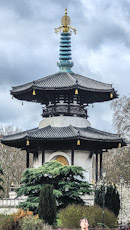
For a modest entry fee (20 rupees per person) one can enter the park, which contains a bandstand, flower beds, a rather rundown Japanese garden, a lake, a café, and a surprising feature that I will describe shortly. When we visited the park on a Saturday afternoon, there was a discotheque operating in the bandstand. The volume of music coming from the bandstand was excessive and unbearable. A local division of the Kolkata Police Special Department were having a party. Despite the racket, we strolled through the park to the attraction, which makes the park quite distinctive: a pagoda from Burma (Myanmar).
The wooden pagoda, which is in need of a little repairing, stands almost surrounded by the lake. The British brought it in pieces from Prome in Burma in 1854 at the end of the second Anglo-Burmese War (1852-1853), and reconstructed it in the park in 1856. Burmese workers put it together in the park.
Prome is known as ‘Pyay’ in Burmese. Regarding the period when the pagoda was removed to Calcutta, Wikipedia related:
“Called Prome by the British … the city became part of British territory after the Second Anglo-Burmese War in 1853. The town was taken by the British in 1825 during the Battle of Prome and again in 1852, on both occasions with hardly any opposition”. In 1862, the city was almost completely destroyed by fire. So, in a way, it was lucky that the wooden pagoda was saved from this conflagration.
The pagoda is an example of Tazoungs (idol house) architecture. It is surrounded by Burmese stone carvings. The pagoda used to contain a Buddha effigy, but this is no longer to be seen.
Kolkata is full of surprises. The Burmese pagoda is just one of them. I am glad we put up with the background noise in the park because I would have been disappointed not to view this unusual souvenir from Burma.
WHEN I FIRST VISITED Kew Gardens, I was a teenager, the entrance fee was sixpence (2.5 pence), and you entered via a metal turnstile. I did not visit Kew often in those days because it was a long way from my family home in northwest London. Recently, we have been exploring the delights of Kew Gardens occasionally with our friends who live in the heart of nearby Richmond town. During our most recent visit, whilst drinking coffee outside the former Orangery, now café, I stared at the nearby red brick building, Kew Palace, and began wondering about the history of the site, where the botanical gardens now stand, before Kew Gardens were opened to the public in 1840.
Kew Palace, which is also known as the ‘Dutch House’, now within the botanical gardens, was built on the site of a 16th century house, the ‘Dairy House’, in 1631. It is one of the oldest of the buildings standing by the Thames and was built for Samuel Forterie (1567-1643), a merchant of Dutch descent. After King George II (reigned 1727-1760) came to the throne, the building was used as a residence by various members of the royal family including King George III during some of his periods of illness.
For a long time, Kew Palace was not the only royal residence in what is now Kew Gardens. Before the Dutch House, now Kew Palace, was built by Forterie, a close friend of Queen Elizabeth I, Robert Dudley (1532-1588), 1st Earl of Leicester, lived in its predecessor. His house was close to one owned by the Keeper of the Privy Seal, Sir John Puckering (1544-1596), which Elizabeth visited both in 1594 and 1595.
Kew Palace was opposite a much larger building, Kew House, also known as the ‘White House’. Originally built in the Tudor era, it was first owned by Richard Bennet, son of the Lord Mayor of London Sir Thomas Bennet (1543-1627). Richard’s daughter and heir, Dorothy, married Sir Henry Capel (1638-1696) and they lived in Kew House. After Dorothy was widowed, she continued living at Kew House until her death in 1721. The next owner of the house was the astronomer and politician Samuel Molyneux (1689-1728), who married a grandniece of Lord Capel.
Two years after Molyneux died, Frederick (1707-1751), Prince of Wales, father of King George III, leased Kew House from the Capel family. He and his wife, Princess Augusta (1719-1772) lived at Kew House, and employed the great designer William Kent (1685-1748) to decorate the house and to lay out the grounds. After Frederick died, Augusta began the creation of the ‘Exotic Garden’, the forerunner of the present Kew Gardens. The architect Sir William Chambers (1723-1796) was put in charge of the works. In addition to the well-known pagoda (erected 1761-62) and still in existence, he oversaw the building of at least twenty structures in the garden. Many of these have been demolished, but amongst those still standing are The Orangery (1757-61), The Ruined Arch (1759), The Temple of Bellona (1760), and The Temple of Aeolus (1763).
After Augusta died, King George III (reigned 1760-1820) used Kew House and then bought its freehold in 1799. The King enjoyed improving the grounds of the property and ploughed up some of the neighbouring Richmond Deer Park to create an enlarged garden. Some of the work was entrusted to the garden designer ‘Capability’ Brown. The King received visits from the botanist Joseph Banks (1743-1820), who brought him seeds and plants for his gardens. By 1802, Kew House was falling to pieces, and was demolished in preparation for a new palace, which was never built. A sundial in Kew Gardens marks the site of the house. On a map drawn by John Roque in 1754, the former Kew House is labelled ‘The Princess of Wales House at Kew’ and the Dutch House (Kew Palace) is labelled ‘His Royal Highness the Prince of Wales House at Kew’. The map also includes drawings of three follies: ‘The Hermitage’, ‘Dairy House’, and ‘Merlin’s Cave’.
When George III was in residence at Kew House, he led an unsophisticated existence as described by Madame D’Arblay (aka Frances [‘Fanny’] Burney; 1752-1840). She wrote in Volume 3 of her published diary that the King lived there in:
“… a very easy, unreserved way, running about from one end of the house to the other without precaution or care … There is no form or ceremony here of any sort …They live as the simplest country gentlefolks. The King has not even an equerry with him; nor the Queen any lady to attend her when she goes her airings.”
This suggests to me that the King was careless about how he dressed (if at all) at his country retreat.
Kew Palace (the Dutch House) was separated from Kew House by a public road. Queen Charlotte (1744-1818), George III’s wife, took over its lease and then bought its freehold in 1781, and eventually died there. As mentioned already, her husband spent time at Kew Palace during his periods of illness.
In 1840, the botanical gardens, the ancestor of what we now enjoy, were opened to the public. Had it not been for the enthusiasms of the area’s earlier owners, some of whom I have described above, the location of this establishment might have been at another site. The main attractions of Kew Gardens today are the plants and some of the magnificent houses built for them during this century and the two preceding it. However, it is of interest to see Kew Palace and the few remaining garden follies created by Sir William Chambers several decades before the foundation of the present botanical gardens.
The Pagoda, which is tall enough to be seen from outside the confines of Kew Gardens is an attractive feature of the place. Writing in 1876 in his guidebook, James Thorne remarked that:
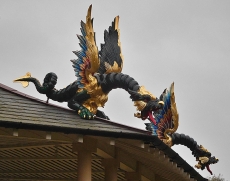
“… It is in 10 storeys, each storey diminishing a foot in diameter and height, and each having a balcony and projecting roof. Originally a Chinese dragon crawled over every angle of each roof, but these have all taken flight.”
The Pagoda remained without dragons until 2018, when its restoration was completed. It was then that these creatures, looking extremely well groomed, returned to their original perches.


 yamey
yamey 