Naturism used to be popular in the former Yugoslavia – a country I visited frequently during the 1970s and 1980s. In those years, I had many friends in Belgrade. In summer, many of them migrated to the Adriatic coast, particularly to Dubrovnik. I used to join them.
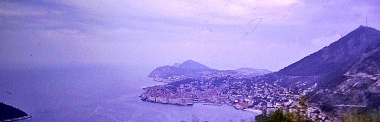
During one visit to Dubrovnik, my friends and I took a ferry to the island of Lokrum, which is less than a mile south of the centre of the historic part of the city.
After disembarking and climbing a short slope, we stopped at a direction sign with two panels, each pointing towards a different path. One bore the words “Ne nudismo”, and the other had only one word “nudismo”.
We followed the path indicated by the ‘nudismo’ sign. The path wound gently downhill through a shady forest, and reached a sandy beach in a small cove. We were about to spend some time bathing nude. My friend, who must have understood my apprehension, reassured me by saying:
“Don’t worry, Adam, there is always someone on the beach who looks uglier than you.”
Though a novelty, I enjoyed bathing without the encumbrance of swimming trunks and so on.
Another year, we spent a pleasant few days on the island of Mljet, which is about 38 miles northwest of Dubrovnik. In those days, the 1980s, no motor vehicles were allowed in the northern part of the island around the port of Polace, where we stayed. Mljet has a lake within it, and within the lake there is an island. Every day, we spent much time wandering around the lake, taking occasional dips, and hiring rowing boats. And all of this activity was carried out without clothes apart from sunglasses and sun hats.
In May 1984, I joined a tour to visit the People’s Socialist Republic of Albania, which was then highly secretive and completely repressed, under the control of its dictator Enver Hoxha, an admirer of Josef Stalin. We flew from London to Belgrade, and then changed ‘plane to fly from Yugoslavia’s capital to Titograd (now Podgorica) in Montenegro. We spent the night in a comfortable, modern hotel that overlooked a fast-flowing river. In each bedroom, the Montenegro tourist office had placed several coloured brochures that extolled the virtues of visiting that part of Yugoslavia.
One of the brochures contained a grainy coloured photograph of people on a beach – Montenegro has a long Adriatic coastline. If one examined this photograph carefully, it could be seen that it was a ‘nudismo’ beach. None of the holidaymakers were wearing any form of clothing. As the brochures did not interest me, I did not bother to keep them, but most of the others on the tour did.
The next morning, after a brief tour of Titograd in a Yugoslav coach, we were driven to the nearby border that separates Yugoslavia from Albania. The border post is next to Lake Scutari (Skadarsko Jezero/Liqeni i Shkodrës). We were asked to disembark as the coach could not enter Albania. Carrying our luggage we walked a short distance, and passed an Albanian soldier standing stock still, looking like a statue, and holding a gun.
Then we entered the Albanian frontier post, a spacious building containing comfortable armchairs, each with a lacy anti-macassar, and we were invited to sit down. On one wall, were the words in English that read:
“Even if we have to go without bread, we Albanians do not violate principles. We will not betray Marxism – Leninism.”
It was written in capitals using faded red letters that looked like those used to advertise films on the canopies above the entrances to cinemas. All of the letters were firmly attached to the wall except one. This was detachable as it had been glued onto a removable hatch cover, which must have provided access to services – plumbing or wiring – hidden within the wall.
We sat down, and then filled in the detailed custom declaration form that needed to know whether we would be importing, amongst a variety of other items, any ‘magnétophones’ or ‘frigidaires’. As I filled in my form, I wondered who, apart from diplomats, visited the country laden with goods such as these. Two by two, we were summoned up to be interviewed by the customs officers standing behind tables.
The customs officials were not particularly thorough, but there was one thing that they wanted to see, and confiscate. That thing was the brochure with the picture of a nudist beach in Montenegro. It was this poorly reproduced image that the Albanian officials were seeking in their attempt to prevent pornographic material from entering the Motherland. Whenever they found one, they confiscated it, but not before labelling it with its owner’s name.
When our tour of Albania reached its end, we returned to the same border post. To my surprise, each of the confiscated Montenegrin tourist brochures was returned to the person whose name was on it.
Sadly, Yugoslavia no longer exists, and happily, Enver Hoxha’s repressive regime that made Albania and the Albanians at least as isolated from the rest of the world as is North Korea today. As for nudist beaches, I have not been to one since my visit to Mljet in the 1980s. This is not because I am averse to nudism and naturism, but I do not enjoy spending time in the sun on beaches.

