Enticed by espresso from a Portuguese cafe

THERE IS A DENTAL practice in Golborne Road (North Kensington). One afternoon in late 1994, I went to meet its then owner, Mr M, with a view to working there. It so happened that he remembered me from his days as a pre-clinical dental student at University College London. At that time, I was a PhD student and once a week I taught (tutored) physiology to the pre-clinical dental students. I believe that I learned more about the subject than my students while I was teaching them.

Because both of us had studied in the Physiology Department and later at the College’s Dental School, we knew a great deal in common and had much to chat about. While we were talking, Mr M offered me a coffee. He ordered this from the café next door to the surgery. It was some of the best espresso coffee I had tasted for a long time. We reminisced for a couple of hours during which we had one or two more of the superb cups of espresso coffee. He offered me the job, and I accepted. I worked in the practice during the next five years, and then left for another one. Later, Mr M sold the practice, which is now owned by another dentist and is still in business.

The café next door to the practice, Lisboa Patisserie, is also still in business, and the quality of the coffee served there has never been less than excellent. This popular Portuguese establishment also serves a wide range of Portuguese baked products, both sweet and savoury. Although it is now about 25 years since I last worked at the surgery, my wife and I visit the Lisboa Patisserie on average at least once a fortnight.

Yesterday, 29 March 2025, I was standing across the road from the surgery and the café when I noticed the magnificent blossom on a tree standing close to them. Seeing this, brought back memories of how delicious espresso coffee helped to entice me to accept a job at Mr M’s dental practice.

A wall of art on London’s Portobello Road

MORLEY COLLEGE WAS founded in 1889 by Emma Cons (1838-1912), who was an artist, social reformer, and suffragette. The college was established to provide education to diverse groups of people living in London. It was named after the wool manufacturer and Liberal MP Samuel Morley (1809-1886), who endowed much money to Emma for the creation of her college. It is one of the oldest of Britain’s providers of education for adults. Its first branch was, and still is, in Lambeth. There are now other branches including one at Wornington Road in North Kensington.

In North Kensington, the stretch of Portobello Road between Golborne Road and Raddington Road is lined by a wall along most of its east side. Students from Morley College have created a series of pictures that are supposed to capture the vibrant atmosphere of Portobello Road and North Kensington, and do so successfully. These images have been attached at intervals along the wall. The collection has been given the name “Street Art Market -Portobello Wall (2024-2025)”. It is one of a series of annual public art commissions, the first of which appeared in 2009. The idea behind this ongoing project is to liven the rather dull stretch of Portobello Road that connects the two popular street markets, one on Portobello Road, and the other on Golborne Road. The result is usually very pleasing, and, surprisingly, does not attract the activities of graffiti ‘artists’, who often deface public surfaces with their spray paints.

An unexpected story told in a cafe in London’s North Kensington

LAST YEAR I READ a fascinating book, “Staying Power”, written by Peter Fryer and first published in 1984. It is a history of black people in Britain from the time of the Roman conquest until 1984. In it, the author gives plenty of examples of the hostile reception that black people arriving in Britain received from their racist British neighbours and workmates.

Today (the 28th of March 2024), I was sitting in the Lisboa Patisserie, a cafe in North Kensington’s Golborne Road, when I began chatting about the ‘good old days’ with a gentleman, who is a few years older than me. He told me that he had come to Britain from the West Indies in the early 1950s when he was 8 years old. Having read Fryer’s book and having heard stories of racist behaviour, I asked him whether it had been difficult for him and his family after they arrived in England. I was astonished and very pleasantly surprised by his reply.

He told me not to believe that everything was as bad as is often recorded. From the moment his family arrived, the English people they encountered were all very kind and friendly. As an example, he described what happened when his family were evicted from their flat by their (black) landlord. They were literally out on the street with nowhere to go. Two English (i.e., white) ladies, who were chatting to each other over a garden fence, saw them, and asked what had happened. Hearing their plight, one of them said that she had a spare room in her attic, where they could live until they found somewhere of their own.

The gentleman in the café told me that once they had settled into new accommodation, they were at a loss as to how to deal with things that they had not had previously encountered in the West Indies. For example, back in the Caribbean, their home did not have electricity or gas or many other domestic things that were usual in British homes in the 1950s. It was their white milkman, who came to their rescue. If there was something they could not deal with – for example replacing a fuse – their milkman would come into the house and help them out.

Our friendly neighbour in the café said that he could give me many more examples of kindness and friendliness of white British people, which his family had encountered. However, as he could see that we had finished our coffees, he concluded by saying that contrary to, as he put it: “what millennials only want to hear”, it was not all bad as far as white British behaviour towards immigrants from the Caribbean were concerned. He did not know that I do a lot of writing, but he said that I should write down what he told us as it needed to be known – and that is what I have done.

I must add that his story is somewhat unusual because even today, we still hear of too many cases of intolerance and even harm to Afro-Caribbean people.

PS: although this has been published on the 1st of April, it is NOT an April Fool’s joke!

A lovely garden just east of a huge supermarket in North Kensington

IF YOU WALK EASTWARDS from the canal side of Ladbroke Grove’s huge Sainsburys supermarket, the towpath alongside the Grand Union Canal (Paddington Arm) next runs alongside Meanwhile Gardens. There are several apertures through which one can enter the gardens from the towpath, and you can also gain access to the place from the streets that surround it.

In my book “Beyond Marylebone and Mayfair: Exploring West London” I wrote:

“In 1976, the Meanwhile Gardens were conceived as a green space for the local, then generally low-income, mixed-race community, by Jamie McCollough, an artist and engineer. They were laid out on a strip of derelict land, which once had terraced housing and other buildings before WW1. The garden received financial assistance from the Gulbenkian Foundation and other organisations. The garden was, according to circular plaques embedded in its pathways, improved in 2000.

The Garden and the Sainsbury supermarket are in a part of London that used to be known as ‘Kensal Town’. Residential buildings began appearing in the 1850s and many local people were employed in laundry work and at the gasworks of the Western Gas Company that was opened in 1845. In the 1860s and 1870s, there was much housebuilding in and around the area now occupied by Meanwhile Gardens.Golborne Road was extended to reach this area in the 1880s. Many of its inhabitants were railway workers and migrants, whose homes in central London had been demolished. The area was severely overcrowded and extremely poor. Few houses had gardens and the population density was high.

After WW2, many of these dwellings were demolished and replaced by blocks of flats, including the impressive, Brutalist style Trellick Tower (designed by Ernő Goldfinger [1902-1987], opened in 1972) and smaller but salubrious shared dwellings.

A winding path links the various parts of the lovely garden including a sloping open space; a concrete skate park; a children’s play area; several sculptures; small, wooded areas; some interlinked ponds with a wooden viewing platform; plenty of bushes and shrubs; bridges; and a walled garden that acts as a suntrap. Near the latter, there is a tall brick chimney, the remains of a factory. The chimney was built in 1927 near to the former Severn Valley Pure Milk Company and the Meadowland Dairy. It was the last chimney of its kind to be built along the Paddington Arm canal and is completely dwarfed by the nearby Trellick Tower.

The Moroccan Garden, an exquisite part of the Meanwhile Gardens, was opened in 2007 by Councillor Victoria Borwick on behalf of the local Moroccan community. It celebrates the achievements of that community and is open for all to enjoy. A straight path of patterned black and white tiling leads from the main path across a small lawn to a wall. A colourful mosaic with geometric patterning and a small fountain is attached to the wall, creating the illusion that a tiny part of Morocco has been transported into the Meanwhile Gardens. Nearby, there are a few seats for visitors to enjoy this tiny enclave within the gardens.

Words are insufficient to fully convey the charm of the Meanwhile Garden, one of west London’s many little gems. If you can, you should come to experience this leafy oasis so near the busy Harrow Road.”

If this short extract from my book that explores parts of west London – both familiar and unfamiliar – head for Amazon, where you can buy the book as a paperback and as a Kindle:

https://www.amazon.co.uk/BEYOND-MARYLEBONE-MAYFAIR-EXPLORING-LONDON/dp/B0B7CR679W/

A quirky little open space in North Kensington

OVERLOOKED BY GOLDFINGER’S brutalist block of flats and hemmed in by Elkstone Road, Golborne Road, and the tracks of the Great Western Railway, there is a small patch of ground that serves as a little haven. Usually occupied by a few local characters, this space measures about 40 by 13 yards. It is The Elkstone Road Garden Oasis.

A curved wall at its northern end is covered with well painted murals depicting musicians and other figures, who I guess might be portraits of people well-known to those who use the garden. There are plenty of plants in this little oasis. Some of them are plastic artificial flowers picturesquely positioned. Others are real. Some of them have little notices next to them, identifying and explaining something about them. There are also printed notices that contain worthy thoughts about life. Amongst the rather tatty chairs, tables, and a small bookshelf, there is a wooden bench with a label stating that it was donated to a parochial organisation by the Chelsea Physic Garden. An online article published in 2018 (https://communityreporter.net/story/oasis-north-kensington-4-jun-2018-1249) revealed:


“The Elkstone Road Garden Oasis in fact, a small strip of land with a history of being neglected and abused. Originally rescued by the work of MIND volunteers the Oasis is now being managed by the Chelsea Physic Garden, which enjoys a somewhat longer history being created in 1683. Building on the work completed by MIND the Physic Garden, with grants from the Royal Borough of Kensington and Chelsea, Band Trust, City Bridge Trust and Turning Point, seeks to provide the local community with a beautiful space, in which the people who live in this area, adults and children, can enjoy being involved in the world of plants and wildlife. Colville Primary school are already participating in developing the garden, with visits every Thursday by Year three pupils. This is a popular activity and always provides a healthy injection of enthusiasm into the Garden.”

Long before Trellick Tower was constructed in the early 1970s and when Elkstone Road was named ‘Southam Street’, the area now occupied by the open space and that where Trellick Tower now stands was covered with rows of small, terraced houses. Unlike the nearby Meanwhile Garden (running alongside the Grand Union Canal), which is well-documented, the small, rather quirky open space I have described above seems to be slightly ‘off the radar’.

Evolution of a shop in North Kensington

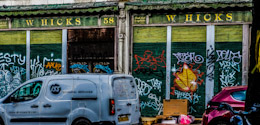
I PRACTISED DENTISTRY in North Kensington’s Golborne Road between late 1994 and about 2000. When I first began working there and for a year or so afterwards, the practice faced a double-fronted, old-fashioned fruit and vegetable shop. It was run by the friendly Hicks family.

Later, Hicks closed. Their premises were acquired by their neighbour the Portuguese Lisboa Delicatessen, which continues to flourish today. Lisbon use the former Hicks shop as a warehouse. Whenever I have been able to peer inside the former fruit and veg shop, I have noticed that it’s current users have displayed e little if anything to change its interior appearance.

Hicks is just one of several shops on Golborne Road that have retained aspects of their original facades despite changes of ownership and usage.