THIS IS A SUNDIAL at Oxburgh Hall in Norfolk . Only useful when the sun shines, which is not always the case in England. According to Wikipedia, that wonderful source of knowledge whose reliability is often good, the earliest known sundials date from 1500 BC. These were discovered by archaeologists working in Egypt. Oxburgh Hall was built largely in the late 15th century.
Tag Archives: norfolk
A circular staircase
Time pass and embroidery in a Tudor setting
THE ILL-FATED MARY Queen of Scots was kept prisoner by her relative Queen Elizabeth the First. Mary spent many years of her captivity under the supervision of the Earl of Shrewsbury, who was the fourth husband of Bess of Hardwick.

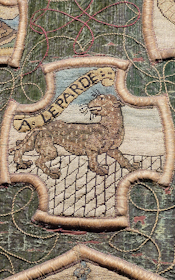
Between 1569 and 1584, Mary and Bess passed the time by working on embroideries, creating embroidered panels. Many of these bear depictions of animals copied from illustrations in a book by the Swiss naturalist Conrad Gessner and another by the Italian doctor and naturalist Pietro Andrea Mattioli. These books had been published a few year before 1569.
A woman who married a former owner of Oxburgh in Norfolk brought the embroidered panels to Oxburgh Hall, a moated Tudor edifice, in 1761 at the time of her marriage. It is not known how they had come into her possession. Now they are now on display to the public in Oxburgh Hall . These well-preserved beautiful embroideries are mounted on panels. They provide some evidence of how Mary spent some of her time in her years of captivity.
PS Mary was never held at Oxburgh.
A great gardener buried in Norfolk
KENWOOD HOUSE IN north London is a place I visit regularly, and have been doing so since the early 1960s. Its magnificent gardens were landscaped by Humphry Repton (1752-1818). Repton, who is considered successor to the great landscape designer Capability Brown was born in Suffolk. He died in Essex.

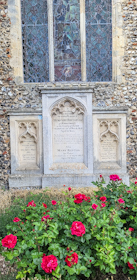
While visiting the small town of Aylsham in Norfolk, we came across the burial place of Humphry Repton. It is outside the southeast corner of the town’s large parish church.
Repton had many connections with Norfolk. His choice of Aylsham as his burial place was because his parents were buried in the church. We had stopped in Aylsham because it has an attractive market square. Until we visited the church we had no idea that the designer of the garden at Kenwood lies buried here.
Pigeon feed at a garden in Norfolk
PIGEON FEED IN A GARDEN IN NORFOLK
ALL OVER GUJARAT in western India, where many people are vegetarian, there are dovecotes in a wide range of designs and sizes. These shelters for the birds are to ensure their wellbeing.

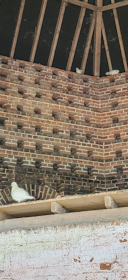
In the walled garden at Felbrigg Hall in Norfolk, there is a dovecote, which was constructed in about 1745. Within it there are 968 recessed compartments, each of which is large enough for two dove’s nests. Cosy as this might sound, the dovecote was built for a reason that would upset vegetarians.
In the eighteenth century, fresh meat was in very short supply during the winter months. The doves, who nested in the dovecote in large numbers provided an endless source of fresh meat for the residents and their guests at Felbrigg Hall. And the birds’ droppings provided a source of nitrogen rich manure.
The dovecote at Felbrigg Hall was beautifully restored in 1923, and is well-maintained by the National Trust, which owns the property. White doves still make use of the dovecote, but, as far as I know, do not end up on people’s dinner plates.
Norfolk is a great distance from South Africa
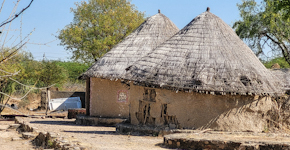
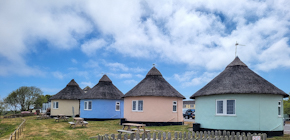
WHEN I WAS LESS than 8 years old, my uncle and aunt took their young daughter and me to the Norfolk coast. We travelled there by car in their Citroën. All that I can remember of this holiday was that we stayed in a circular cottage wirth a conical thatched roof. It was like what in South Africa is called a ‘rondavel’.

The rondavel we stayed in was not in South Africa but at Winterton-on-Sea on the coast of Norfolk. The resort, which still exists and was fully booked when we paid a brief visit in May 2025, is called Hermanus is the name of a popular seaside resort on the south coast of the Cape Province of South Africa.
Although the Hermanus resort at Winterton-on-Sea changed hands about 50 years ago, its original owners were South Africans. And because my aunt was born in South Africa, it was likely that this resort in Norfolk was chosen for a short break because of its South African owners and the rondavels.
Off with his head in the centre of Norwich
THE CHURCH OF St Peter Mancroft stands above the marketplace in the centre of Norwich. Built between 1430 and 1455, it is an elegant example of the Perpendicular style. It was constructed to show off the wealth of the 15th century citizens of Norwich. It is filled with interesting features. I will discuss two of them.
The church contains a Resurrection tapestry, which is in fine condition. It was woven by Flemish weavers in 1573, and might have once been used as an Easter Day covering for the front of the high altar. The tapestry depicts the Easter story in three episodes. The central panel shows Christ emerging from his tomb. In another panel of the tapestry, Jesus is depicted as a gardener, which is how he appeared to Mary after he had left his tomb (John, chapter 20).
The tapestry is kept at the west end of the church close to the font. The other feature that I will describe is in the chancel in the eastern half of the church. It is a memorial to the polymath and writer Sir Thomas Browne (1605-1682), who was a parishioner of St Peter Mancroft. He was buried in the church and lay undisturbed until 1840, when workmen accidentally broke open his coffin. Then, his skull was removed from the rest of his skeleton for phrenologists to study it. It was only in 1922 when the detached skull was reburied in St Peter Mancroft, but not in the same place as the rest of Browne’s body. The burial register for 1922 recorded the skull as being aged 317 years,
Browne, who was interested in everything in a scholarly way, would most likely have approved of having his skull investigated by phrenologists.
Although visiting the Anglican cathedral is one of the highlights of a trip to Norwich, St Peter Mancroft should not be missed.
Holy rollers in the centre of Norwich
DURING OUR LAST HOUR in central Norwich, we explored an alley, which we had not noticed before. It led downhill to a churchyard. This surrounded two sides of a mediaeval (late 15th century) church: St Peter Parmentergate. A ‘parmenter’ was a tailor or someone who made facings and trimmings for clothes. The doorway at the southeast corner of the church was open, and two men were standing outside it. We asked them whether we could look inside the church. They said that we could do so, but did not tell us what to expect inside.
The interior of the church maintains many of its original church-related features, but in all other respects it is quite unusual. The nave of the church has no pews, but instead there is a new wooden floor that curves up at both its east and west ends. The chancel is filled with skateboards, magazines about skateboarding, and a variety of toys. Where there were once kneelers in the choir stalls, there are now skateboards. Elsewhere in the church, there were skateboards galore and helmets for skateboarders. The church is a mecca for skateboarders.
Since 2021, the church has become a skateboarding rink and a shop for skateboards. The owner of this extraordinary establishment told us that he knows of only four churches that have become converted for the use of skateboarders, and one of them is currently out of use.
The church ceased being used as a place of worship in 1980. Since then, it has been maintained by the Norwich Historic Churches Trust (‘NHCT’). Before it became used as a skateboarding centre, it served various purposes. From 2007 until 2017, it housed a centre for martial arts. Next, it was let out to the NHCT. After that, it was used by a counselling specialist.
A few hours before seeing St Peters Parmentergate, we had visited St Gregory’s, a church converted to an antiques shop. That surprised us, but not as much as St Peters Parmentergate, which must be seen to be believed. It is good to see those churches in Norwich, which have ceased serving the purpose for which they were built, are being both looked after and being kept alive as part of the city’s life.
Antiques in the aisles within a church in Norwich
THE CITY OF NORWICH used to have about 100 churches. Today, there are about 73 churches in use as places of worship. That is approximately one church for every 1900 people. Many of Norwich’s churches are no longer used for worship, but being of historic and architectural value, they are kept standing. One of these redundant churches is St Gregory’s in the heart of the city. It was constructed in the 14th century, and has been designated a Grade 1 Listed Building. Closed in 1971, it is looked after by the Norwich Historic Churches Trust.
On entering St Gregory’s, you are confronted by models of deer with antlers standing in the porch alongside all manner of ‘junk’. Beyond this, there is a glass fronted refrigerator containing cans of carbonated drinks. On entering the body of the church, the visitor is confronted by all manner of used goods (including antiques) arranged picturesquely in the aisles, the chancel, and other parts of the church. When the initial surprising impact of the church is over, one notices features of the original church that still remain: the stone font; the royal coat of arms; stained glass windows; funerary sculptures; the organ; and a fine wall painting of St George and the dragon. Towering above the sea of goods, there is beautiful gothic vaulting.
Since 2011, the church has been used as an antiques centre (actually, it is more like an indoor flea market). The variety of goods on sale is huge. Beneath the organ, where the choir stalls must have been, there is a second-hand book seller. Despite the somewhat Bohemian look about this stall, the books are not moderately priced.
Whether or not one has any interest in purchasing antiques, St Gregory’s is well worth a visit because what has been created within it is much better than many immersive installations created by professional artists.
Country and eastern in the heart of Norwich
DURING THE 1970s, Philip and Jeannie Millward began collecting folk art and other artefacts in the Swat Valley of Pakistan. Over the years, these intrepid travellers have been collecting folkloric and other objects from all over south Asia: from Pakistan, India, Indonesia, and so on. At first, they stored their growing collection in a warehouse in Norwich. The Millwards’ collection grew and grew and included things bought from auctions and dealers in the UK. Today, a part of what they have amassed is beautifully displayed in a building with an interesting history.
The Millwards’ South Asia Collection is housed in a huge building, which opened in 1876. It was designed to be an indoor roller-skating rink. However, by 1877, this enterprise failed, and the building became used for Vaudeville theatre. Five years later, it became a Salvation Army ‘citadel’, and then in 1898, it became a builders’ merchant’s storehouse. In 1993, the edifice was purchased by the Millwards, who converted it to become a museum to display items from their collection.
The museum’s exhibits are beautifully laid out, and clearly labelled. Many of the objects on display are very fine examples of their type. I have seen only few museums in India that come up to the high standard of this museum in Norwich. Many of the fine pieces that the Millwards have brought from the Indian subcontinent and elsewhere in the past might not now be allowed to leave their countries of origin. But luckily, they have come to Norwich where they are being expertly cared for. The museum is not simply a display place. It works with academic institutions such as CEPT University in Ahmedabad (Gujarat) to carry out research projects that help put objects in the collection into their true context.
Although the museum is the main attraction of the place, the former roller-skating rink also houses a shop where finely crafted, high quality folkloric goods, sourced in India and other places, can be bought. What is on sale has been purchased directly from the craftspeople who made them, rather than from middlemen. And the prices attached to them are very reasonable – not much greater than one would expect to pay in good handicraft shops in India.
Norwich is filled with attractions for the visitor. Less well-known than the castle, the cathedral, and the Sainsbury Centre for Visual Arts, the Millward’s South Asia Collection in Bethel Street should become one of the first places a visitor heads for.