
Words of advice to an early shopper in India

TODAY, MY SHOULDER bag broke suddenly whilst on my way to Calcutta’s New Market – one of my favourite shopping districts. Humayun Place, which leads from Chowringhee to one side of New Market, is lined with pavement vendors. We stopped at one selling bags, and asked to see one that I hoped might be a suitable replacement for the bag whose strap had just broken.

Inside New Market in Calcutta

The bag was ‘ok’ but not ideal. We asked the price, and were quoted 950 rupees (about £9.50). We told the seller that seemed too much for such a bag. We told him that we had paid about 500 for the old bag less than a year ago. Hearing that, he said we could have it for 500, and as he spoke those words, he put it into a plastic carrier bag.

I was still not sure that this was the ideal replacement, and we began to walk away. The seller then offered us the bag for 400, saying that if we bought it would be his ‘bohni’ for the day. Hearing that and feeling that the bag was worth 400, we purchased it.

In India (and Pakistan), the custom of bohni is commonly observed. The bohni is the vendor’s first sale of the day (or at the start of some other defined period of time). Many shopkeepers believe that the bohni establishes the success of his or her business during the rest of the day.

So, one of the risks faced by those who shop soon after the stores or stalls open is they will be made to feel that they ought to buy something in order not to jeopardise the vendor’s success during the rest of the day. For, being the first to enter a shop or halt at a stall without purchasing a bohni is a bad omen for sellers.

Although I am sure most vendors who tell you that by making a purchase you are doing the bohni for the day are bona fide, there must be a few who try to achieve a sale by saying it is the bohni when it is not.
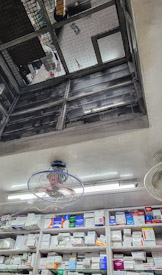
Perfect aim in a pharmacy shop in Calcutta

I HAVE BEEN TO many shoe shops in India. Some of these have the store room above the showroom. The ceiling of such showrooms has a hatch through which pairs of shoes can be thrown to the salesmen waiting below. The salesman asks for a particular shoe in a specific size, and someone in the store room drops the pair through the hatch. The shoes are caught by the salesman. Until yesterday, the 4th of January 2024, I had never seen such a system in shops other than those selling footwear.

The hatch in the ceiling of the pharmacy

Yesterday, we entered a chemist shop (a pharmacy) close to Calcutta’s New Market (SS Hogg Market). The walls were lined with shelves from floor to ceiling. These shelves were filled with boxes of medicines on what seemed like considerable disarray, although I feel sure that there must have been some organisation of the products. There were 5 or 6 men serving customers from behind the shop’s counters.

Like the shoe shops described above, the chemist shop had a hatch in the ceiling. The shop’s stock room was on the floor above the sale room. At frequent intervals, the salesmen yelled names of medicines, ointments, and so on. Somebody in the room above hurled the desired product through the small ceiling hatch. The product was aimed accurately at the salesman who asked for it. Different products kept dropping from the ceiling and being caught by the salesman who had shouted up for it. Whoever it was that was dropping the medications must have recognised the voice of the person who requested it. In addition, the person dropping the products must have had an extremely good aim. He (or she) would make a good cricket player. And the salesmen below never dropped a catch.

Having seen this amazing pharmacy, I have now poked my head into a few others, but none operated this remarkable aerial delivery system. For me, seeing things like that pharmacy near New Market is what makes India seem so wonderful.