Do you have middle name(s) and do they embarrass you?

FREQUENTLY PEOPLE HAVE more than one name other than their family name (surname). For example, I am Adam Robert Yamey. My father, an economist, had suggested that I should be called Adam Smith Yamey to commemorate the famous early economist Adam Smith. I would not have minded that, but my mother was not happy with the idea, so I learned much later. More famous examples include the painter John Mallord William Turner and the politicians Winston Leonard Spencer Churchill and Mohandas Karamchand Gandhi. My PhD supervisor at University College London had even more ‘middle’ names. He was Robert Douglas Mignon Innes Kerr Harkness. Often, the middle names are those in memory of ancestors. Such must have the case for Robert Harkness, as well as for Churchill and Gandhi.

Photo source: wikipedia

My mother hated her middle name. It was Bertha. I often wondered why she had been given that name. When I began researching the history of my mother’s family, I discovered why she might have had that name on her birth certificate. Her mother had a cousin called Bertha. The reason my mother disliked this name was that during WW1, the Imperial German Army had a large canon, the 42 centimetre kurze Marinekanone 14 L/12, which was manufactured by the Krupp company in Essen (Germany). What upset my mother was that the artillery piece was commonly known by its nickname ‘Big Bertha’. My mother was born only two years after WW1 ended, and the Big Bertha must have been reasonably well-known when she started going to school. You can imagine how much teasing she got when the other pupils discovered her middle name.

Do you have a middle name (or several middle names) and does it (or they) embarrass you?

Blades and flames and other hazards in the kitchen

WHILE PREPARING A SAUCE for pasta today, my mind shot back to my mother in the kitchen during my childhood. Many people regarded her as being a competent cook. She was an enthusiastic follower of the recipes in cookbooks by Elizabeth David.  She bought only the best cooking utensils, and sourced many ingredients in the Mediterranean food stores that used to exist in Soho – a few remain, but many have gone. As a child, I was allowed in the kitchen to watch when my mother was cooking. The more I saw, the greater my desire to try to cook. However, this wish was not to be fulfilled while my mother was alive.

My birth and the first few months of my life were difficult as far as health was concerned. Consequently, my mother was highly protective of me, and then later also of my sibling. My mother saw danger everywhere, and not least in the kitchen. There were sharp knives, razor like tin can lids, and the risk of getting burnt either by the oven or the hot things prepared on it. We had electric hob rings because my mother was anxious about gas explosions and open flames. I was allowed to watch her cooking, but not to touch anything she was using. Curiously, even though knives were involved, I was often asked to wash the dishes, cutlery, and cooking utensils.

Sadly, my mother died at a young age. I was 28 when she went, and still residing in the family home along with my father, who had no interest in cooking. He enjoyed good food, but would have no part in preparing it. With my mother no longer around and a well-equipped kitchen, I began to experiment with cooking, and enjoyed the activity.

Over the years, I have done much cooking, and still enjoy doing it. I am not sure what made me think of my mother today as I prepared the pasta sauce, but it might have been the pan in which I was making it. For, that pan was one that my mother used often. She must have bought it back in the 1960s, and because she purchased only the best, it is still perfectly usable much more than 50 years later.

My wife is a good cook, but I do most of the day-to-day cooking. When she told a friend of ours that I do most of the cooking, the friend asked my wife:

“Don’t you feel diminished as a woman if Adam does most of the cooking?”

My wife, who is quite happy with the arrangement, replied with another question:

“Do I look like an idiot?”

Sometime later when our daughter was a toddler, she and my wife visited some friends. After a few minutes, our little one, used to seeing me cooking, came running out of the kitchen with wide open eyes, and said to my wife:

“Do you know, Mama, but the Mummy is doing the cooking in this house.”

My wife answered:

“Well, I never…”

An email from the USA about a sculpture made of metal

A COUPLE OF DAYS ago (in March 2024), I received an email from the widow of an American (USA) anthropologist with whom my father collaborated many years ago (in connection with the economic aspects of peasant society). She wrote that she had read one of my blog articles about my mother’s career as a sculptor, and wanted to let me know that she and her husband had bought one of them while my mother was alive (she died in 1980).

I asked the lady whether she could send me pictures of the piece they had purchased. She did. The piece is abstract, and made of pieces of steel welded together. At first sight, you might mistake it for a work by Anthony Caro (1924-2013). This similarity might well have arisen because my mother and Caro worked together in the sculpture studios of London’s St Martin’s School of Art.

I was pleased to receive the two photographs of the work because I remember that steel and metal working were my mother’s favourite materials for creating sculptures. After she left St Martin’s, she had a studio in a garage in Golders Green, but did not have access to welding equipment and other tools needed for making steel sculptures. Instead, she created large abstract works from heavy chunks of timber, but this did not satisfy her nearly as much as working with metal. Gradually, she lost enthusiasm for sculpting, which I felt was a great shame.

I am very grateful having received the photographs, and seeing them prompted me to write this short piece.

An interesting intersection

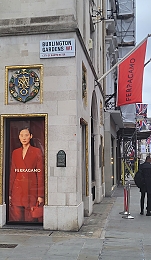
WHERE BURLINGTON GARDENS meets the south end of New Bond Street and the north end of Old Bond Street, there are two things that reminded me of my late mother.

One of them is a shop in a colourfully decorated building. This edifice used to be the home of Atkinson’s – a firm that sold perfumes and beauty products. Founded in 1799, it moved to the building on the corner of Burlington and Old Bond Streets in 1832. The decorative building is surmounted by a carillon of 23 bells, which is played by hand occasionally – to celebrate both public and private special occasions. Currently, the ground-floor is occupied by a branch of Ferragamo’s. And this firm has a connection with memories of my mother.

Salvatore Ferragamo (1898-1960), born in Italy, was a designer of luxury shoes. His clients included the Maharani of Cooch-Behar, Eva Peron, and Marilyn Monroe. He died in Florence (Firenze), where he had a shop on the Via dei Tornabuoni. This shop was close to Via del Giglio, where we as a family used to spend a fortnight in the city every year until I was about 15.

One of my clearest memories of our sojourns in Florence was not the Uffizi or the famous Duomo or the Medici Chapels, or even Michelangelo’s statue of David, but Ferragamo in Via dei Tornabuoni. You might wonder why. It was not that I have a shoe fetish or any great interest in footwear. It was because of my mother. Hardly a day passed without us having to enter Ferragamo’s to watch my mother trying on several pairs of shoes. For a youngster like me this was not an interesting way to spend my precious school holidays. And what is more, I cannot recall my mother ever buying a pair of shoes in that shop.

Facing Ferragamo’s on the corner of New Bond Street and Burlington Gardens, there is a small paved open space. In the middle of it, there is a bronze sculpture of a horse and rider. This was sculpted by Elisabeth Frink (1930-1993). My mother was also a sculptor and met Frink (or ‘Liz Frink’, as we knew her) at St Martins School of Art (in Tottenham Court Road), where they both worked in the Sculpture Department. They became close friends. I used to meet Liz Frink when she was invited to our house for dinner occasionally.

The Frink sculpture has been on Bond Street since 2018. Before that, it was located at the corner of Dover Street and Piccadilly, where it was placed in about 1975. As for the branch of Ferragamo’s that faces it across Burlington Gardens, I am not sure how long it has occupied its present site. However, it was only today that it occurred to me that the intersection of the two Bond Streets with Burlington Gardens has a connection with recollections of my mother.

Art and memory in East Anglia

MY LATE MOTHER worked in the Sculpture Department of London’s St Martins School of Art in the days when it was located on Charing Cross Road, near Foyles bookshop. Amongst her colleagues at St Martins were Sir Antony Caro (1924-2013) and one of his pupils, Phillip King (b 1934). Both of these artists helped my mother to learn sculptural metal welding techniques in the early 1960s.

THIS SCULPTURE, which is on display in a glade within the gardens of Houghton Hall in Norfolk, reminds me of the kind of work Caro produced, but this was by his ‘disciple’ Phillip King. I like it, but cannot explain why, but it might not be seen as beautiful by everyone. My mother was mainly involved in abstract composition. This might have helped me me to become appreciative of this kind of art. .