From brewery to library in a small town in Cornwall

THE TOWN OF Redruth in Cornwall was once the centre of a flourishing mining industry. Now, although it contains a few attractive buildings that remind the visitor of its heyday, it has a slightly forlorn feeling.  Amongst the many places in Cornwall that attract the visitors, Redruth is not highly rated. However, it has an attraction that is well worth visiting. Located at the western edge of the old town, it is called ‘Kresen Kernow’.

Kresen Kernow is the Cornish for ‘Cornwall Centre’. Recently opened (in 2019), it houses the historical archives of Cornwall, a library, and a café. What makes it so very special is its architecture and the ‘recycling’ of a former industrial building. This used to be the on the site of the Devenish Brewery, which had been the Cornish Brewery Company Ltd until 1934. In 1991, the brewery was sold to new operators and renamed the ‘Redruth Brewery’. This closed in 2004, and the edifice fell into decay, and was damaged by fire both in 2011 and 2013.

During the early 2000s, Cornwall Council began to consider having a new archive centre and local studies library. After much deliberation, the former Redruth Brewery was chosen as the site for a new home for Cornwall’s archives. In 2015, the derelict brewhouse was purchased by the council, and after the site was cleared and decontaminated, construction commenced. The building was chosen because despite the damage it had suffered, its shell was recognised as being of great beauty.  Making use of much of what was left of the original brewhouse, the architects of the Purcell Practice designed a new building. Pictures of the project before and after it was completed can be seen on their website (www.purcelluk.com/projects/kresen-kernow/).

Completed in 2019, the result is a beautiful blend of modern design and the remains of the original structure. With clean lines and plenty of natural illumination, the building consists of a harmonious combination of interconnecting spaces. On the ground floor, there is a spacious reception area in which there are exhibition display cases and an area for temporary exhibitions. There is also a café. Apart from public spaces, there are several for use of the staff of the archives. The first floor has a library and rooms where people can carry out research on archival material.

Behind the refurbished building, there is a courtyard in which there are sculptures of ‘ordinary’ people. They resemble a group of people who have suddenly frozen during conversations. They were created in 2015 by two artists from Glasgow: Craig Little and Blake Whitehead.

I hope that the presence of Kresen Kernow and the gradual recognition of the beautiful 19th century and earlier buildings in the town will help elevate Redruth to the ranks of places worth visiting in Cornwall.

Gas holders at London’s Kings Cross now reused for householders

The remains of former gas storage units (gasometers) have been spruced up and repurposed as blocks of flats (near King’s Cross Station). Where the telescopic, cylindrical gas holders used to be, there are now cylindrical apartment blocks.

A friend pointed out:

” I marvel at the ingenuity and question how you’d furnish such impractical circular geometry that would probably require bespoke furniture. But frankly if you can afford to buy/rent one, you should be able to foot that expense!”

She has made some good points about these buildings.

Drama by the river: the Bridge Theatre

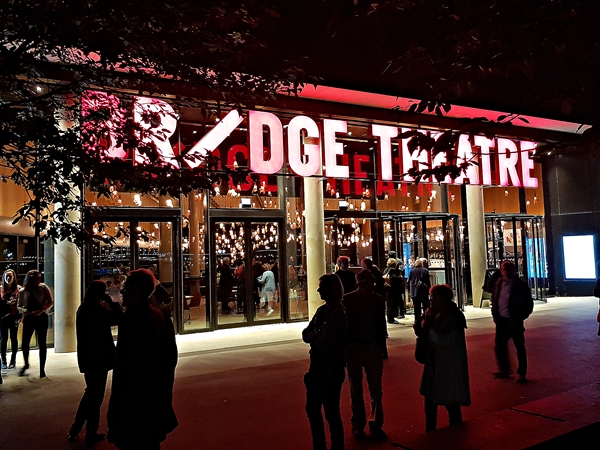
On Saturday the 29th September 2018, we had a wonderful evening at London’s recently opened Bridge Theatre. It is located on the south bank of the River Thames, a stone’s throw from the world famous ‘icon’ of London, Tower Bridge. From the glass front of the theatre’s foyer, there are superb views of: the new high-rise buildings in the City (including the ‘Gherkin’); the White Tower and the walls of the Tower of London; and Tower Bridge, which is beautifully illuminated at night.

BR 1

The Bridge Theatre opened for its first show in October 2017. The theatre is the brainchild of Nick Starr, of the former National Theatre, and the renowned theatre director Nicholas Hytner. Both of these two Nicks have been long involved with London’s National Theatre. Their creation, the Bridge, is an improved version of the facilities offered by the now ageing National Theatre on the Southbank. Excellent as the National Theatre is, the Bridge seems to have been designed to avoid some of the defects of the former. The newer theatre, which can seat 900 audience members, was designed by S Tompkins and R Watts of Haworth Tompkins Architects.

BR 0

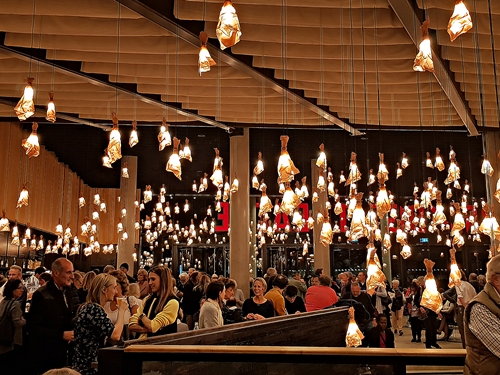
Doorways in the wide glass façade give access to a vast foyer, well-illuminated by a myriad of lamps with curious shades that look like large translucent handkerchiefs. Ample tables and chairs are available for people to sit in the foyer, enjoying excellent food and drinks from the counters lining one side of the space.

BR 1a

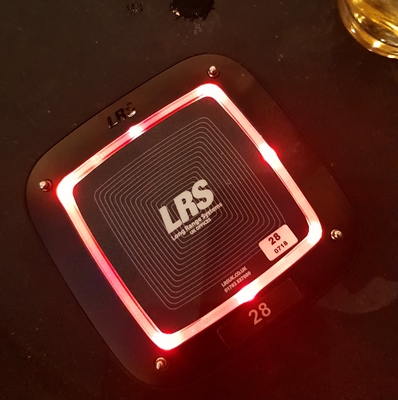
When you order food, you are handed a small flat, square receiver that looks like a drinks mat. When your food is ready, lights on the receiver flash alarmingly. The flashing object must be taken to a counter where your freshly prepared food is waiting for you. Despite the size of the foyer and its large capacity, it never felt crowded or noisy. It is a well-designed space.

BR 3

The cloakroom and toilet facilities are easily accessible, not hidden in odd places as they are in the National Theatre.

BR 4

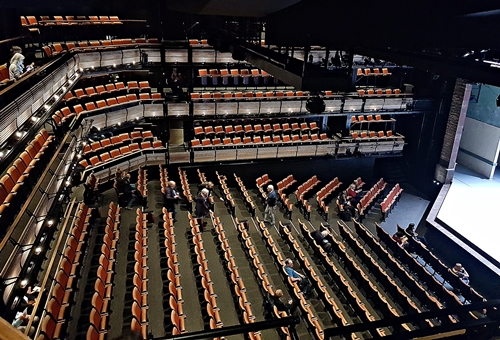
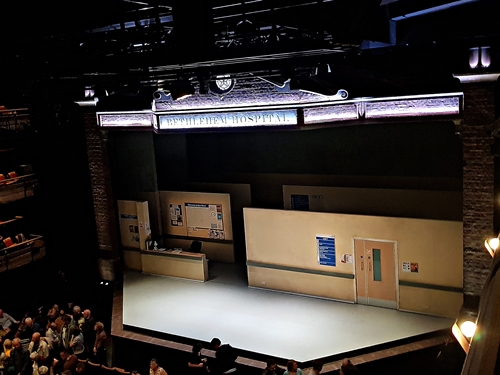
The auditorium is large, but not too large to be without intimacy. No seat is excessively far from the very wide stage. Sightlines are either excellent or more than satisfactory. We had ‘restricted view’ seats, which we bought at the last moment. They were as good as many ‘full view’ seats in older theatres. The acoustics are excellent. We were seated quite far from the stage, but had no difficulty hearing every word. The play we saw, “Allelujah” by Alan Bennett, was well-staged, well-acted, and well-written. In short, it was highly enjoyable. Set in an ageing National Health Service (‘NHS’) hospital facing imminent closure, most of the actors play either the roles of geriatric patients or those of hospital staff and management. The plot is about the plight of the aged and the plight of the ageing NHS system in today’s profit-oriented, economically declining Britain.

BR 5

Our visit to the Bridge Theatre was enjoyable and uplifting. I cannot wait to see another performance there.

BR 2