
A poorly placed direction signpost

I FIRST BECAME AWARE of fingerposts when I was in Ootacamund (‘Ooty’) in South India in 1994. One of the places in the spread out town is called Fingerpost because there is a fingerpost in the centre of the so named district.
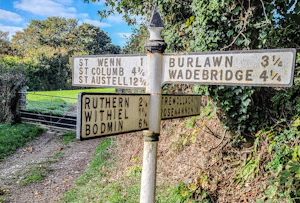

Where we are staying in Cornwall this October (2022) there is a finger post at a T-junction where one road meets another slightly larger one. The fingerpost at this junction ought to have three arms, one pointing along the road that ends here, and two for the larger road. However, the sign has four arms. One of them, pointing to Trewollack and Rosenannon appears to point where there is no road but the entrance to a farmer’s field without even a footpath crossing it.


This sign puzzled us for several days. Then, we spotted a small side road located about 100 yards downhill from the sign and the T-junction. This road leads to Trewollack and Rosenannon, but has no sign indicating this near where the lane begins. The four armed fingerpost is supposed to direct travellers along this road but is nowhere near enough to it to be helpful.

An eminent tourist

MANY YEARS AGO, a now deceased Greek friend, ‘S’, related the following story.

S was born in a small port in the Peloponnese long before WW2. It was a place that tourists disembarked from their boats to visit the Ancient Greek archaeological site of Olympia. S left school at an early age (by the age of about 12 to earn money by working on the docks of the small town. When cruise ships called in at the port, he offered services as a tourist guide to earn a few extra Drachmas.

Most of the tourists swallowed the tales that S told them as they wandered around Olympia. However, one day he met his match. An English gentleman accepted his offer to act as his guide. Soon after they reached the site and S had begun giving his customer his ‘spiel’, the Englishman stopped him, saying

“Listen, young man. It is clear that you know nothing about this site and its history. Let me tell you the correct story.”

S listened to his well-informed customer with interest and amazement. It turned out that the knowledgeable gentleman was no other than the future Prime Minister of the UK, Winston Churchill.

Many years later during one of my several visits to Olympia, I was standing in the lobby of a hotel near the site on a warm afternoon. The place was filled with members of an American tourist group. One lady asked her friend if she was going to take a tour around the famous site. The friend replied:

“Aw, no. It’s too damned hot to see more of those old rocks.”