ONE OF INDIA’S greatest modern painters was Maqbool Fida Husain (1915-2011), who was born in what is now Maharahtra. He studied art at the Sir JJ School of Art in Bombay.
While visiting Bombay’s branch of the National Gallery of Modern Art (NGMA) on 2 January 2026, we saw two of Husain’s drawings and two of his paintings. They had been hinges next to a portrait of the artist by Anil Naik (born 1959), a graduate of Sir JJ School School of Art.
Husain’s painting at LIC
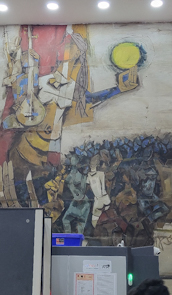
From the NGMA, we made our way to the huge Bombay headquarters of the LIC insurance company. My wife had read that this place is home to a painting by MF Husain. Nobody in the building knew about it despite the fact that the painting occupies most of one wall of the foyer of one wing of the building.
Husain’s painting at LIC is in need of some conservation work. The lower part of it is hidden from view because an x-ray machine used to check bags etc has been placed against it. It was painted in 1963 and depicts Indian life and culture.
It is to be hoped that thus fine mural will neither be allowe to fade away nor destroyed.
THERE IS A SUPERB collection of modern art from south Asia, which is being exhibited at Phillips auction house in London’s Berkely Square until 31 July 2025. Amongst the artworks on display are several paintings by the late Maqbool Fida Husain. As you can read in the following excerpt from my book about the first journey I made to Gujarat in western India in 2018, the Husain was keen on the area. We were in Ahmedabad when we stumbled across a restaurant called Lucky.
Now read on …
“We ate lunch at Lucky, an unusual restaurant near our hotel. This vegetarian eatery is divided into two sections: one serving sandwiches and Punjabi-style dishes, the other serving mainly south Indian dishes. In one of them, we noticed a framed painting by the famous Indian painter MF Husain (1915-2011), who was born in a Bohri Muslim family in Maharastra. He often travelled to Gujarat to paint. The picture in Lucky, and the place is truly lucky to have it, is a gift which the artist presented in 2004. This was the second original work by Hussain that we had seen in a restaurant. Earlier, we had seen a sketch by him in Bombay’s Noor Mohammadi Hotel, which serves Bohri dishes. When Hussain’s art works began to offend the extremist nationalist sentiments of some Hindus in India and they threatened his life, he felt forced to exile himself. He lived the last few years of his life in the Gulf States and the UK.
The curious thing about Lucky is not the MF Hussain painting, but its location in a disused Muslim cemetery. Its chairs and tables are placed between unmarked Muslim gravestones, painted green and surrounded by low metal railings painted white. The manager thought that these graves were over 300 years old. In addition to the graves, the thick trunk of a tree grows through the middle of the restaurant. The food and service are both good in this busy but peculiar place.”
ON TUESDAY THE 24th of January 2023, we arrived in the city of Ahmedabad in the Indian State of Gujarat. That evening, we visited a friend who had been the curator of a building in Ahmedabad, which had been designed by the architect Le Corbusier. Our friend was pleased to see us but was upset because a close friend had died that morning at the age of 95. That friend had been a disciple collaborator of Le Corbusier.
Our friend’s friend was Balkrishna Vithaldas Doshi, who was born in Pune in 1927. He worked with Le Corbusier in Paris between 1951 and 1954. He returned to Ahmedabad to supervise Le Corbusier’s architectural projects in that city. In 1955, Doshi established his own studio in Ahmedabad, and was working there until the day before he died.
Clearly influenced by Le Corbusier and Louis Kahn, with whom he designed the campus of the Indian Institute of Management (Ahmedabad), his (some might say Brutalist) architecture embodies the ideals of Le Corbusier in a much more user-friendly form than that which his mentor produced.
Amdavad ni Gufa
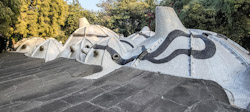
Next door to CEPT University in Ahmedabad much of which was designed by Doshi, there stands Doshi’s most unusual edifice, the Amdavad ni Gufa (the Ahmedabad Cave), which was completed by 1990. Its is difficult to describe this structure, but I will try. Covered in a mosaic of black and white ceramic tiling, it resembles an enormous caterpillar partially submerged in the ground. It is a giant caterpillar punctuated by bulbosities of various sizes, some of which have hemispherical windows at the end of short stalks that project from the dome-like bulbosities.
Steps descend to the two entrances of the Gufa. Originally designed as an art gallery, its irregular shape and wavy floor deemed it unsuitable for its intended purpose. Within the Gufa, the ceiling is supported by irregularly shaped columns that resemble stalactites with have joined with stalagmites beneath them. The strange space, which was too odd to be used as a gallery, is now decorated with sculptures and murals painted by the celebrated Indian artist MF Husain (1915-2011).
The Gufa is one of the ‘must-see’ sights of Ahmedabad. With the recent demise of Doshi and the earlier death of Husain, the Gufa makes a fitting memorial to these two great creators.


 yamey
yamey 