FALMOUTH IS A small port on the south coast Cornwall, It was founded near their ‘palace’, Arwenack, by the Killigrew family in 1613.
In 1385, the Killigrew family acquired a property, a manor house called Arwenack, now in Falmouth. Although fragments of the 14th century house remain, the shape of Arwenack that can be seen today was established in the mid-16th century by John Killigrew. After that, the family continued to modify this grand residence. During the Civil War (1642-1651), Arwenack was badly damaged. Nothing much was done to the building until the 18th century when extra wings were constructed. Thereafter, the building fell into decline until 1978 when a firm from Redruth repaired and modernised it before converting it into several dwellings, which are still in use today. Arwenack faces a 44-foot-high granite obelisk/pyramid that was erected in 1738 by Martin Lister Killigrew to celebrate his illustrious family.
Now, Arwenack faces a large car park, and behind that a complex of modern buildings that contains shope, restaurants, and the National Maritime Museum (Cornwall)
WE FIRST VISITED the grounds of Boston Manor in the London Borough of Hounslow in April 2021.
Plenty of covid19 restrictions were then in force and the old Jacobean manor house was inaccessible both because of the pandemic and also because the building was undergoing extensive restoration works. We were able to enjoy the lovely grounds that surround the manor house. In July 2022, long before the manor house’s restoration was completed, I published my book about west London, “BEYOND MARYLEBONE AND MAYFAIR: EXPLORING WEST LONDON”, and included a chapter about Boston Manor. Here is a part of this chapter:
“… the name Boston is derived from an older name ‘Bordeston’, which comes from the word ‘borde’, meaning ‘boundary’. Another etymology of the name, which is unrelated to that of the Boston in Lincolnshire, is that it derives from the name of a Saxon farmer named ‘Bord’. Whatever the origin of the name, Boston Manor, the house, and its lovely gardens (now known as Boston Manor Park), which reach the bank of the River Brent, stands on the border between Hanwell and Brentford.
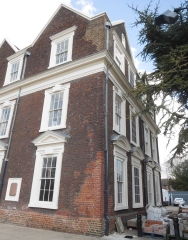
Until the Priory of St Helens in Bishopsgate (in the City of London) was suppressed in 1538, the Manor of Bordeston was owned by it. King Edward VI granted it to Edward, Duke of Somerset (1500-1552), Lord Protector of England during the earlier part of his reign, and later, it reverted to the Crown. In 1552, Queen Elizabeth I gave the manor to the Earl of Leicester, who immediately sold it to the merchant and financier Sir Thomas Gresham (c1519-1579). After several changes of ownership, the property was sold in 1670 to the City merchant James Clitherow (1618-1682). The new owner demolished much of the existing manor house. He modified and enlarged Boston House, which was originally built in the Jacobean style by Lady Mary Reade in 1622, widow of Gresham’s stepson, Sir William Reade. This house with three gables still stands (but was closed when I visited it during April 2021 because it was undergoing extensive repairs). It looks out onto grounds planted with fine trees, many of them Cedars of Lebanon. The grounds, which include a small lake, slope down gently towards the River Brent.”
Today, the 26th of October 2023, I revisited Boston Manor. Fortunately, the Jacobean manor house’s restoration had been completed. After enjoying coffee in its fine café and walking around the grounds ( part of which is beneath an elevated section of the M4 motorway), we were able to enter the manor house. Visitors are allowed to wander freely through rooms on the ground and first floors. Each room is identified by informative labels. In one of the rooms, there are portraits of several members of the Clitherow family. One was painted by Godfrey Kneller (1646-1723), and another by George Romney (died 1802), who lived in Hampstead for a few years at the end of the 18th century. Several of the rooms have beautiful three-dimensional plastered ceilings. These have been restored well to look like they must have done when they were first installed. Reproductions of the original wallpapers line many of the walls and the grand staircase. The reproductions were based on the few fragments of the original wall papering that were discovered. A couple of wall panels have large expanses of original wallpaper that have survived the passage of time. Although the manor house was stripped of the Clitherow’s furniture long ago, Hounslow Borough Council have restored the rooms magnificently.
Boston Manor house is not nearly as architecturally exciting as its neighbours Osterley House and Chiswick House, but it is older than them, and in good condition. I feel it ought to become as well known as the more frequently visited stately homes nearby.
My book about west London is available as a paperback and a Kindle from Amazon websites such as follows:
LYTES CARY is a mediaeval manor in the English county of Somerset. This beautiful building, maintained by the National Trust, was owned by the Lyte family since the 15th century, if not earlier. The Great Hall of the manor house was built in the 1460s. The manor remained in the Lyte family until 1755, when the indebted Thomas Lyte IV surrendered all rights to their family home. Between then and 1907, the property fell into decay.
In 1907, the dilapidated Lytes Cary was purchased by Sir Walter Jenner (1860-1948) and his wife Flora, who died in 1920. They lived with their daughter Esme (1898-1932), a keen horse rider, who died of pneumonia after having been drenched in a rainstorm. Sir Walter was the son of Queen Victoria’s physician, Sir William Jenner (1815-1898), who studied at my alma mater University College in London. At his death, he left a great fortune.
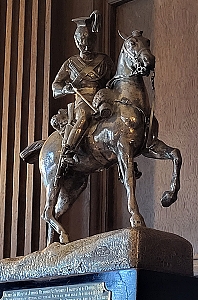
Polo trophy
Sir Walter had the house repaired and filled it with furniture and objets d’art appropriate to the age of the house. The result was a comfortable home with fascinating contents. One of the many objects that caught my eye is a trophy depicting a military man on a horse. This item bears an engraved plate:
“Major Sir Walter Jenner Bt, from Lt Colonel Forrester Colvin 1915 to commemorate joining the Ninth Lancers together December 1880. The many happy years spent therein and the following polo tournaments won by the regiment…”
Below this, there is a long list of tournaments played in India, England, Wales, and Ireland. In India, he was in the winning teams in Umballa (Ambala) in 1883 and 1884, and in Meerut in 1885. The latest tournament listed on the trophy was in Dublin in 1893.
Educated at Charterhouse School, Sir Walter became a magistrate in Somerset after retiring from the Ninth Lancers. He served in his regiment during WW1 and was awarded the DSO for his services in that conflict.
I enjoy visiting old houses like Lytes Cary and always find it interesting when I discover links between them and the history of India. Sir Walter’s polo trophy is not one of the most attractive pieces on display at Lytes Cary, but for me it was most fascinating.
NOT FAR FROM the busy A13 road that links London with Tilbury and places further east, and surrounded by a sea of unremarkable dwelling houses in the London Borough of Barking & Dagenham, stands an unexpected historical Tudor architectural treasure: Eastbury Manor.
Part of a wall painting in Eastbury Manor
This beautiful Tudor mansion, built between 1560 and 1573 for Clement Sisley (or Sysley) and his family, stands on land that had been owned by Barking Abbey until its dissolution in 1539. He was a wealthy businessman connected with high-status families. Married thrice, each of his wives’ dowries added to his prosperity. The manor house remained connected with his extended family until it was sold in 1628. After that, the house and its associated extensive land had a series of owners and tenants until sometime in the 19th century when the building began to deteriorate. The various inhabitants made use of the place’s formerly large grounds for agricultural purposes: principally, grazing. The National Trust (‘NT’) bought the house in 1918, and this purchase is responsible for its survival. Owned by the NT, it was Barking’s local museum between 1935 and 1941. Now, still the property of the NT, it is maintained by the London Borough of Barking and Dagenham.
“A little beyond the town, on the road to Dagenham, stood a great house, ancient, and now almost fallen down, where tradition says the Gunpowder Treason Plot was first contriv’d …”
I checked my copy of Defoe’s book and discovered that the editor of my edition (Pat Rogers) had doubts about this connection with Guy Fawkes et al. Rogers noted that the conspiracy was largely planned in Northamptonshire.
The house, which stands on land rich in clay, is built of bricks made locally, on-site. It is built to an H-shaped plan: two parallel wings are linked by a central portion perpendicular to near their northern ends. The central part and the two wings enclose a charmingly intimate courtyard, whose fourth (southern) side is bounded by a wall connecting the two wings. Although a modern staircase and lift have been added, the house’s original timber spiral staircases were housed in octagonal towers that encroach onto the northwest and northeast corners of the courtyard: they are classed as ‘external staircases’.
The house and its garden have many fascinating features typical of Tudor architecture. For example, in the Great Hall on the ground floor, there is a huge fireplace. It is large enough for several adults to stand within it. Our informative guide directed us to look up into the large chimney. There, we could see platforms that were built to allow workmen to climb into the chimney to clean it in the era long before there were chimneysweeps with special equipment. The Tudor brick wall surrounding one of the gardens has 17 small niches. These were designed as bee boles, in which skeps, baskets where bees lived, were placed. Interesting as these and many other things are, the most amazing feature is to be seen in the so-called Painted Chamber on the first floor, which we reached using the original timber staircase.
Discovered beneath layers of paint after a fire during the 19th century, are the sizeable fragments of two exceptional wall paintings. It is believed that these were commissioned by the London Alderman Sir John Moore who died in 1603. His coat of arms is depicted on one of the pictures. Moore, who took an interest in international trade and the then proposed East India Company, used the house as his country home.
The paintings depict trompe-l’oeil walls with columns, classical figures, and archways. The latter frame depictions of countryside and nautical scenes. Apart from their great age and skilful execution, these frescos are remarkable for their use of perspective. The lady who was showing us around the Manor mentioned that these wall paintings are some of the earliest surviving examples of pictures in England displaying the kind of perspective that is now commonly used in Western European art. So-called ‘true geometric perspective’ was developed by Italian painters during the 14th and 15th centuries. Its use spread to other parts of Europe and would have been known in England by the time of Moore’s occupancy of Eastbury Manor. The surviving wall paintings were executed before his death in 1603, but by whom we might never know. It is quite possible that the artist had either been abroad or had come from overseas. Whoever painted these lovely images had a good grasp of what was then regarded as the latest way of portraying the illusion of depth and distance. Whether there are earlier examples of surviving paintings created in England (using tru perspective) than those at Eastbury Manor, I do not know. So, until I am wiser on the subject, I will accept what we were told. I have seen older surviving wall paintings in English churches, but none of them display even the slightest hint of true geometric perspective.
All in all, it is well worth venturing into the rather dull suburbs of Dagenham and Barking to visit Eastbury Manor. It might not be as glorious as other surviving Tudor edifices, such as Hatfield House, but it is no less a wonderful reminder of an era long-since passed.
THE NAME BOSTON is often associated with a revolutionary tea party in a former British possession. Some might also associate it with a town in Lincolnshire. And Londoners might connect it with a tube station on the Piccadilly Line of the London Underground. The station, which is a stop on the line to Heathrow Airport is Boston Manor, a place which I first visited in April of this year (2021).
In the case of Boston Manor, the name Boston is derived from an older name ‘Bordeston’, which comes from the word ‘borde’, meaning ‘boundary’. Another etymology of the name, which is unrelated to that of the Boston in Lincolnshire, is that it derives from the name of a Saxon farmer named ‘Bord’. Whatever the origin of the name, Boston Manor, the house and its lovely gardens, stand on the border between Hanwell and Brentford.
Until the Priory of St Helens in Bishopsgate was suppressed in 1538 (https://en.wikipedia.org/wiki/St_Helen%27s_Church,_Bishopsgate), the Manor of Bordeston was owned by it. King Edward VI granted it to Edward, Duke of Somerset (1500-1552), Lord Protector of England during the earlier part of Edward VI’s reign, and later it reverted to the Crown. In 1552, Queen Elizabeth I gave the manor to the Earl of Leicester, who immediately sold it to the merchant and financier Sir Thomas Gresham (c1519-1579). After several changes of ownership, the property was sold in 1670 to the City merchant James Clitherow (1618-1681; www.bhsproject.co.uk/families_clitherow.shtml). James demolished the existing manor house. He modified and enlarged Boston House, originally built by Lady Reade in 1622 in the Jacobean style. This house with three gables still stands but is closed as it is undergoing extensive repairs. It looks out onto grounds planted with fine trees, many of them cedars of Lebanon. The grounds that include a small lake slope down towards the River Brent. The house and grounds, Boston Manor Park, remained in the possession on of the Clitherow family until 1923, when Colonel John Bourchier Stracey-Clitherow (1853-1931) sold the house and what was left of the estate (after some of it had been sold to property developers) to the then local authority, Brentford Urban District Council. During his military career, this gentleman was taken prisoner during the ill-fated Jameson Raid in South Africa, a prelude to the Second Anglo-Boer War.
Before the Clitherows began selling off their land at Boston manor, there was a house in the grounds called ‘Little Boston’. It stood until the early 1920s when it was sold to a developer named Jackman, who demolished it to build houses now standing on Windmill Road (https://littleealinghistory.org.uk/node/6). John Quincy Adams (1767-1848), who became the sixth president of the USA in 1825, resided in Little Boston house between 1815 and 1817 whilst he was American minister to Britain during that period. Adams was born in Massachusetts. So, it seems fitting that he lived in a house and an estate both bearing the name of an important city in that American state.
On our way to see our friend who took us to see Boston Manor House and Park, we drove along a road named in memory of the Clitherow family. Sadly, what with the building works and covid19 restrictions, we were unable to view the fine interior of Boston Manor House. However, the garden and its lake, where we spotted its resident tortoise sunning itself on a log, proved to be a lovely surprise, well worth visiting … and you need not cross the Atlantic to get there from London.




 yamey
yamey 