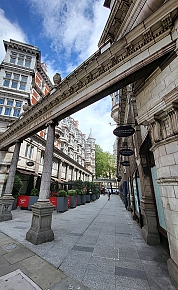
A walk along
Sicilian Avenue is
Always quite calming

A walk along
Sicilian Avenue is
Always quite calming
WE OFTEN VISIT the Tate Britain art gallery on London’s Millbank, usually to see special temporary exhibitions. Rarely, if ever, do we spend time looking at the Tate’s permanent collection. However, today, the 6th of July 2023, we met some friends who wanted to see the recently re-hung paintings in the permanent collection. The paintings are arranged in rooms in chronological order. Each artwork has an interestingly informative label, which describes the social conditions of the era in which it was created and other points about it.
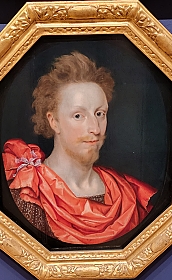
The first room of the series of galleries is dedicated to works created just before, during, and after the (Protestant) Reformation in 16th century England. I found it to be most interesting. The radical rejection of Roman Catholic religious practices involved, amongst many other things, a profound disapproval of the artistic portrayal of religious subjects. A consequence of this was that artists switched from painting religious scenes to portraiture. Just as people love being portrayed in photographs today, those who could afford it in the 16th century were pleased to have themselves immortalised in well-executed paintings. What I had never realised before was that the Reformation unwittingly gave birth to the long tradition of British portrait painting. Maybe, most people know this already, but it was news to me.
The gallery dedicated to the Reformation era has many fine portraits, by artists both known and unknown. However, one of the paintings hanging amongst the portraits is a religious scene, “An Allegory of Man”, by an unknown artist. Painted in about 1596, it would have been a highly controversial subject given the Protestant aesthetics prevailing at that time.
Although the temporary exhibitions at the Tate Britain are usually well worth viewing, the permanent collection deserves many a visit, as we discovered today.
UNTIL FEBRUARY 2022, only very few people with specialised knowledge of history would have been able to point out the house in which Marie-Louise Christophe lived in London between 1821 and 1824. Now, there is a plaque on the house in Marylebone’s Welbeck Street that marks the house in which she resided. And by now, you might well be wondering why anyone might want to know.

Marie-Louise (1778-1851) was born into a free black family, which ran a hotel, in St Dominique (which is now Haiti). In 1793, she married Henri Christophe (1767-1820), who had been one of her father’s slaves before he had earned enough in tips to purchase his freedom. After several years of revolution, in which Henri Christophe was an important freedom fighter, Haiti gained independence from France in 1804. In 1811, Henri was crowned the King of Haiti and the following year, Marie-Louise was given the title of Queen of Haiti. After the death of her husband in 1820 and the assassination of her two sons, she fled from Haiti along with her daughters. Their escape was assisted by the British, and they settled first in Blackheath, where they were hosted by the Anti-Slavery activist (abolitionist) Thomas Clarkson. After several changes of address, the Queen and her daughters settled in number 49 Welbeck Street.
According to the British press of the time, she and her daughters were popular with British people in all the social echelons. In 1824, they left London for Europe. Marie-Louise died in Rome, where she is buried. She never returned to Haiti. It was only in February 2022 that the Nubian Jak Community Trust were able to put up the commemorative plaque which you can see on number 49 Welbeck Street. It correctly describes Marie-Louise as “First and Only Queen of Haiti.”
I STUDIED AT University College London (‘UCL’) between 1970 and 1982. I was not there for so long because I kept failing examinations. Instead, I was a student there while I completed three different degree courses. Today (and during the years I attended UCL), the Students Union building is still located in a not particularly attractive building on the southwest corner of Gower Place and Gordon Street. Whereas it was a popular haunt of many of my fellow students, I hardly ever entered it except for a very brief period in the mid-1970s, when I was a PhD student in the Physiology Department.

During that short period, an Italian man opened a small restaurant on one of the floors of the Union building. His menu was limited to beautifully prepared beefsteaks that were accompanied by salad. This wonderful steak was priced no more than the often mediocre (or sometimes even poor) food that was available in the various subsidised student canteens in UCL. The reason for the Italian’s low priced, superb fare became obvious when after a few weeks, his eatery closed – or was closed. It turned out (so I was led to believe) that he was using the Union’s premises, but not paying the rent that he owed.
Winding the clock forward to the 26th of June 2023, we walked past the Union building, and I noticed something that I had never seen before. The building has a commemorative plaque that reads:
“This building housed the London School of Tropical Medicine and the Hospital for Tropical Diseases. 1920-1939.”
The plaque was placed by the Seamen’s Hospital Society, based in Greenwich. I do not know when the memorial was affixed to the Union, but I feel sure that it was not there when I was a student. It is interesting that what was once a hospital has become a centre for hospitality.
THE ARCHITECT SIR John Soane (1753-1837) created what is my favourite museum in London – Sir John Soane’s Museum. Son of a builder, Soane became a successful architect in the reigns of Kings George III and George IV. In 1806, he was elected Professor of Architecture at the Royal Academy. Although he was able to undertake the Grand Tour in Italy and Malta during the period 1778 to 1779, many of his students were unable to do so because of the Napoleonic Wars raging in Europe between 1803 and 1815. This meant that they were deprived of the opportunity of viewing the great works of art and architecture, which was considered an important part of an architect’s training during the Regency Period. However, Soane got around this problem as I will explain.
Between 1792 and about 1812, Soane purchased and then demolished three neighbouring houses on the north side of Lincoln’s Inn Fields. He rebuilt them to his own designs. He continued remodelling their interiors to test out the efficacy of his novel architectural designs. One feature that stands out are his clever ways of getting natural light to reach parts of the buildings that were far from natural light sources. Often skylights are located above tall internal lightwells, which allows light to reach, for example the basement rooms. In addition, carefully placed mirrors assist the distribution of natural light. These clever methods of illumination were important innovations in the era before electricity or gas-lighting.

Soane lived in his houses, had his architectural workshops there, kept a picture gallery, and created a museum. The picture gallery is ingenious. A small square room, lit from above, has some of the pictures arranged in two layers, one covering the other. The wall carrying the outer layers of pictures is in fact a huge, hinged door, which can be opened to reveal the pictures on the layer it covers (see the photo above). By this method, Soane created much more hanging area within the room. The pictures and drawings include many by Hogarth and Piranesi, and at least one by Canaletto. There is also a pair depicting Soane and his wife. Other pictures depict buildings designed by Soane as well as projects that he planned but were never fulfilled. To squeeze so many large artworks into such a small room, where they can be viewed comfortably, is a work of genius.
Soane, who was a successful architect and married the daughter of a wealthy builder, was not short of cash. He spent some of it on purchasing a huge variety and a great number of antiques including the Sarcophagus of Seti (Egypt, c 900BC). The sarcophagus had lain in front of the British Museum for two years before he was able to purchase it from the man who owned it. It had been offered to the British Museum, which declined to purchase it for £2000. So, Soane bought it, and it is the most important exhibit in his museum. The other antiques include Ancient Greek and Roman as well as mediaeval and renaissance artefacts. Soane put much effort into arranging his collection and established it as a museum. In 1833, he managed to get a Private Act of Parliament passed. This enshrined in law that after his death, number 13 Lincoln’s Inn Fields (the museum) should be preserved in perpetuity in the state he left it. And this has been done faithfully, but with careful restoration when necessary.
One of the purposes of Soane’s Museum was to allow his architectural students to view and study the sort of things that would have been able to see had the Napoleonic Wars not prevented them from undertaking their own Grand Tour. A visit to the curiously cluttered museum is fascinating and wondrous. The staff and volunteers that keep an eye on the various rooms and chambers in the museum are well-informed and provide interesting information.

LONDON’S HOLLAND PARK contains a lovely area – the Kyoto Garden. It is a well-maintained Japanese-style garden. I visit it frequently. Each time, I see something different there.
The garden is planted around a small pond in which there are several rocks, which look like miniature islands. Today, I saw a heron perched on the summit of one of these rocks. It stood still, moving its head slowly every now and then. It showed little interest in the many fish that swim in the pond. My wife noticed that there was a nest containing eggs just below the bird’s feet. The creature stood like a sentinel, guarding its future offspring.
I could see four eggs in the nest – there might have been more. In general, so I learned from Wikipedia, the various species of heron are monogamous and lay between three and five eggs. I have no idea what species I saw in the Kyoto Garden, but it is the first time I have seen a heron’s nest with eggs anywhere in Holland Park.
IT ALMOST GOES WITHOUT saying that wherever you are in central London, you are never more than a few footsteps away from a spot that has played a role in significant historical events. Most of these historical spots have been recorded, and therefore are not unknown to at least a few people. However, when walking around London, I often come across a memorial which I had not noticed before despite having passed it several times. Such is the case with number 51 New Cavendish Street – a brick building in Marylebone, which we have walked past several times recently.
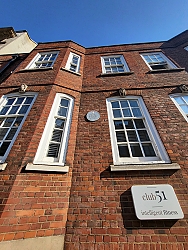
Number 51 bears a commemorative plaque which has the following information:
“This building housed the headquarters of the Polish navy during 1939-1945”.
Underneath this, but in much smaller letters, are sixteen Polish names. From an informative website (https://wartimelondon.wordpress.com/2018/12/12/new-cavendish-street-and-the-free-polish-navy/), I learned that these are the names of Polish naval vessels -ships and submarines.
Poland became an independent country at the end of WW1. By 1920, then with only 90 miles of coastline, Poland began to construct a navy. This was based in Gdynia, near to the ‘free port’ of Gdansk (Danzig), which was not under Polish control. In 1939, with little chance of withstanding attack by the Germans, Polish naval vessels began leaving the Baltic, and heading for British waters. In late 1939, Polish Naval Headquarters were established at 51 New Cavendish Street. Although the Poles had administrative control over their vessels, operational control was dictated by British military requirements. Between 1939 and 1945, the number of men working in the exiled Polish Navy increased from 1000 to 4000.
After the end of WW2, in September 1946, the Polish Naval Detachment in the UK was disbanded. One of its warships was handed back to the new Communist government of Poland. Only a few of the naval personnel felt able to return to their native land now that it was under Communist rule.
Well, I knew a little about the exiled Polish Air Force and have visited Audley End House, where Polish Special Operations Executive personnel trained before being dropped behind the lines in German-occupied Poland. I have even eaten dinner at a Polish Airman’s Club in South Kensington, but this place’s restaurant might well have closed since then. However, until my most recent visit to New Cavendish, I did not know anything about Poland’s navy and its role in WW2.
THE ARCHITECT EDWIN LUTYENS, who designed a set of important government buildings in India’s New Delhi, was also one of the principal planners of Central Square and its surroundings in London’s Hampstead Garden Suburb (‘HGS’). Here is a little bit about this that I have published about this in my book “Golders Green & Hampstead Garden Suburb: Visions of Arcadia”:

“Designed to be the throbbing communal heart of HGS, Central Square is a failure. Pevsner and Cherry noted in their “Buildings of England: London 4: North”:
“Unwin’s first plans had included shops along the approaches, but as built by Sir Edwin Lutyens, appointed consultant architect in 1906, the shops were omitted and the square became a high-minded enclave of churches and public buildings with a fringe of smart houses.”
The writers pointed out that without shops, the square never became a true social centre. In fact, most of the time it is an almost deserted open space. Lutyens (1869-1944) did not get on well with Henrietta Barnett. In her book “The architect and his wife: a life of Edwin Lutyens” (published in 2002), Jane Ridley wrote:
“Lutyens was no progressive. He had no interest in using architecture to change the way people lived, to eliminate servants or smooth social divisions … He disliked the bossiness of social reformers such as Mrs Barnett. Ugly, squalid towns such as Manchester depressed him, but he didn’t see town planning as a motor for change. All he wanted was to build beautiful buildings: ‘Loveliness alone is akin to godliness and whilst ugliness is countenanced and excused Hell is possible.’”
Later in her book Ridley recorded that Lutyen’s wife Emily had written to him after he had fled abroad in 1908 (having had disagreements with Henrietta):
“‘I am glad you went,’ she wrote, ‘as you needed rest and change, only you must work up the Hampstead affair and not let grass grow under your feet, or Mrs Barnett will put you in the wrong again.’”
Despite his differences with Mrs Barnett, Lutyens left his architectural mark on the square. These are his buildings built before he drew up plans for most of his buildings in British India, notably in New Delhi. As Mary Lutyens described in her book “Edwin Lutyens” (published in 1991), his work in the suburb was of importance for his future career:
“At the beginning of 1912 Lord Crewe, Secretary of State for India, approached Reginald Blomfield, President of the Royal Institute of British Architects, to recommend an architect to serve on a commission of three experts to advise the Government of India on the siting and laying out of the new capital. Blomfield recommended Lutyens on the strength of his country houses …his work in Johannesburg … and for Hampstead Garden Suburb. Sir Richmond Ritchie, Permanent Secretary for India, then sent for Lutyens and asked him if he would be willing to serve on the Commission. Incidentally, in connection with the above, Lutyens was already married to the daughter of a Viceroy of India…”
Central Square and its surroundings remain a rather sterile centre of what its founders hoped would be a garden suburb with a vibrant community spirit. If you are lucky, you can spot someone walking a dog or a few children playing on the lawns. Otherwise, this part of London is peaceful and, dare I say it, rather dull.
You can read more about Hampstead Garden Suburb in my book, which is easily available from Amazon:
FIVE YEARS AGO, I wrote the following:
“In the early 1960s, my parents installed a Permutit water softening unit in our family home. I have no idea why they did this. Maybe it was to save soap and the furring up of pipework. I am not sure that they would have done it had they known of the research that shows that heart disease is reduced as the hardness of drinking water increases.
The apparatus consisted of two cream-coloured cylinders, each about five feet high, which stood next to each other in our garage by the side of the house. One of the cylinders was sealed shut and surmounted by a circular metal control wheel. Its neighbour could be opened by lifting a lid. Once a week, my father had to refresh the ion-exchange resin in the sealed container. This was done by adding salt in large quantities to the other cylinder …
… A special salt, called dendritic salt, was required for the weekly process … There was only one store that would both supply sacks of dendritic salt and, also, deliver it to our home. That store was the world-renowned Harrod’s in Knightsbridge, which brought us the salt in their silent, electrically powered delivery vehicles. In order to get these regular deliveries, my parents had to open a Harrod’s account...”

Today, at the end of May 2023, I paid a visit to Harrod’s – a department store, which I last entered about 15 years ago. Since then, its interior has been modified considerably. The Ancient Egyptian themed central escalator hall is as it was when I last saw it, as is the superb, tiled food hall. Otherwise, it seemed unrecognisable to me.
Rather than being what I have always believed a a department store should be – a large shop in which its various sections display different kinds of goods (for example, men’s clothing, kitchen appliances, toys, etc), todays Harrod’s is a collection of departments, each one dedicated to a brand rather than a type of product. Wandering through the store, trying to find our way out, it occurred to me that Harrod’s has become more like a shopping area in a large international airport than an ‘old-fashioned’ department store. Is this, I wonder, because today’s customers are more interested in brand names than the products to which they are attached? Also, I am curious to know whether Harrod’s still deliver sacks of dendritic salt to addresses in the Hampstead Garden Suburb, where we used to live.
GEORGE FREDERIC WATTS (1817-1904) was a sculptor and a painter. I first became acquainted with him and his work when I was writing my book about west London (“Beyond Marylebone and Mayfair: Exploring West London”). My interest in him increased when I was writing a book about the Victorian photographer Julia Margaret Cameron (1815-1879). Between about 1850 and 1870, he lived with Thoby and Sara Prinsep’s family, about whom I have written in another book, in the now-demolished Little Holland House in Kensington. Not far from where he lived, there are two bronze statues by Watts: a portrait of Lord Holland in Holland Park, and the equestrian sculpture “Physical Energy” in Kensington Gardens. While living with the Prinseps, Watts met Julia Cameron, who was Sara’s sister. Cameron lived at Freshwater on the Isle of Wight in a house that neighboured the property where the poet Alfred Lord Tennyson lived. Watts, who had helped the Prinseps rent Little Holland House, was a frequent visitor to Freshwater, where he met and socialised with both Tennyson and Cameron. Watts, who was briefly married to the actress Ellen Terry, painted Tennyson several times and was himself photographed by Cameron. And Watts painted at least one portrait of Cameron – now in the National Portrait Gallery.
Apart from the numerous paintings and sculptures created by Watts, one of his most unusual works is neither a sculpture nor a painting – it is what one might describe as a precursor of Conceptual Art. Although attractive, the concept that it conveys – self-sacrifice – is more important than its appearance. Located in Postman’s Park, which extends from Aldersgate Street to King Edward Street, it is a memorial to ordinary people who lost their lives during peacetime whilst trying to save those of others. Created in 1898 but conceived by Watts in 1887, the work of art is called “Memorial to Heroic Self-Sacrifice”. It consists of a stretch of wall protected from the elements by a wooden loggia, which was designed by Ernest George who helped design the buildings at the Golders Green Crematorium. On the wall there are memorials to those who sacrificed their lives whilst rescuing others. Each memorial is made of ceramic tiles and records the name of the hero and a brief account of how he or she met their deaths. The first four memorials were designed and made by William de Morgan. Later, others were made by the Royal Doulton pottery. There is room for 120 memorials but by 1931, only 53 had been placed. In 2009, the Diocese of London permitted another memorial to be added.

Watts supervised this project. When he died, his widow, his second wife Mary, took over its supervision, but after a while she lost interest in it as she began concentrating on the management of the Watts Mortuary Chapel and the Watts Gallery – both near Compton in Surrey. The memorial is in Postman’s Park, which was formerly the graveyard of the nearby St Botolphs Aldersgate Church and is, I am guessing, maintained by the Church of England or a local authority.
The memorials are both fascinating and moving. Here are a few examples:
“Mary Rogers. Stewardess of the Stella. Mar 30 1899.Self sacrificed by giving up her life belt and voluntarily going down in the sinking ship.”
“Herbert Peter Cazaly. Stationer’s clerk. Who was drowned at Kew in endeavouring to save a man from drowning. April 21, 1889”
“Herbert Maconoghu. School boy from Wimbledon aged 13. His parents absent in India, lost his life in vainly trying to rescue his two school fellows who were drowned at Glovers Pool, Croyde, North Devon. August 28, 1882”
According to Wikipedia:
“Maconoghu was actually Herbert Moore McConaghey, the son of Matthew and Martha McConaghey, and he was born in Mynpoorie in India where Matthew was working as a settlement officer for the Imperial Civil Service,”
Standing amidst these memorials is a small sculpture depicting Watts. Its inscription reads:
“The Utmost for the Highest. In memoriam George Frederic Watts, who desiring to honour heroic self-sacrifice placed these records here.”
Luckily for us, Watts’s unusual creation has been kept in good condition. Since 1972, it has been a protected structure. Unlike most of the art made by Watts, the memorial in Postman’s Park was an idea created by him, rather than something he made with his own hands. I had seen the memorial several times in the past, but today, the 17th of May 2023, I took my wife to see it for the first time. A few weeks earlier, while visiting the Tate Britain, we had seen an art installation by Susan Hiller. It incorporated photographs of 41 of the memorials on Watts’s wall of memory in Postman’s Park. Having seen this, we wanted to see the original, and were not disappointed.
You can discover more about Julia Margaret Cameron, Tennyson, the Prinsep family, and Watts in my book “Between Two Islands: Julia Margaret Cameron and her Circle”, which is available from Amazon:
 yamey
yamey 