Anti-slavery in London’s Fitzrovia

GIGS KEBAB SHOP has been in Tottenham Street near to London’s Goodge Street station for over fifty years. Frequently, during the twelve years that I studied at University College London, I used to purchase a pita filled with lamb shish kebab from Gigs and then sit on a bench in the open space next to the nearby American church opposite Heal’s furniture shop on Tottenham Court Road. While I enjoyed the snack, hopeful pigeons used to wander around my feet, hoping for crumbs from the student’s pita. In those far-off days, I had no idea that Tottenham Street had once been the home of an important figure in the movement to abolish the slave trade. It was only this month, March 2021, that we noticed his house at 37 Tottenham Street, which is close to the northern end of Goodge Place, and used to bear the number ‘13’.
Olaudah Equiano, also known as ‘Gustavus Vassa’ (c1745-1797) was born in what is now Nigeria (see https://equiano.uk/the-equiano-project/ for a useful timeline of his life). In 1756, he was kidnapped by slavers and sent to the Caribbean, where he was sold to a British naval officer, MH Pascal. Between 1756 and 1762, he served with Pascal in the Royal Navy during the Seven Years War with France and was baptised in 1759 in London. From 1763 to 1766, he was ‘owned’ by Robert King of Montserrat. During this time, he made money ‘on the side’ and was able to purchase his freedom in 1766. The following year, we find him in London, from where he set sail to Italy and Turkey. In 1773, this intrepid man set sail on an expedition to the Arctic. Its aim was to find a new passage to India. After more adventures in the Caribbean and Central America, Equiano informed the abolitionist Granville Sharp (1735-1813) about the Zong massacre of 1781, during which more than 130 enslaved Africans were murdered on the Zong, a British slave ship.

After a trip to New York and Philadelphia in 1784-85, Equiano returned to London, where he became involved in the relief of the plight of ‘black’ people in London. After another sea voyage to Sierra Leone, we find him back in London in 1788. In his book “The Interesting Narrative of the Life of Olaudah Equiano, or Gustavus Vassa, The African. Written by Himself” (published in 1789), he recorded:

“March the 21st, 1788, I had the honour of presenting the Queen with a petition on behalf of my African brethren, which was received most graciously by her Majesty”.

The Queen was Charlotte, wife of King George III. Part of his petition was as follows:

“I presume, therefore, gracious Queen, to implore your interposition with your royal consort, in favour of the wretched Africans; that, by your Majesty’s benevolent influence, a period may now be put to their misery; and that they may be raised from the condition of brutes, to which they are at present degraded, to the rights and situation of freemen, and admitted to partake of the blessings of your Majesty’s happy government; so shall your Majesty enjoy the heartfelt pleasure of procuring happiness to millions, and be rewarded in the grateful prayers of themselves, and of their posterity.”

Although Equiano might have begun writing his “The Interesting Narrative…” in London’s Baldwin’s Gardens (number 53) near Grays Inn Road, from where he sent the petition to the Queen, he had moved to the house in Tottenham Street by the 25th of June 1788, according to an interesting article by Gene Adams, published in “Camden History Review Vol.29” (2005).  Tottenham Street is near Warren Street, where The Committee for the Relief of the London Black Poor was founded in 1786. It is also close to the former Tottenham Court Chapel founded in 1756 by George Whitefield (1714-1770), an American founder of Methodism, who had inspired Equiano. The chapel stood where the American church stands today. By 1774-5, Equiano was already a ‘Calvinist-Methodist’ Christian.

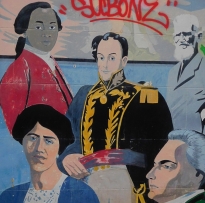
The house on Tottenham Street, which bears a plaque recording his stay there is undistinguished architecturally. Around the corner from it on the east side of the north end of Goodge Place, there is a fading mural, painted by Brian Barnes in 2000, which depicts Equiano with other local celebrities, all in 18th century attire. This is next to another mural depicting the nearby Post Office Tower and four women, two of whom are wearing Indian saris.

Equiano married an English woman, Susan Cullen, in 1792 from Soham in Cambridgeshire. They had two daughters, Anna Maria (1793–1797) and Joanna (1795–1857), who were both baptised in Soham i (https://en.wikipedia.org/wiki/Olaudah_Equiano#Marriage_and_family). The family lived in Chandos Street in London, where his youngest daughter died.  Susan died in 1796, aged 34, and Equiano the following year.

For many years after his death, it was not known where Equiano was buried. Eventually, it was discovered that he had been buried in the churchyard of Whitefield’s chapel, on the site of the present American church. Unlike many of the other corpses that had been buried there and then later shifted to a cemetery in Chingford in 1898, Equiano’s was amongst those which were not shifted and therefore must lie within the churchyard of the former Whitefield’s Tottenham Court Chapel (https://equiano.uk/wp-content/uploads/2019/11/EQUIANO-Campaigner-MP1.pdf), probably near where I used to sit on a bench eating my kebab from Gigs. Looking at an old map, I found that the graveyard was a little to the north of where I used to munch my lunch.

A socialist by the River Thames

ISLEWORTH IN WEST London was until this month, March 2021, a place where I had never before set foot. A road direction sign with the words “Historic Isleworth Waterfront” tempted us to investigate the place and we found it to be a delightful location despite it being under a flight path for aeroplanes coming into land at nearby Heathrow Airport. After enjoying the view across the River Thames from Old Isleworth, my eye alighted on a house with a circular memorial plaque placed to remember someone significant of whom I had never heard.

Arthur Joseph Penty (1875-1937) lived at 59 Church Street in Isleworth between 1926 and his death. The commemorative plaque bears the words:

“Architect and pioneer of Guild Socialism”

Penty was born in York, eldest of the two sons of the architect Walter Green Penty (1852-1902) of York. Arthur first worked in his father’s architectural practice before moving to London in 1902, where he increased his involvement in the Arts and Crafts Movement. Shortly before his move, he met Alfred Richard Orage (1873-1934). He was an influential British socialist and a Theosophist. He edited a journal called “The New Age”, which was inspired by Fabian Socialism (https://en.wikipedia.org/wiki/The_New_Age).

Old Isleworth

In London, Penty collaborated with the architect Raymond Unwin, who was responsible for much of the planning and design of Hampstead Garden Suburb, whose construction began in about 1904. Penty, working in Unwin’s office, is believed to have designed some of the details of two large buildings, Temple Fortune House and Arcade House, in Temple Fortune, as well as aspects of the so-called ‘Great Wall’ that separates part of the Suburb from the northern edge of Hampstead Heath Extension (www.hgs.org.uk/tour/tour00045000.html).

Apart from architecture, Penty was an important exponent of Guild Socialism. Many of his thoughts on the subject were published in Orage’s “The New Age”. I had never heard of Guild Socialism before seeing Penty’s house in Isleworth. Let me see if I can make any sense of this now long-outdated form of socialism, whose ideas were influenced by the great designer William Morris (1834-1896) and his associates. Guild Socialism opposed capitalism. According to Encyclopaedia Britannica (www.britannica.com/event/Guild-Socialism), Guild Socialism is:

“…a movement that called for workers’ control of industry through a system of national guilds operating in an implied contractual relationship with the public.”

It began in 1906 with the publication of “The Restoration of the Gild System”, written by Penty. The Guild Socialists believed that industry should be owned by the state but controlled by workers through national guilds organised by their members democratically. The system proposed was a kind of nostalgic revival of the mediaeval guild system. During WW1, Guild Socialism was enhanced by the actions of left-wing shop stewards demanding ‘workers’ control’ of the war industries. The movement declined with the onset of the economic slump of 1921 and the subsequent policies of both the Labour and Socialist Parties in Great Britain.  

As Penty neared the end of his life, he became attracted to the ideas of Fascism that were prevalent in the Europe of the 1930s. The Oxford Dictionary of National Biography (www.oxforddnb.com/view/10.1093/ref:odnb/9780198614128.001.0001/odnb-9780198614128-e-53509?rskey=IABIgM&result=1) reveals that by the early 1930s, Penty:

“… was attracted to the anti-modernism of the far right. He admired the corporatist* economic organization of Mussolini’s Italy, supported the nationalists in the Spanish Civil War, and interested himself in the ideas of Oswald Mosley. At the same time he denounced Italian imperialism in Abyssinia and rejected Nazism for its racial doctrines and its statism.”

Penty, who dedicated his life to the revival of mediaeval craftsmanship and guilds, died at 59 Church Street in Old Isleworth on the 19th of January 1937. This late 18th century building bears the name “Manor House”. According to one source (http://edithsstreets.blogspot.com/2016/10/riverside-north-of-river-and-west-of_12.html), this is neither the manor house nor is it on the site of the real manor house. It was bought by Michael Penty, who also bought the manor of Isleworth. Michael’s father was Arthur Penty (http://www.panoramaofthethames.com/pott/isleworth-2006/59-church-street-isleworth). His name is on the front door, along with a brass plate bearing the words:

“MICHAEL PENTY Solicitor & Commissioner for Oaths

LORD OF THE MANOR OF ISLEWORTH RECTORY”

Had it been open, we would have enjoyed a drink at the riverside pub, “The London Apprentice”, which is a few steps away from the house where Arthur Penty once lived, but it was closed. However, a short walk away across the Duke of Northumberland’s River, we found a small café called South Street that served beverages and locally made ice-cream to take away.

*Note:

“Corporatism is a political ideology which advocates the organization of society by corporate groups, such as agricultural, labour, military, scientific, or guild associations, on the basis of their common interests.” (https://en.wikipedia.org/wiki/Corporatism).

Gracie Fields and modernism in Hampstead

ACTRESS AND ENTERTAINER GRACIE Fields (1898-1979) commissioned a house to be built in Hampstead in 1934. This was five years before she moved to the Italian island of Capri. I cannot establish how long she retained ownership of this home. The house, with its roof covered by interlocking curved green tiles (pantiles) and centrally located gable that resembles those found in houses built by the early Dutch settlers in the Cape of Good Hope, is by no means a masterpiece of architectural design. It stands on the curved section of a private road, Frognal Way, which links Frognal to Church Row. The short Frognal Way, apart from being the location of the house that Gracie built, contains two masterpieces of twentieth century British architecture.

Number 4 Frognal Way, London NW3

Standing on raised ground above the north side of Frognal Way is number 9, Sun House. This was designed by the modernist architect Maxwell Fry (1899-1987) and built 1934-35.  Fry and his wife, the architect Jane Drew (1911-1996), worked with Le Corbusier on his 1950’s project to build Chandigarh, the new capital of the Indian state of the Punjab.  Maxwell was originally trained in the classical style, but soon began working with noted exponents of modernism including Walter Gropius, Le Corbusier, and Pierre Jeanneret. His early compositions, which were in the neo-classical style, include Margate Station (1924-26), which is a far cry stylistically from the Sun House in Hampstead. It would be difficult to believe that the same person had designed both.

The architectural historian Nikolaus Pevsner (1902-1983), himself a resident of Hampstead (at North End) and much admired by Maxwell Fry, wrote of the Sun House:

“… an object lesson in façade composition. White rendered walls, three-storeyed window bands of different heights, large first-floor balcony on thin steel supports and then a broad projection at the r. end on the first floor, and a narrow one on the l. on second floor level. The effect is surprising and shows what a design of quality can make of relatively elementary material …” (from “The Buildings of England. London 4: North”)

Regarding the other buildings in Frognal Way, Pevsner and his co-author Bridget Cherry summarise them beautifully:

“Otherwise Frognal Way has an assortment of interwar villas from Neo-Georgian to Hollywood Spanish-Colonial and South African Dutch (with pantiles) …”

The latter mentioned is the house that Gracie Fields had built. Opposite the Sun House, there is a house with two wings and a centrally located entrance, number 4, which defies stylistic categorisation. It has three windows above the front door and above these there is a curious roundel with a bas-relief depicting a man wearing a skull cap and a winged cloak. On either side of him there is a single flower. The roundel is dated 1934, the same year as the Sun House and Gracie Field’s home were built. The house with the roundel is mentioned in a blog (https://trainwalkslondon.wordpress.com/2014/02/06/walk-1-st-pancras-walk-to-west-hampstead-thameslink/), whose author, like me, cannot shed any light on the history of this building.

There is another treat for lovers of modernism in Frognal Way. It stands where this short unpaved road meets the main road, Frognal. The façade of number 66 Frognal reminds me of paintings by the Dutch artist Piet Mondrian (1872-1944). The building was constructed in 1937, the year before the artist arrived in London. It was designed by Amyas Connell (1901-1980), Basil Ward (1902-1976), and Colin Lucas (1906-1984). Their architectural practice was short-lived (1933-1939), but highly creative and productive. They

“… were among the foremost exponents of the International Style in Britain. Their architecture largely comprised cubic sculptural forms made from reinforced concrete and an emphasised horizontality.” (www.themodernhouse.com/directory-of-architects-and-designers/connell-ward-lucas/)

To quote Pevsner again, the house they designed on the corner of Frognal Way was:

“… the extreme idiom of the day, now something of a classic. The design was perhaps a little too concerned to ‘épater les bourgeois’ [i.e., ‘to shock the bourgeois’]. The design has been diluted by alterations …”

Some of these alterations were approved by the original architects, others not. Despite the alterations, the building remains a stunning and pleasing architectural statement, and is a house in which I would be happy to reside. Despite this, the architectural critic Ian Nairn (1930-1983), who both admired and criticised Pevsner’s approach to architectural writing, wrote that in his opinion it was the best house built in Britain before WW2 (www.wowhaus.co.uk/2019/02/12/1930s-connell-ward-lucas-designed-66-frognal-modernist-house-in-london-nw3/).

During the last few months, we have been making regular visits to Hampstead, each time wandering slowly along its often steep streets and alleyways.  Amongst the many historic buildings there is a good number of adventurous new buildings, many of them superb examples of late 20th and early 21st century architectural talent. It is pleasing that the pioneering work of the pre-War architects, such as can be seen in Frognal Way and other parts of Hampstead (e.g. Willow Road and Lawn Road), is continuing even today. That these visually adventurous new buildings are being constructed is a credit to the open-mindedness of local planning authorities.

Survived in Soho

IN SEPTEMBER 1940, a 17th century church in London’s Soho was destroyed by fire because of aerial bombardment by the Luftwaffe. All that remained intact was the tower at the west end of the church, St Anne’s Soho. Today, the tower still stands and overlooks a small but interesting churchyard.

St Anne’s was completed in 1686 during the period when Soho was becoming urbanised as London grew in a westerly direction. It had been designed either by (more likely) Sir Christopher Wren (1632-1723) or by William Talman (1650-1719), or maybe they collaborated (www.british-history.ac.uk/survey-london/vols33-4/pp256-277). According to John Timbs, writing in “Curiosities of London”, published in 1867, when the church was standing:

“The interior is very handsome and has a finely painted window at its east end.”

Sadly, this no longer exists. The tower, which we see today, was built in about 1806 to the design of Samuel Pepys Cockerell (1753-1827), great-great nephew of the diarist Samuel Pepys, to replace an earlier one that had become unstable.

The pleasant rectangular churchyard that extends from the tower to Wardour Street measures approximately 150 feet by 80 feet. It contains several fascinating memorials, some of which used to be inside the church before it was bombed. Standing near the northern edge of the churchyard is the prominent gravestone for the essayist William Hazlitt (1778-1830), one of my favourite writers, who died in a house in Frith Street, not far from the church. His gravestone bears an extremely lengthy inscription, which might have been composed by a lawyer and poet called Charles Jeremiah Wells (c1800-1879; http://www.lordbyron.org/persRec.php?choose=PersRefs&selectPerson=ChWells1879), who had become a “devoted acolyte” of Hazlitt (according to his biographer AC Grayling). Amongst many other positive attributes, the inscription describes Hazlitt as:

“… The unconquered Champion of Truth, Liberty, and Humanity…”

There is a second monument to Hazlitt, which is attached to the wall of the tower. This has less of an inscription, but includes the words:

“Restored by his grandson February 1901”.

Near to this and also attached to the tower, there is a small rectangular metal plate in memory of the Welsh philosopher David Williams (1738-1816), who founded The Royal Literary Fund in 1790, lived in Gerrard Street, and is buried somewhere in the churchyard.

The most curious memorial in the churchyard is to Theodore, King of Corsica. The monument informs that Theodore died in the Parish of St Annes soon after his release from the King’s Bench Prison in 1756.  This man, Theodore Anthony Neuhoff, who was born in Prussia, disembarked from an English vessel on the coast of Corsica in Spring 1836. He had with him a considerable supply of arms and money. He led the Corsicans in a successful revolt against their Genoese rulers and was crowned ‘King of Corsica’. After a short time of peace, the Genoese returned, and Theodore travelled around Europe trying to seek foreign supplies and aid. His journey took him to Livonia, France, and Holland, where he managed to obtain a frigate armed with 52 guns and an army of 150 men. Sadly, the Neapolitans arrested him and imprisoned him in the north African town of Ceuta. Unable to help his Corsican subjects, he fled to London, where problems with debt landed him in prison (for full story, see: “The Patrician, Vol. 1”, 1846, edited by Bernard and John Burke). His memorial states that after getting into debt, he “registered the Kingdom of Corsica for use of his creditors”.  His memorial was financed by the writer and politician Horace Walpole (1717-1797), whose words about Theodore, who died a pauper, are inscribed on the stone:

“The grave, great teacher, to a level brings

Heroes and beggars, galley-slaves and kings;

But Theodore this moral learn’d ere dead;

Fate pour’d its lesson on his living head,

Bestow’d a kingdom, and denied him bread.”

The bodies of Hazlitt, Williams, and the King of Corsica, are amongst the 60,000 corpses buried in the graveyard, which his why the level of the ground in the churchyard is much higher than the pavement in Wardour Street that runs alongside it.

Hidden from sight because it is below the ground floor of the tower are the ashes of the author Dorothy L Sayers (1897-1957), who was a churchwarden at St Anne’s between 1952 and 1957. I have not yet discovered her connection with Soho.

More recent monuments are also of interest. There is a list of those of the parish, who died in WW1. Beneath that there is one to those who died in active service in WW2, which includes several with probably non-English surnames: Rosenfeld, Grossman, Kosky, and Masser. This monument also remembers those in the parish who died during the Blitz. A small plaque on a post in a flower bed records the names of three young people who were killed on the 30th of April 1999 when the Admiral Duncan pub in nearby Old Compton Street was bombed by a racist homophobe, David Copeland (https://www.bbc.co.uk/news/uk-england-london-47216594). A triangular wooden bench near the monument to the victims bears a plaque that reads:

“This triangular bench represents Brixton, Brick Lane, and Soho, three places brought together by acts of hate, made stronger by acts of love. 17 – 24 – 30 April 1999”.

The three places were all sites of horrific nail bombings that April.

So much for the churchyard, but what about the church? After many years of having used the site of the bombed church as a car park, which I can dimly recall, a new building that contains social housing as well as a small chapel was built in the early 1990s. The new church is entered from Dean Street. Apart from being a site of many historical associations, the churchyard is a peaceful haven in the heart of a normally busy part of central London.

French connections

GENERAL CHARLES DE GAULLE (1890-1970), an eminent refugee from France, was dead against Britain joining what was the Common Market and is now the European Union, despite the country having generously hosted him during WW2, when his country was invaded by Germany. This is quite well known, but far less known is the fact that he lived in Hampstead, north London. His home was at 99 Frognal in what is currently St Dorothy’s Convent.

The convent building, Frognal House, was built in about 1740 and later modified in various ways (https://historicengland.org.uk/listing/the-list/list-entry/1113077). The convent building stands on the site of a 15th century tenement known as ‘house called Frognal’ (www.british-history.ac.uk/vch/middx/vol9/pp33-42). At the beginning of the 18th century, the land on which this stood was owned by the bricklayer Thomas Smith, who probably built the present building, which became known as ‘Frognal House’. During the Crimean War (1853-1856), the house became The Sailors’ Orphans Home (from 1862-1869), which later shifted to the northern end of Fitzjohns Avenue in 1869 and which was constructed on land once owned by Sir Harry Vane (1613-1662).

De Gaulle and his family lived in Frognal House between 1940 and 1942. Monique Riccardi-Cubitt, a writer and art-historian, stayed in Frognal House in about 2000 and has written about it (https://blogs.mediapart.fr/monique-riccardi-cubitt/blog/210418/memories-general-de-gaulle-london). She wrote:

“The reception rooms on the ground floor have remained, but the General’s Cabinet de travail is now the chapel … The first floor panelled library is where I would feel his spirit most strongly hovering as I would work alone early in the morning … In the garden roses grew, I drew and painted them in the late afternoon … His spirit was there too, and I used to wonder how often he would have come back from his headquarters in Carlton Gardens worn and weary with cares, to wander off to the peace of the leafy bowers and refresh his tired mind and soul … From the roof terrace overlooking the whole of London below, he would stand at night and watch the German bombings on the City of London during the Blitz …”

While living in Hampstead, De Gaulle used to attend masses at St Mary’s Catholic Church in Holly Walk. It was the first Catholic church built in Hampstead after the Reformation (16th century). It opened its doors to worshippers in 1816. Its first pastor was a refugee, one of 500 clergy fleeing from the French Revolution, the Abbé Jean-Jacques Morel (1766-1852; https://parish.rcdow.org.uk/hampstead/about-the-parish/). Thomas Barrett, a historian of Hampstead, writing in 1912 in his “Annals of Hampstead”, noted:

“Towards the end of the eighteenth century another interesting religious association came into the life of Hampstead, in a very modest and unassertive way, as one of the minor overflows from the French Revolution. Among the priestly refugees from France was a certain Abbe Morel, who had been connected with the Grand Seminary at Bourg. He was attracted to Hampstead by the fact of there being several French families living there—Talleyrand among the rest, some say—exiles like himself, to whom the question of religious worship according to their own faith was becoming a matter of difficulty…”

Barrett believed that Talleyrand, Charles Maurice de Talleyrand-Périgord (1754-1838):

“… lived for a time at Tensleys, on Hampstead Green, during his service as French Ambassador from 1830 until 1834 … It was pulled down, and the site is now partly covered by the Hampstead General Hospital.”

This is now the location of the Royal Free Hospital. Barrett quotes the following anecdote that reveals that the refugees included members of the French aristocracy:

“… A story is told of two handsomely dressed ladies visiting Hampstead in 1819. They drove in a carriage to the bottom of Holly Hill, and then got out and walked to the top; and sometime later the Abbe was seen walking down the road bareheaded, respectfully escorting them. As the elder of the two ladies got into the carriage she kissed the Abbe’s hand and shed tears. This lady, it was said, was the Duchesse d’Angouleme.”

After some years in Hampstead, Morel:

“… was put to a severe ordeal when, the Revolution having come to an end, it became possible for the refugees to go back to their native country. Most of the little congregation for which he had been officiating returned. He would fain have gone with them ; but in Hampstead he had found a real haven of rest after the turbulence which had preceded his exile, and had formed many ties with the people of the village. He decided to remain, and for many years after that Abbe Morel was a worthy and loved figure in Hampstead.”

In 1941, Fr Joseph Geraerts became the parish priest. During this period:

“… one of the more notable parishioners was General Charles de Gaulle who lived for about a year at 99 Frognal, now St. Dorothy’s Convent. We are told that his tall and impressive figure was always to be seen in the front bench at the 11 o’clock Mass whenever he was home.” (https://parish.rcdow.org.uk/hampstead/wp-content/uploads/sites/193/2015/09/St-Marys-June-15.pdf).

De Gaulle returned to France in June 1944. After initially declining to join the Common Market, Britain applied to join in 1963. De Gaulle was dead against this (https://en.wikipedia.org/wiki/Charles_de_Gaulle#European_Economic_Community_(EEC)). It was only after De Gaulle resigned as President in 1969 that Britain was able to join the European community, which it has left recently.  

Frognal House was converted into its present role, the home of St Dorothy’s Convent, part of a religious community based in Malta, in 1968. The organisation:

“… caters for young ladies coming to study in London or for a short holiday from all over the world. It aims at providing not only a boarding house, but a homely environment where guidance and advice assure the well being and comfort of all the students. Besides catering for the students, the sisters are very much involved in their Parish St Mary’s.” (www.stdorothysmalta.org.mt/convents.html).

Apart from a couple of restaurants in Hampstead, the former Cellier du Midi and the still extant Cage Imaginaire, I had never considered that Hampstead had any other French connections. However, seeing the convent today and looking into its history, has shown me that France had a significant role in Hampstead’s history.

PS: I almost forgot to mention the onion sellers, who used to come to Hampstead from France with their bicycles ands strings of onions. And, also, there is a French creperie in Hampstead next to the King William IV pub on Hampstead High Street.

A year of plague

BY THE SUMMER, five hundred people were dying every week in London. The fatalities included both the rich and the poor. Parliament was moved from the capital to the city of Oxford. By July, the plague was destroying the city of London and every Londoner became regarded as a potential carrier of the disease. Towns such as Bristol would not admit Londoners unless they had proof that they were free of contamination. This proof was in the form of a document issued by the Mayor of London, in whose own household illness was rife. Towns near London shut their doors to Londoners and their citizens stayed at home.

In London, volunteer searchers inspected every house and whenever they came across one in which at least one resident had signs of the disease, they posted a notice above the door. This bore the words “God have mercy on us.” Then, two soldiers were posted by the entrance of each affected house to make sure that no one entered or left.  By August, the theatres, inns, and markets were closed in London. When business was conducted, coinage used to pay for goods was dropped into a tub of water by the customer and then retrieved by the vendor or supplier. Nobody touched the hands of another. Later that month, terrified Londoners began fleeing from the diseased city, but they were turned away from wherever they went. By September, 5000 Londoners were dying each week. Schools were closed. As a result, schoolteachers applied to the government for financial relief.

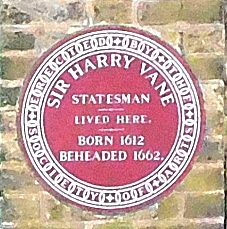
What I have been describing is nothing to do with the current covid19 pandemic, even if there are some remarkable similarities. Also, when considering the number of deaths, it is worth noting that London’s population in 1625 was about 300,000. It refers to a plague (possibly bubonic) that afflicted London in 1625. The information I have given has been extracted from a book that I am reading at the moment: a biography of Sir Harry Vane (1613-1662) by the historians JH Adamson and HF Folland, both professors at the University of Utah in the USA.

And, why, you might wonder, am I reading a book about a man whose existence was unknown to me less than a couple of months ago. The answer lies in Hampstead in north London. I was brought up in this part of the metropolis and recently have been revisiting old haunts and thus begun to become interested in Hampstead’s rich history. It was whilst rambling around Hampstead one cold February morning that I saw a gatepost (near the upper end of Rosslyn Hill) with a commemorative plaque. This memorial recorded the fact that the gate post was all that remained of the house in which Sir Harry Vane, politician and for some time a Governor of the Massachusetts Bay Colony, resided for some time before his arrest (ordered by King Charles II), trial, and execution.

What struck me when reading about the plague of 1625 and comparing it with what we are facing currently was how similar were some of the actions taken then with those taken now, almost 400 years later. By the way, in case you were wondering, the 1625 plague subsided almost completely by November that year and that was without any vaccines being available.

King Richard III and more

SEEN FROM ACROSS THE THAMES at Battersea Park, it looks like a Tudor palace in immaculate condition on the opposite bank of the river. But do not be fooled because much of Crosby Hall, the edifice you can see from the riverside at Battersea, was built between 1910 and about 1926.  Part of the building is far older, dating back to mediaeval times and it was moved from the heart of the City to its present location in Chelsea in 1910. Let me explain, please.

In 1466, Sir John Crosby, alderman and a sheriff of London, built his mansion, Crosby Place, on land just east of Bishopsgate, leased to him by the Prioress St Helens Bishopsgate, a church nearby.  After Crosby died in 1475/6, Crosby Place was owned by the Duke of Gloucester (1452-1485), who was to become King Richard III, of Shakespearian fame.  John Timbs in his “Curiosities of London” (published in 1855) suggests that in 1598, Shakespeare had lodgings close to Crosby Place. In Act 1, scene 2 of his play, Richard, Duke of Gloucester says:

“And presently repair to Crosby House;

Where (after I have solemnly interr’d

At Chertsey monast’ry this noble king,

And wet his grave with my repentant tears)

I will with all expedient duty see you.

For diverse unknown reasons, I beseech you,

Grant me this boon.”

Writing in 1603 in his “The Survey of London”, John Stow (1524/25-1605) noted:

“Then you have one great house called Crosby place, because the same was built by Sir John Crosby, grocer and Woolman … This house he built of stone and timber, very large and beautiful, and the highest at that time in London … he was buried in St Helen’s, the parish church…”

Stow also recorded that in the late 16th century several ambassadors lived in the house.

The fourth owner of Crosby Place was the senior government official, Sir Thomas More (1478-1535), whose head was removed at the Tower of London after disagreements with his ‘boss’, King Henry VIII. It has been suggested by Timbs that More wrote his books “Utopia” (1516) and “History of Richard the Third” (1512-1519) whilst residing at Crosby Place. In 1523, More sold Crosby Place to his friend, the banker and merchant Antonio Bonvisi (died 1558) from Lucca in Italy. Interestingly, More moved to his house in Chelsea after leaving Crosby Place. His riverside home, the former Beaufort House was a few yards away from the present Crosby Hall.

The ownership of Crosby Place changed several times after More sold it. Sir Walter Raleigh lived there in 1601. Between 1621 and 1638, the Place was home to the East India Company (founded 1600). Soon after 1642, fire struck the property, and it was never again used as a residence. The conflagration spared the great hall, which became known as Crosby Hall. During the Civil War, it was used as a prison for Royalists. In 1672, it was converted into a Presbyterian meeting house, and was used as such until 1769. Next, the hall was used as a packer’s warehouse. The packer’s lease expired in 1831. Following that and public concern about its condition, the hall was restored in about 1836. Timbs noted that it was:

“… the finest example in the metropolis of the domestic mansion Perpendicular work … The glory of the place is, however, the roof which is an elaborate architectural study, and decidedly one of the finest examples of timber-work in existence. It differs from many other examples in being an inner roof…”

From Timbs’s detailed description, it sounds as if it was a spectacular creation.

Following its restoration, Crosby Hall became used for musical performances and as a meeting place for literary societies. In 1868, Crosby Hall became a restaurant. The Hall was sold to the Chartered Bank of India, Australia, and China in 1907. The bank wanted to destroy what was one of the oldest buildings in the City of London, one of the few survivors of the Great Fire of 1666. These plans caused a public outcry. In 1910, the Hall was dismantled and moved stone by stone to its present site in Chelsea, opposite Battersea Park. There, it was reassembled and Tudor-style additions, designed by the architect Walter Godfrey (1881-1961) were constructed.

During WW1, the relocated and enlarged Crosby Hall was used to house refugees from war-torn Belgium. Between 1925 and 1968, the Hall was leased by the British Federation of University Women. Following the anti-Jewish laws passed by the Nazis in 1933, Crosby Hall provided residential fellowships for Jewish women academics who had fled from Hitler’s Germany. After 1988, Crosby Hall became a private residence (www.christophermoran.org/news/crosby-hall-the-most-important-surviving-domestic-medieval-building-in-london/).

Close to the relocated Crosby Hall there is a statue of Sir Thomas More, seated and looking across the Thames. This statue is appropriately located between what is left of his old home, which used to be in Bishopsgate, and the land on which his Chelsea mansion used to stand. One day, I hope that I will be able to see the superb hammer beam roof in Crosby Hall. I wonder how it compares with the wonderful example that can be seen in Middle Temple Hall, in which Shakespeare’s “Twelfth Night” was first performed in 1602.

Beef, mutton, and martyrs

COPENHAGEN FIELDS WAS an open space north of the Barnsbury district of London’s Islington. In the 17th century, the place was beyond the northern edge of London. As with other open spaces in 17th century Islington, it was an area where people whose homes had been destroyed in the Great Fire of 1666 congregated with what belongings they managed to salvage. By the 18th century, Copenhagen Fields had become a place where large numbers of Londoners used to gather for political meetings.

Animals being led to Caledonian Market

According to William Howitt writing in his “The Northern Heights of London” (published in 1869), the fields acquired its name following a visit of the King of Denmark to his relative King James I (reigned over England, Scotland and Ireland from 1603 to 1625). A Dane built a house on the open space, Copenhagen House. The name ‘Copenhagen’ appears on a map published in 1695. Howitt reveals that Copenhagen Fields and its house became a place of recreation for Londoners:

“It became a great tea house and resort of the Londoners to play skittles and Dutch-pins. It commanded a splendid view over the metropolis, the heights of Highgate and Hampstead …”

As mentioned, Copenhagen Fields was connected with political activity; it was a place of mass protests. Not long after the French Revolution, there was a meeting in the open space:

“On the 12th of November 1795 a public meeting was summoned by the London Corresponding Society in Copenhagen Fields which was attended by more than a hundred thousand persons. Five rostra or tribunes were erected, and Mr. Ashley, the secretary, informed the meeting that it at each of them petitions to the King, Lords and Commons against the Bill for preventing seditious meetings would be offered to their consideration.” (www.historyhome.co.uk/c-eight/france/copenhagen.htm).

The best remembered protest that occurred in Copenhagen Fields was on the 21st of April 1834. Thousands of people commenced marching from there to central London in support of the Tolpuddle Martyrs, who lived in Dorset:

“In 1834, farm workers in west Dorset formed a trade union. Unions were lawful and growing fast but six leaders of the union were arrested and sentenced to seven years’ transportation for taking an oath of secrecy. A massive protest swept across the country. Thousands of people marched through London and many more organised petitions and protest meetings to demand their freedom.” (www.tolpuddlemartyrs.org.uk/).

Many of those marchers began their procession from Copenhagen Fields:

“Up to 100,000 people assembled in Copenhagen Fields near King’s Cross. Fearing disorder, the Government took extraordinary precautions. Lifeguards, the Household Cavalry, detachments of Lancers, two troops of Dragoons, eight battalions of infantry and 29 pieces of ordnance or cannon were mustered. More than 5,000 special constables were sworn in. The city looked like an armed camp.

By 7am the protesters began to gather marshalled by trade union stewards on horseback. Robert Owen, the leader of the Grand Consolidated Union and the father of the Co-operative Movement arrived.

The grand procession with banners flying marched to Parliament in strict discipline. Loud cheers came from spectators lining the streets and crowding the roof tops. At Whitehall the petition, borne on the shoulders of twelve unionists, was taken to the office of the Home Secretary, Lord Melbourne. He hid behind his curtains and refused to accept the massive petition.” (www.tolpuddlemartyrs.org.uk/story/mounting-protest)

In June 1855, Queen Victoria’s Consort, Prince Albert, opened the Metropolitan Cattle Market (later known as ‘Caledonian Market’). This market occupied most of the area of Copenhagen Fields. It was built to ease the congestion caused by driving live animals into the more centrally located Smithfield Market. Although at first many animals walked to the market from the fields where they were raised, the market was built close to the goods yards of the recently built Great Northern and North London railways (https://en.wikipedia.org/wiki/Metropolitan_Cattle_Market).

Cattle travelled (under their own ‘steam’) two hundred miles from Devon at two miles per hour, walking twelve hours a day. Sheep from Wales, also two hundred miles from Copenhagen Fields, would be trotting across England to London for twenty days. Some cattle travelled even further: over five hundred miles from Scotland. These fascinating figures can be seen on a sign located in the park that stands where the cattle market stood between 1855 and the early 20th century, when trade in live animals began to decrease. Later, the market area was used for selling antiques and bric-a-brac. The Caledonian Market finally closed in 1963.

Much of the old market area is now used for recreation. On the south side of Market Road, there are enclosed sporting areas. The northern side is an attractive little park. All that remains of the market are the Victorian cast-iron railings, which are in various states of decay, and the market’s clock tower, which has been beautifully restored. The tower is 151 feet tall. It used to stand amidst the now-demolished dealers’ offices and close to the also demolished abattoirs.

Just north of the tower, there is a small café which is named in honour of the Tolpuddle Martyrs. Within it, there is a wall facing the serving counter. This has two murals commemorating mass protest. One of them, painted in a style reminiscent of social realism depicts people of many different ethnicities marching beneath a banner of The Islington Trades Union Council. This bears the words:

“Reclaim our past. Organise our future”.

The other mural commemorates the Tolpuddle Martyrs.

Panels on the walls of the café and around the north entrance to the park are decorated with scenes from the history of the area in the form of silhouettes. Some of them show animals being driven through the countryside. Others depict market scenes and the shops in which the meat was sold. Circular panels mounted on the walls of the tower show old photographs of the market in its heyday.

Although the park is not as spectacular as many other London parks, it is worth visiting to see the magnificently restored market clock tower and the several plaques and illustrations that provide clear explanations of the area’s historical importance. In addition, the small café and surrounding buildings within the park are good examples of contemporary architecture. The Caledonian Park, the former Copenhagen Fields, is yet another fascinating feature that contributes to what is wonderful about London.

Huguenots and Catholics in London’s Soho

SOHO SQUARE IN London’s West End contains two places for Christian worship: St Patricks Church (Roman Catholic); and The French Protestant Church. After Henry VIII came to the throne, life in Britain began to become awkward and sometimes dangerous for Roman Catholics. At around the same time, the same was the case for French Protestants (the Huguenots) across the English Channel in France. Life for the Huguenots was perilous in their native land. For example, in 1545 several hundred Waldensians, people who questioned the truth of the teachings of the Catholic Church, were massacred in Provence, and about ten years before that, more than 35 Lutherans were burnt elsewhere in France. Things got worse for the French Protestants during The Eight Wars of Religion (1562-1598; https://museeprotestant.org/en/notice/the-eight-wars-of-religion-1562-1598/). Even before the war broke out, Huguenots began fleeing to places where Protestantism was either tolerated or encouraged. England was one of these. Under the Tudors, the country became home to Huguenot refugees from France and Holland.

When the Huguenots began arriving in London, that is during the 16th century, the metropolis covered mainly what is now the City of London and areas just east of it such as Spitalfields. So, it was in what is now the City and East End that the Huguenots settled and added significantly to the richness of London life. Fournier Street in Spitalfields is one of several streets where they worked and lived. As the centuries passed, London expanded westwards and what some now call the West End began to be developed. Soho Square was built in the 1670s. As increasing numbers of Protestant refugees arrived in England, some of them settled in the newly developed western parts of London. Writing in his “Huguenot Heritage” Robin D Gwynn noted:


“If Huguenot taste made an impression in the cramped quarters of Spitalfields, it was stamped more deeply on the life of the nation through the work of the refugee settlement in Westminster and Soho. Here was the centre of French fashion, cuisine and high society in England, located conveniently near Court and Parliament.”

The churches used by the Huguenots in London were mainly in Spitalfields before the West End was built. By the 18th century, there about 14 in Westminster and Soho. By the 18th century, there were 31 Huguenot churches and their number increased to such an extent that the Anglican Church began to feel that its churches were becoming outnumbered in London. A version of the Marriage Act that was in force between 1753 and 1856:

“…required marriages other than those of Jews and Quakers to take place in a Church of England church, and led to the demise of some French churches. Some Huguenots of Spitalfields chose Christ Church as their place of worship. It was also the case that Huguenots gradually assimilated and intermarried into English society during the century since their arrival, eliminating the need for separate French churches.” (www.thehistoryoflondon.co.uk/huguenots/2/)

By the latter part of the 19th century:

“Soho was London’s major French neighbourhood and was therefore the obvious setting to build a new church …” (www.egliseprotestantelondres.org.uk/en/heritage/history-2/huguenot-refuge-england/)

The church that was constructed is that which is located on the west side of the northern edge of Soho Square and was completed in 1893. It was designed by Aston Webb (1849-1930), who also designed a façade on the Victoria and Albert Museum in South Kensington.  The ornamental details on the mainly red stone façade were created by William Aumonier (1841-1914), a sculptor with some Huguenot ancestry. A bas-relief in the demi-lune above the main entrance attracted my attention. On the left, there is a depiction of a crowded sailing ship. On the right, there is a man holding a document, which is being signed by a man (a king) holding a quill pen. Both panels are surmounted by angels. The base of the sculpted demi-lune has the following inscription:

“To the glory of God & in grateful memory of HM King Edward VI who by his charter of 1550 granted asylum to the Huguenots of France.”

Edward the Sixth (lived 1537-1553) was only nine years old when he succeeded his father King Henry VIII, yet even at this tender age he was an ardent promoter of Protestantism as the state religion. Following the visits to London by Protestant leaders such as John Laski (Jan Łaski or Johannes à Lasco (1499 – 1560), King Edward VI issued Letters Patent, which permitted the establishment of the (protestant) Dutch and French churches of London. Robin Gwynn wrote that:

“The nature of the letters patent was most unusual. In an age which set great store on stringent religious conformity, they allowed foreigners in London to worship … freed even from the jurisdiction of the Bishop of London.”

A reason that Edward VI might well have sanctioned these foreign Protestant churches was because he hoped that they would be, to quote Gwynn:

“… the model, the blueprint, for a pure, reformed Church of England. The twin refugee churches [i.e. French and Dutch*] offer us a window into the future envisaged by Edward, a future in which there might be superintendents but not bishops.”

Laski had been a superintendent in Emden before he came to England. As such, he:

“… instituted the first example in England of fully-fledged reformed Protestant discipline, based on elected, ordained ‘elders’.”

At the end of Edward’s short reign and his successor Lady Jane Grey’s even shorter one, Queen Mary, a committed Catholic, temporarily put the brakes on the advancement of Protestantism in Britain, and Laski fled to the European mainland with some of his congregation.

The Roman Catholic Church of St Patricks that stands close to the French church was designed by John Kelly (1840-1904) and built between 1891 and 1893 on the site of one of the first Catholic buildings to be allowed in England after the Reformation (which countered Catholicism). It is interesting to note that many of the Catholics who came to London (from, for example Italy and Ireland) over the centuries were economic refugees rather than religious fugitives, as were the Huguenots. 

Despite the passage of time, Soho remains a richly cosmopolitan district of London. Although there are fewer than in than in the past, the area is still home to some fine purveyors of imported foods, notably delicious ingredients from Italy. Back in the 1960s, when I was a child, my mother used to do much our food shopping in these stores as well as in French and Belgian shops, which have long since closed. The disappearance of shops such as these is probably partly a reflection of the migration of members of communities such as the Huguenots out from the centre of town to the suburbs.

*Note: the Dutch Church is currently in Austin Friars in the City. It was first established in 1550.

Shoot up in north London

THE ROMANS BUILT straight roads when they occupied Britain. Watling Street, which linked Dover (in Kent) and Wroxeter (in Shropshire) via London, was no exception. London’s Edgware Road, part of the A5 main road, follows the course of Watling Street. It connects Marble Arch with Edgware. A short section of this road travels over a hill between Kilburn Underground station and the start of Cricklewood Broadway, about 840 yards away. This aesthetically unremarkable stretch of the former Watling street is called Shoot Up Hill. Although it is hard to imagine by looking at this non-descript portion of one of London’s main thoroughfares, its name is associated with the history of the area of northwest London known as Hampstead.

Also known in the past as ‘Shuttop’ or ‘Shot-up’, Shoot Up was the name of a mediaeval manor or an estate, which was part of the Manor of Hampstead. The land with the name Shoot Up (or its variants) was part of the Temple Estate, which was granted to the Knights Templars in the 12th century (https://www.british-history.ac.uk/vch/middx/vol9/pp91-111). In 1312, the Pope dissolved the Order of the Templars and transferred its possessions to the Knights Hospitallers of St. John of Jerusalem.  By the 14th century, the Watling Street marked the estate’s western boundary, as well as that of the Manor of Hampstead. The Hospitallers were dissolved in 1540 by King Henry VIII.

One of the king’s officials involved in the dissolution of religious orders such as the Hospitallers was Sir Roger de Cholmeley (c1485-1565), the man who founded Highgate School in 1565, the school where I completed my secondary (‘high school’) education. One of his recent biographers, Benjamin Dabby, relates in his “Loyal to The Crown. The Extraordinary Life of Sir Roger Cholmeley” that in 1546, Sir Roger was granted the:

“… the lordship and manor of Hampstead Midd. [i.e. Middlesex], and lands in the parishes of Wyllesden and Hendon, Midd. …”

He was granted these lands which he helped to take from the Hospitallers. Dabby wrote that his newly acquired estate was known as ‘Shut Up Hill’ or ‘Shoot Up Hill’ Manor and that it consisted of:

“… some two hundred acres of arable land, fifty acres of meadow, two hundred of pasture, one hundred and forty of wood, and one hundred of waste, in the parishes of Hampstead, Willesden, and Hendon.”

It was a valuable estate, and being a landowner gave him enhanced status in Court circles. Income from this estate helped finance the school that Sir Roger created shortly before his death. Unlike others of his status, Sir Roger was uneasy about the signing of the document that brought the unfortunate Lady Jane Grey to the throne. This allowed him to escape execution when Queen Mary succeeded her as monarch. Instead, he was imprisoned briefly and fined.

The Shoot Up Manor (or Estate), which remained in the northwest corner of Hampstead Parish, passed through various owners after the death of Sir Roger. Until the 19th century when most of it was developed for building, there was little in the way of buildings on the land. A history of the area (https://www.british-history.ac.uk/vch/middx/vol9/pp91-111#p41) revealed:

“There is unlikely to have been a dwelling house on the Temple estate earlier than the one which the prior of the Hospitallers was said in 1522 to have made at his own expense, a substantial dwelling house with a barn, stable, and tilehouse. It was probably on the site of the later Shoot Up Hill Farm, which certainly existed by the 1580s, on Edgware Road just south of its junction with Shoot Up Hill Lane.  The farm buildings remained until the early 20th century.”

A map surveyed in 1866 shows that what is now Edgware Road was built-up as far as the railway bridges where Kilburn station is located, but north of this, Shoot Up Hill ran through open country, passing a flour mill (‘Kilburn Mill’) where the current Mill Lane meets the Hill, on the west side of the road.

Today, Shoot Up Hill is lined on its eastern side by large dwelling houses, mostly divided into flats. The western side is occupied mainly by large purpose-built blocks of flats. One of these architecturally undistinguished blocks is appropriately named Watling Gardens. As for origin of the name Shoot Up Hill, this is unknown. It is extremely unlikely that it has anything to do with firing weapons.  If the traffic is heavy, you will have plenty of time to meditate on its possible origin, otherwise you will hardly notice it as you speed along it.