
I HAVE NUMEROUS albums full of photographs that I have taken in India and many places in Europe over the years since about 1993. Before that date, for about 10 years, I used to take pictures on slide film, and have them processed into slides for projecting. I still have most of these, and each one is labelled. For some mysterious reason, when I began putting my photographic prints in albums, I hardly ever labelled them. Consequently, I have a vast collection of – dare I say it – interesting photographic prints taken at locations I can either not remember or can only vaguely recall.
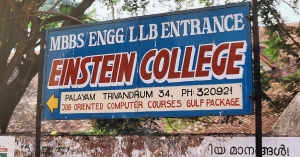
Yesterday (5th August 2023), I chose to look at one of my albums randomly chosen from a box containing several of them. As I flicked through the pictures, I came across one showing an advertisement for an institution called Einstein College, somewhere in India. The location was easy to identify because the college’s address was in the city of Trivandrum (Thiruvananthapuram) in Kerala. Having looked on the Internet, I see that the college still exists.
Two other prints were stored close to the college photograph in the album. So, I guessed they might also have been taken in Trivandrum. One of them shows a building with geometrically decorated walls and numerous small roofs. At first, I thought it might be a temple, but then I wondered whether it was the palace-like museum in Trivandrum, which houses a fine collection of paintings by the Keralan artist Ravi Varma. I checked on the Internet, and discovered my picture shows apart of the museum’s exterior. The third print shows what looks like an enormous terracotta coloured ‘multi-storey’ pigeon coop. It is a cylindrical structure with some helical decorative features. The edifice bears a sign that reads “India Coffee House”. Using that clue, I found that is one of the three branches of the India Coffee House chain in Trivandrum.
Had I labelled these photographs, I would not have needed to do any detective work to identify them and their locations. Sadly, many of my unlabelled prints do not have obvious clues that can help me identify them, and most likely they will remain a mystery. The moral of this story is that it pays to be methodical and systematic occasionally.

 yamey
yamey 