
Two barristers from South Africa stand together in central London

A FEW MONTHS AFTER Mahatma Gandhi was born in India in October 1869, Jan Smuts was born in South Africa’s Transvaal Republic (in May 1870).

In 1893, the young barrister Mohandas K Gandhi, the future ‘Mahatma’, arrived in Durban, South Africa, from Bombay. This was the year before Smuts graduated in law at Christ’s College in Cambridge, England. After passing the Bar examinations in late 1894, he returned to South Africa, where he became involved in politics.

Gandhi remained in South Africa from 1893 until 1915. During his time there, he practised law as a qualified barrister, fought for the rights of Indians in the country, and gradually developed his non-violent approach to protest, which he later practised during the struggle to free India from British domination. During the Second Anglo-Boer war (1899-1902), Gandhi assisted the British with caring for casualties. Meanwhile, Smuts fought with his fellow Boers.

After that war, Smuts was involved with negotiations that led eventually to the union of the four territories, which then became unified as the South Africa we know today. In 1914, the First world War broke out. Smuts fought for the British, most notably in what was then German Southwest Africa, now Namibia. Meanwhile, in 1915 Gandhi returned to India, and the rest is history.

Both Gandhi and Smuts are commemorated by statues in London’s Parliament Square. They stand near each other, but not next to each other. Jan Smuts stands on the north side of the square, and is depicted as striding towards Westminster Abbey. Mahatma Gandhi stands on the east side of the square quite close to the statue of another South African, Nelson Mandela. Gandhi appears to be gazing at the Houses of Parliament.

Seeing those statues standing in the same square today made me wonder how, if at all, Gandhi and Smuts felt about each other. I found an article in a website called “The Observation Post”, which helps understand their relationship. Here are some quotes from it:

“It’s a common misconception that Jan Smuts and Mahatma Gandhi’s relationship was one of animosity. It is a little known fact that both men actually respected each other, remaining life long admirers of one another … Gandhi tried, at all times, to look for the positive in Smuts and said of him that he had a ‘high place among the politicians of the British Empire and even of the world’.”

When Gandhi was about to leave South Africa in 1915, he sent Smuts a pair of sandals that he had made at Tolstoy Farm, a cooperative colony he set up near Johannesburg, from which he ran his campaign of satyagraha (non-violence). Smuts wore these every day when at his farm, and is recorded as having said on Gandhi’s seventieth birthday:

“I have worn these sandals for many a summer, even though I may feel that I am not worthy to stand in the shoes of so great a man.”

Meeting Mahatma Gandhi in 2023

INDIA BECAME A REPUBLIC on the 26th of January 1948. Every year since then the 26th of January has been a public holiday known as Republic Day. On the 25th of January 2023, we met a senior advocate sitting in the Gujarat Club, which is next door to Ahmedabad’s Civil & Sessions Court. After showing us around the court building, he invited us to join him and his colleagues for the next day’s celebration.

The Republic Day celebrations began in the garden of the Court building at 9 am. A few soldiers, some of them armed with automatic rifles, arranged the flag raising. At 9 o clock, the Indian flag was unfurled by one of the senior judges, wearing a colourful pugree on her head, in front of a large group of senior advocates and some of the court’s staff. Many of the female advocates were attractively dressed in saris decorated with the colours of the Indian flag (green, saffron, and white). One of the ladies told us that 25 of these had been specially ordered from Agra.

When the flag was unfurled at the top of the flagpole, everyone sung the national anthem,”Jana Gana Mana”. Then everyone began taking photographs of one another. After this, we moved en-masse from the court garden to the compound of the Gujarat Club, where Mahatma Gandhi met Vallabhai Patel for the first time.

You can imagine my astonishment when I saw an elderly man who looked just like Mahatma Gandhi, both in physiognomy and in his manner of dressing. Holding a wooden staff and dressed in a white dhoti, sandals, and a shawl, he was a highly credible Gandhi lookalike.

Residing in the USA, this Gandhi impersonator has attended many Indian patriotic ceremonies. To date, he has appeared in 35 in the USA and about 60 in Ahmedabad. His presence was a huge success. Everyone wanted to be photographed alongside him. With his sturdy staff in one hand, he held his mobile phone in the other. Had they been available, I wonder whether the real Mahatma would have been happy to use one.

The lookalike took part in the Club’s flag raising ceremony, giving a short speech. After the ceremony was over, we were invited to join the advocates for a special breakfast in the Club. We were served jelebis, ganthia, kadhi, and shredded raw papaya with whole green chillies.

We were very happy to have been invited to join the advocates in their extremely enjoyable celebration of Republic Day at the Gujarat Club. This occasion increased my already great affection for the lovely city of Ahmedabad.

Where Mahatma Gandhi met Vallabhai Patel in Ahmedabad

THE GUJARAT CLUB, the oldest club in Ahmedabad, stands opposite the Ahmed Shah Masjid, the oldest mosque in the city. The club was founded in 1888 by Rao Bahadur Nagarji Desai. With over 1000 members, the much used clubhouse is in an unmodernised condition. Located next to the recently constructed (2020) City Civil and Session’s Court, the Club is a ‘hang-out” and informal meeting place for many senior advocates. In former times, the place was frequented by Ahmedabad’s wealthy Mill owners and high ranking Britishers. It was the first Indian club that admitted Indians as well as Europeans from the moment it was established.

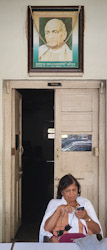
Vallabhai Patel above a doorway at the Gujarat Club

The Club is located close to a house where Sardar Vallabhai Patel (1875-1950) lived. Patel frequented the Club regularly and played bridge there. It was where he first met Mahatma Gandhi in 1916. A tree marks the spot where they chatted.

After having passed the Bar Examination at London’s Middle Temple, where my wife achieved the same thing many years later, Patel came to live in Ahmedabad. The first meeting with Gandhi at the Club marked the start of Patel’s attachment to the Mahatma’s cause. Years later, Patel played a key role in uniting the former Princely States with what had been British India to form the India of today. An important freedom fighter for Indian independence, he became a senior member of the country’s government after 1947. A close associate of Gandhi, the two men chose to differ on how to deal with certain issues, for example the creation of Pakistan.

We sat under the verandah of the Gujarat Club and enjoyed cups of tea. From where we sat we could see a large rectangular open space, which was being used as a car park. The ground was marked out with tennis court lines and a couple of nets were stretched between rows of parked cars.

We began conversing with an advocate at the next table. When he learned that my wife was a barrister, he kindly offered to show us around the neighbouring court building.

We spent well over an hour sitting in various court rooms. Most of these had two layers of glass screens, separating the judges and the court officials from the rest of the room: a covid precaution.

Several things impressed my wife as being different from what happens in British courtrooms. First, the plaintiffs are permitted to speak directly with the judges, rather than via intermediaries such as barristers. Secondly, the judges seemed to be handed the papers of a case at the moment it was about to be heard, rather than in advance. Thirdly, each judge was able to switch seamlessly between fluent Gujarati, Hindustani, and English. Also, they made decisions far more rapidly than their counterparts in the UK.

After our fascinating visit to the court house, our host and a charming advocate from his firm invited us to return to the court and the Club to celebrate Republic Day on the following morning, the 26th of January 2023. We accepted, and I will describe the events in another essay.

Our visit to the vibrant Gujarat Club proved far more exciting than we had anticipated. What was once a place where mill owners rubbed shoulders with British officers and officials, where Patel first met Gandhi, is now a congenial place where advocates meet, converse, read, and relax.