From Lahore to London but he did not live long

THE WHITECHAPEL GALLERY in London’s Aldgate area often hosts exhibitions of adventurous art, and has been doing so for many decades. The current show “Hamad Butt: Apprehensions”, which is on until 7 September 2025, displays works by an artist Hamad Butt. He was born in Lahore (Pakistan) in 1962, and died of AIDS in London, aged only 32. His family brought him to London when he was 2 years old. He studied art at London’s Goldsmith College, Morley College, and Central Saint Martins.

Familiars 3

The ground floor of the Whitechapel Gallery contains three enormous sculptures. Together they form an art installation, which the gallery’s website described as follows:

“Familiars 1: Substance Sublimation Unit is a steel ladder made of glass rungs, each filled with an electrical element and crystals of solid iodine. The current ascends the ladder, intermittently heating the rungs, causing the iodine to sublimate into a purple vapour. In Familiars 3: Cradle, named after Newton’s cradle, 18 vacuum-sealed glass spheres are filled with lethal yellow-green chlorine gas. If smashed together, the gas – a respiratory irritant – would be released into the air. In Familiars 2: Hypostasis, three tall, curved metal poles, reminiscent of Islamic arches, contain bromine-filled tubes at the tips.”

Well, they were visually intriguing pieces of conceptual art. What they stand for is almost more important than their physical appearance.

Upstairs, the galleries are hung with paintings, drawings, and prints. There is also another installation that contains a set of lights emitting ultraviolet rays. Visitors are provided with protective goggles when viewing this exhibit called “Transmission”, which is yet another example of conceptual art that you need to read about to make any sense of it.

What saved the exhibition for me was the display of Butt’s paintings and prints. Ranging from almost figurative to abstract, they appealed to me immediately.  It is a shame the artist lived for such a short time. That which he produced in a few years, I am sure, would have led to him becoming a noteworthy artist with a fascinating output.

An artist from Pakistan at an Indian art gallery in London

THE CHEMOULD ART Gallery was founded in Bombay (Mumbai) in 1963, and ever since then it has been an important player in India’s modern art world. Until 8 June 2025, it is holding a temporary exhibition at London’s Frieze at number 9 Cork Street. The exhibition is of works by Rashid Rana (born 1968).

Rana was born in Lahore (Pakistan), where he is currently the Dean of the School of Visual Arts and Design at BNU (Lahore). Apart from being an artist, he is also a curator and an educator. He is considered to be one of Pakistan’s most innovative artists.

The exhibition in Cork Street includes 4 intriguing images. Each one consists of a mosaic of thousands of tiny photographic images, each one not much larger than a passport photograph. The photographs are not arranged randomly and subjects in neighbouring photographs seem to be unrelated to each other. They are put together in ways that when seen from a distance, form either large objects or abstract patterns. The resulting images are both fascinating and unusual.

Rana has exhibited in many parts of the world. These places are listed on the gallery’s handout and on the artist’s website. However, as far as I can determine, India is not one of these places. I wondered whether this related to the fact that an Indian gallery is displaying his works not in India but in London.

Dragons in Mayfair and an artist from Pakistan

ONE GREY SEPTEMBER afternoon, we stepped into the Almine Rech gallery in London’s Mayfair a few days before its wonderful exhibition of paintings, “Summer of Dragons”, by Hiba Shahbaz was due to end (on the 28th of September 2024). Each of the works on display depict dragons, and some of them also include human figures, often scantily dressed.

Hiba was born in Karachi, Pakistan. She studied Indo-Persian miniature painting in Lahore’s National College of Art. Then, she studied in the USA at the Pratt Institute in Brooklyn (New York City), where she was awarded her Master of Fine Arts degree. She now lives and works in the USA.

The skills she gained while training to paint Indo-Persian miniatures can be seen in the much larger paintings, which are on display at Almine Rech. Some of the paintings evoked memories of Chinese or Japanese art. Others depict dragons in the company of naked women. All the paintings, including some wooden boxes decorated with paintings, were completed in 2024. I suspect that had she remained in Pakistan and produced the same images, those containing the nudes might have been severely frowned upon.

We left the gallery, feeling very satisfied with what we had seen. Although the clouds above us had become more threatening, the visual experience of the exhibition brightened our moods.

Bringing India to Queen Victoria in England

OSBORNE HOUSE ON the Isle of Wight was one of Queen Victoria’s favourite residences. Apart from one room within it, I was not overly impressed by the place. That room, which alone is a very good reason to visit Osborne, is the ornate Durbar Room. Entering this vast hall is like stepping inside an exuberantly decorated Maharajah’s palace somewhere in India. It is a superb example of the Indo-Saracenic style, which is according to one definition (on Wikipedia) was:

“… a revivalist architectural style mostly used by British architects in India in the later 19th century, especially in public and government buildings in the British Raj, and the palaces of rulers of the princely states. It drew stylistic and decorative elements from native Indo-Islamic architecture, especially Mughal architecture, which the British regarded as the classic Indian style, and, less often, from Hindu temple architecture.”

The Durbar Room was built not in India but in the country that ruled it at the time. It was designed not by a British architect but by a man from British India – Ram Singh (1858-1916), who was born in Rasulpur in the Punjab (now a village in Pakistan). His skills were recognised at a young age when he was seen working in a woodcarver’s shop in Amritsar. The man who spotted his talent was Rudyard Kipling’s father, the art teacher Lockwood Kipling (1837-1911). At the time, Lockwood was the first principal of the Mayo School of Industrial Arts, Lahore (established in 1875). He enrolled Ram as a student. Ram Singh was a successful student and soon became assistant drawing master at the school and Lockwood’s protégé. The two men collaborated in many important projects including designing Aitchison College in Lahore, the Mayo School in Lahore, and both the Indian Passage and ballroom at Bagshot Park (near Windsor). The work he had done in England led to him and Lockwood Kipling being given the commission to design the Durbar Room at Osborne.

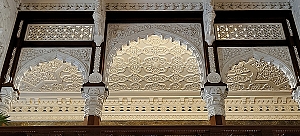
The Durbar Room was designed to accommodate large ceremonial occasions and to reflect Queen Victoria’s exalted position as Empress of India, a role created by the British Parliament in 1876. This room, completed in 1891 as an extension of Osborne House, with its riotous array of mainly Mughal-style plasterwork decorations might have served yet another purpose. By the time it was completed, Victoria had never visited India, and at the age of over 70 years was unlikely to do so (and never did). In a way, the Durbar Room brought India to Victoria, and judging by its appearance, did so very well.

Macchiavelli and spicy masala meat dishes

RAAVI KEBAB BEGAN serving Pakistani and Punjabi food in the mid-1970s. It is located on Drummond Street, close to London’s Euston Station. This unpretentious eatery with barely any internal decoration except some mirrors with Koranic verses engraved on them in Urdu script, is next door to the Diwana Bhel Poori House. It was at the latter that we used to enjoy Indian vegetarian dishes when we were undergraduate students at nearby University College London during the first years of the 1970s. In those days, Raavi, named after the river that flows through the now Pakistani city of Lahore, did not yet exist. It was only in the early 1990s that a friend visiting from Bombay suggested that we ate with him at Raavi’s. When the grilled kebabs arrived at our table, it was love at first bite. We have been returning to Raavi’s ever since.

Raavi’s with Diwana in the backround

Yesterday (1st of September 2022), we made yet another visit to Raavi’s. As we sat down, I noticed a thick wad of photocopies held together with a bulldog clip. They were resting on top of a neatly folded shawl. Out of curiosity, I looked at the top sheet, which was a page copied from a book with annotations added in red ink. I looked more carefully and noticed that the printed text was in Italian. The page was headed “<De ingratitudine> Joanni Folci Niccolaus Maclavellus”. It is a chapter (‘The ingratitude of Joanni Folci’) from a book by Niccolò Machiavelli (aka Maclavellus), who lived from 1469 to 1527. The rest of the text on the photocopied page appeared to be a learned commentary on Macchiavelli’s chapter.

I do not know why, but I felt that Raavi’s was the last place I would expect to find scholarly papers lying about so casually. I associate the place, as do most of its many customers, with grilled meat and spicy masalas. I asked the waiter about the papers. He shrugged his shoulders and said that someone must have left them behind after eating, and that he had no idea whether anyone would return to retrieve them.