BASILDON PARK IS an 18th century neo-classical mansion not far from Reading. From 1949, the house was owned and restored by the 2nd Baron and Lady Iliffe. They lived in it for 25 years. In one room on the ground floor, which contains the fascinating sketches made by the artist Graham Sutherland for his tapestry in Coventry Cathedral, there are four chairs. Two of them have the insignia of King George VI embroidered on their covers, and the other two are embroidered with the insignia of Queen Elizabeth II.
A National Trust volunteer guide working in the house explained that the 2nd Baron and his wife had attended the coronations of both King George VI and Queen Elizabeth II. The chairs were those they had sat on during these ceremonies. After the coronations, so the guide told us, the Iliffes bought the chairs they were sitting on to keep as souvenirs. The proceeds of sales such as this helped to pay for the coronation events.
Seeing these chairs reminded me of another chair, which I saw in a cousin’s house in Cape Town, South Africa. It was in this chair that Queen Mary (wife of King George V) had sat for a few minutes when she paid a brief visit to the Mayor’s house in King Williams Town (now called ‘Qonce’) in South Africa in 1946. The Mayor was my mother’s uncle. His grandson, my cousin, has kept this souvenir of the royal visit. I saw it when I visited him in Cape Town. Unlike the chairs at Basildon Park, there is no royal insignia on it.
WHEN MY FATHER sold our family home in Hampstead Garden Suburb in the early 1990s, he gave some of his unwanted possessions to some neighbours, who still live opposite. They stored much of it in their attic. Recently, a plumbing problem required them to empty the attic. Soon after this, we paid them a visit as we had not seen them since before the start of the covid19 pandemic and its associated lockdowns. Amongst the stuff they removed from their attic, they found a sturdy, brown leather suitcase in a well-worn canvas protective covering. The covering was stencilled with the letters ‘BSY’, these being my father’s initials.
The canvas case bears an oval label, which was provided by the “Holland-Afrikalijn”. It states that the suitcase was “For the cabin” and the name of the ship’s destination was “Southampton”. The ship carrying this case was the “Jagersfontein”, and the label bears the date “3/9/55”, There is another torn label, which was issued by South African Railways and what is left of it is “T Elizabeth”, which probably was “Port Elizabeth” before it was torn. This suggests that the case must have travelled to and/or from Port Elizabeth by rail. A third label, which is circular and was stuck on by the shipping company bears a large capital “Y”.
By September 1955, I was three years (and a few months) old. That year, my parents, who were born in South Africa, took me from London, where we lived, to be shown to family and friends in that country. I remember almost nothing of that visit apart from two things. One of them was getting my small foot caught in the groove of the tram-like track of a mobile dockside crane. The other thing was being afraid of the cacti in a greenhouse in a park in Port Elizabeth, the city where my father’s sister and his mother resided.
I know that we also visited King Williams Town, where many of my mother’s family lived. This visit was recorded in a 1955 issue of the town’s “Cape Mercury” newspaper. I discovered it while I was researching information about my mother’s grandmother, who lived in the town. The newspaper article, which is full of small inaccuracies, described me as being “… an adorable little son, aged three …”.
The Jagersfontein has an interesting history (http://ssmaritime.com/fontein-ships-1.htm). Built in Danzig (Germany) in 1939 and given another name, it was badly damaged during WW2, and it sunk. In 1947, she was recovered from the sea, towed to Holland, and refurbished by the Dutch. In September 1947, she began sailing again, as a passenger-cargo liner.
During the voyage from Southampton to South Africa, I crossed the Equator for the first time in my life. My mother told me that when the ship carrying us crossed the Line, a fancy-dress party was held for the children onboard. Some of the parents knew that this would happen and had come prepared with fancy-dress costumes for their children. However, my mother was unaware that this would happen. Being a creative person, she took some of the white bed linen from our cabin, and fashioned a Roman toga for me to wear at the party.
My mother died 44 years ago. Only a few days before we saw the suitcase at our old neighbours’ home, I was rummaging through some photographs that I had not seen since her death. It shows me in my rapidly fashioned bedsheet toga, standing between two larger children dressed up to depict Belisha beacons (that mark so-called ‘zebra’ pedestrian crossings). A small cloth with black and white stripes, representing a zebra crossing, separated the two beacons. Behind the three of us are some adults, whom I cannot recognise.
Empty, the leather case, which looks almost new, weighs 6.3 kilogrammes (13.9 lb). In 1955, passengers travelling by ships such as the Jagersfontein did not need to worry about the weight of their luggage. There were plenty of porters to carry it. We have been given the suitcase, which our daughter is keen to have because it is a family heirloom with sentimental value. Along with the photograph and the newspaper cutting, the case is a wonderful reminder of my first ever travel adventure.
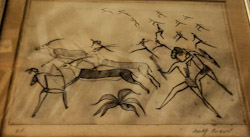
WHILE I WAS STUDYING to become a dentist (in the late 1970s), I used to attend an etching and engraving class in a studio in West Hampstead’s Sumatra Road. The class was supervised by the owner of the studio, my mother’s cousin Dolf Rieser (1898-1983). Like my mother, he was born in South Africa. They were both born in King Williams Town, but he was 23 years older than her.
An engraving by Dolf Rieser
Dolf ‘s childhood memories evoke South Africa as it was at the turn of the century (19th/20th) and are recorded in his unfinished autobiography (dolfrieser.com). Here is an extract that gives a flavour of them:
“The climate of King William’s Town was particularly difficult to bear and my mother suffered greatly especially where her nerves were concerned. I vividly remember her awful attacks of migraine when she had to stay in a darkened room. In the end we decided to leave South Africa, as I shall relate later on . My uncle, my mother’s brother, was at that time living on the border of Basutoland. He was running a small trading post and also kept some horses and sheep. This place was right up on the high plateau and was called Moshes-Ford after the famous Basuto chief, Moshes. My uncle invited us up to him for a holiday and I think we first took a train and then had to continue by horse and carriage, which presumably was also the postal service at the time. I remember well an “ooutspan” for lunch near an immense field full of dried bones and skeletons. These were the remains of the “Rinderpest” which shortly before had nearly wiped out the cattle of South Africa. I played football with a cow or ox skull, very much to the annoyance of the grown-ups. The following night we had to spend at the German Pastor’s home and I remember how impressed I was with the enormous bed and unknown eiderdowns.”
The ’Rinderpest’ was a disease that afflicted cattle.
During his classes at Sumatra Road, he would regale us with stories of Paris in the 1920’s and 1930s, when he was there learning etching an engraving in the studios of both Stanley Hayter and Joseph Hecht. One story that sticks in my mind is how he used to attend the same Parisian café as Pablo Picasso. The great master sat at one table alongside the the other leading artists in Paris, and junior artists like Dolf sat close by at another table.
Dolf was an excellent teacher. He showed us how to etch and engrave. However, what impressed me most is that he had the ability to look at his students’ works in progress, understand what we were trying to achieve, and then provide constructive (rather than prescriptive) advice.
I really miss Dolf, even though it is so many years since he died. He had a wonderful sense of humour, was a wonderful raconteur, and, having once trained as a biologist (before becoming an artist), a wonderfully adventurous approach to his métier.
The first time I encountered the term ‘fire plug’ was when I was researching the life of my great grandfather Franz Ginsberg, who died in 1936. As an 18 year old, he went from his home in the German Empire to the South African town of King Williams Town in 1880. By 1885, he had established a factory for making matches. Such factories are full of raw materials that are prone to catching fire. As his business grew, so did his need for a reliable water supply for dealing with fires.
Water in the Eastern Cape was expensive in the late 19th century. Franz had to apply to the town council for permission to increase the supply of water to his factory. He also needed permission to install more fire plugs. In my published biography of my great grandfather, I wrote:
“Almost a decade later, in 1898, Franz and his brother-in-law Mr Siegfried Salomon (who married Franz’s sister Ida and was a Town Councillor for a while) both applied to the Town Council to have ‘fireplugs’ placed on their premises. This was allowed on condition that the applicants paid the expense of placing them there; and that they would be liable to other charges including a fine of £25 if they used the water from these for any purpose other than the extinction of fire.”
Recently, I visited Windsor Castle, where I saw several signs such as is shown in the illustration to this blog article. They indicate the locations of fire plugs in the castle. Had I not seen the term ‘fire plug’ before while writing about my ancestor, I might not have noticed these small old-fashioned signs.
So, what, you might be wondering, is or was a fire plug? The modern term for them is ‘fire hydrant’. The fire plugs, which were precursors of fire hydrants were simply holes made in the water mains pipe, which were blocked with a plug. The plug could be removed when water was required to extinguish fires.
I suspect that you are by now asking yourself if Franz ever had to make use of the plugs he had requested. Well, he did occasionally:
“In February 1893, the Cape Mercury newspaper published a long article about Franz’s match factory. It begins with a spark of humour:
‘In December last an unusual illumination made a “King” industry more widely known than before. A fire broke out in, and consumed the drying shed at Messrs. Ginsberg & Co.’s Lucifer Match Factory, which is situated in Victoria Street. The loss was not great, but the advertisement was extensive – and cheap – for it was gratuitous.’”
If you want to know more about my ancestor who went to South Africa in search of prosperity and later became a senator in that country, please read:
“Soap to Senate: A German Jew at the dawn of apartheid”
by Adam Yamey.
It is available from: lulu.com, Amazon, bookdepository.com and Kindle
We visited South Africa in 2003. Wherever we parked, young men offered to ‘look after’ our hired car for a small fee. It was NOT a good idea to turn down their offers!
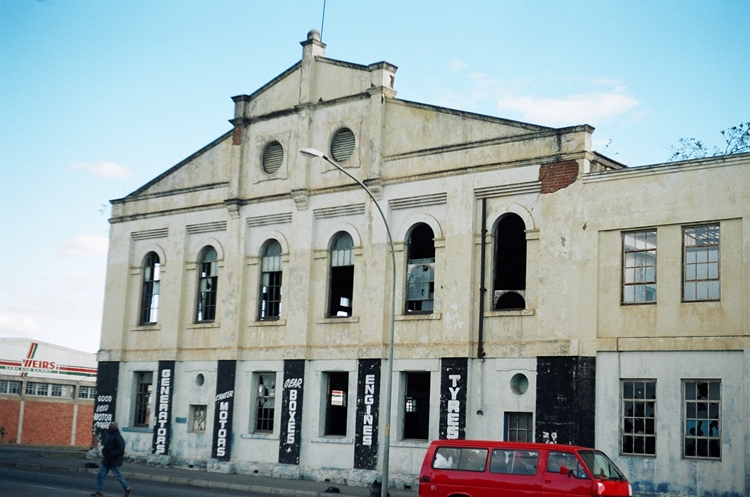
My great-grandfather, Franz Ginsberg, began industrial enterprises in King Williams Town in the late 19th century.
Once part of my great-grandfather’s factory in King Williams Town
We drove the short distance to the Amathole Museum (formerly called the ‘Kaffrarian’) in King Williams Town. Our car-minder was David, a friendly young man, who appeared to live in a derelict car parked near the museum…
We returned to the museum on the next day. We received a friendly greeting from David, our car minder from the day before. He offered to wash our car whilst we were away. As it needed this, we agreed. We met the curator again. She had prepared a vast number of photocopies for me. I returned the photograph album, we chatted briefly, and bid farewell.
We had a quick look around the large museum. One exhibit in the Industry Section was a poster exhorting people not to buy imported matches but instead to buy locally made matches, that is matches made by Ginsberg & Co (my great-grandfather’s company). Near this is a picture of another large enterprise, King Tanning.
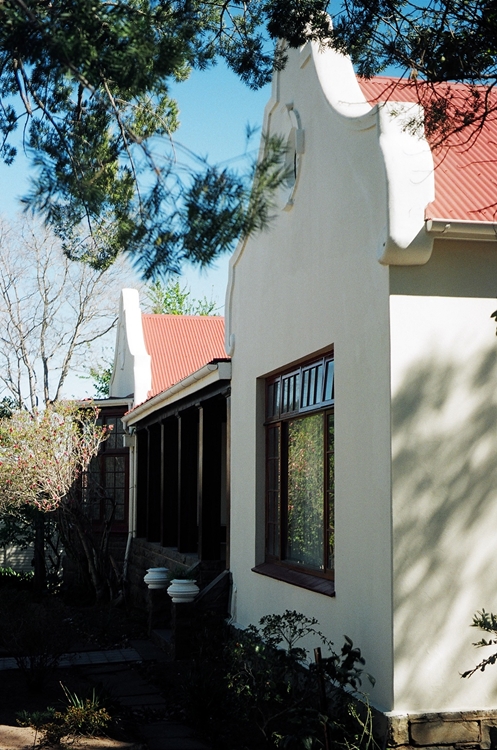
My great-grandfather’s home in King williams Town
The museum has an enormous collection of stuffed animals. The curator said that this collection was better than the Kruger National Park, and that the animals were easier to see, as they don’t move around! The best known of these animals is Huberta, the Hippo. This creature, in the 1920s, wandered many 100’s of miles south from its tropical habitat in the north of the country and passed through King Williams Town. Near Port Elizabeth, an ignorant farmer ended her life by shooting. The body of Huberta was sent to London for taxidermy before returning to South Africa to its present home.
David, the car-minder, and his friends
After about an hour we left the museum. David and some of his friends had just started to clean our car. We watched them perform this procedure painfully slowly. Eventually, it was sort of done. To some extent it was a bit cleaner that before! We said good-bye and David asked to visit him again. He asked us to bring him a shirt and a pair of shoes on our next visit to King Williams Town.





 yamey
yamey 