Mediaeval paintings on a wall in a church in Kent

ON OUR WAY to visiting friends, who live in Tonbridge (Kent), we stopped to look at the Church of St Thomas à Becket in the village of Capel. The saint lived from c1120 until his murder in 1170. An old tree in the churchyard at Capel is fenced off and alongside it, there is a label that informs the reader that the saint was:

“… supposed to have preached beneath this lovely old yew tree.”

Given that it is now the year 2025, the very latest that he could have preached beneath this tree would have been 855 years ago. As some yew trees can remain alive for several thousand years (https://fortingall-graveyard.org.uk/yew-tree), it is quite possible that the venerable yew at Capel was around when St Thomas à Becket was active.

The interior of the church offers visitors a wonderful surprise. The north wall of the church has many sizeable fragments of wall paintings that were uncovered in 1927. They had been covered with whitewash (paint) during the Reformation (sixteenth century) during which church decorations were largely removed, destroyed, or hidden. Experts believe that these paintings were executed in two periods: in about 1200 and then about 50 years later. The subject matter of these wall paintings was religious, designed to convey bible stories to those parishioners who could not read, and who did not understand Latin, then the language used during church services.

Amongst many other fascinating things in this small church, the communion rail caught my attention. Carved in the seventeenth century, it bears the date 1682 and the name “Michael Davis”. According to an informative leaflet in the church, in the 1630s Archbishop Laud (1573-1645) recommended installing such rails to prevent dogs from entering and defiling the sanctuary that contains the high altar. The simple stone altar was made in 1979 to replace a seventeenth century communion table that had been stolen. Like mediaeval stone altars, the modern one at Capel is inscribed with five crosses, which symbolise the five wounds made in the crucified Christ.

Although still consecrated, the church is not used often. It is now cared for by The Churches Conservation Trust and left open during the day for visitors to enter. For those interested in seeing mediaeval wall paintings in Kent, apart from at Capel there are fine examples at: Chiddingstone, Newington-next-Sittingbourne, Stone, and Barfreston.

A small hamlet in Kent with many memories

GODDEN GREEN IS a tiny hamlet next to Knole Park, close to Sevenoaks in Kent. There is not much to the place, but it has a special place in my heart, and seeing the place, or even thinking about it, makes me nostalgic. You can discover why by reading my book “AN ALPHABETICAL TOUR OF ENGLAND”. The book and Kindle are available from Amazon https://www.amazon.co.uk/gp/aw/d/B0FVV6JLZ7/

Green hops and beer at a pub near Tonbridge in Kent

THROUGHOUT THE COUNTY of Kent, you will spot the conical roofs of oast houses in which the hops used to flavour beer are dried. Many of these curious looking buildings are no longer used for their original purpose. Many of them have been converted into picturesque residences. In late October 2025, we booked a table to eat lunch at the Dovecote Inn, a pub near Capel, which is not far from Tonbridge in Kent. We were advised that it might be noisy because there would be a beer festival going on when we were there.

The event was “The Dovecote Green Hop Festival”. Green hops, sometimes called ‘wet hops’, are hops harvested from the vines (the ‘bines’), and used to make beer within 24 hours of having been picked. The beers produced with these fresh, rather than dried, hops, have their own distinctive flavours, which are fresher and more vibrant than other beers. This is because the green hops contain ingredients that are lost when hops are dried out. However, to produce beer with the freshly picked hops, a far greater quantity of hops is required than when using the dried ones. I tried one of the green hop bitters, and it tasted wonderful.

The Dovecote Inn turned out to be a delightful, small late eighteenth century establishment. Its landlord was extremely friendly, as were his team of staff. Although we had to wait a long time for our food, it was well-worth waiting for. As for the noisy festival about which we had been warned, it did not seemed to have taken off by the time we ate there early on a Friday afternoon. We looked around at the customers and amongst about twenty people, only four of them were drinking beer. I suspect that had we stayed until the evening, the beer consumption level would have increased by then.

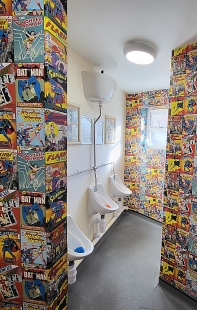
On the way out, I paid a visit to the men’s toilet. This was a sight to be seen. The walls of this part of the pub are covered with an eye-catching wallpaper whose design is a dazzling collage of American comic covers (“Bat Man”, “Wonderwoman”, Superman”, etc.).

Only a few miles from Tonbridge, The Dovecote Inn is well worth a visit, but if you plan on eating there, leave plenty of time.

Wonderful stained-glass windows at a church in the countryside of Kent

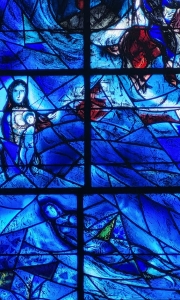
IT IS NOT EVERY day that when one walks into a remote English country church, you are confronted by set of stained-glass windows that were designed by a famous Jewish early Modernist artist. At Tudely, near Tonbridge in Kent, the church’s stained-glass windows were designed by none other than the famous artist, Marc Chagall (1887-1985). I have visited the church several times, and each time I am even more amazed than on previous visits.

You might be wondering why windows designed by an artist as famous as Chagall are in a small, isolated parish church. To discover the reason for their presence, you should get a copy of my book “An Alphabetical Tour of England”, and read about the tragic event that led to the creation of these fascinating windows. The boo is available from Amazon sites such as:https://www.amazon.co.uk/ALPHABETICAL-TOUR-ENGLAND-Adam-Yamey/dp/B0FVV6JLZ7/

Down the slope to an uncertain fate in France and Flanders

A PARABOLIC ARCHWAY made of stainless-steel straddles a pedestrianised roadway on the clifftop near to the harbour in Folkestone (Kent). A few yards east of the archway, the road descends steeply towards the harbour and a pier from which ships used to sail to and from Fance. The impressive metal hoop was inaugurated in 2014 by Prince ‘Harry’, son of King Charles III. It commemorates the one hundredth anniversary of the start of WW1. The roadway that runs along the clifftop and then down to the harbour is now known as Road of Remembrance. On a fence close to the archway, there are thousands of crocheted poppies, lovingly made by women mourning the tragedy of the so-called Great war.

It was along this road and down the slope, formerly known as Slope Road, that during the Great War (1914-1918) millions of soldiers and auxiliary staff marched from nearby Shorncliffe Camp to the harbour, where they embarked on ships that carried them across the English Channel to war-torn France. As a BBC website page (www.bbc.co.uk/news/uk-england-22892729) related in connection with the roadway:

“For many of the millions of servicemen making their way to the trenches of World War I it was the last part of Britain they stepped foot on.”

The archway, which is close to the steep slope is called the Step Short Memorial Arch because as the website explained, “Step Short” was:

“… the order given to the marching men to shorten their stride as they went downhill.”

When we visited Folkestone in July 2025, we were able to walk beneath the arch, see the poppies, and read the various emotional commemorative information panels near it. However, the sloping part of the road leading down to the harbour was closed off for repairs. The banks lining the slope had begun to subside making it hazardous to be on this historic stretch of road.

I was very much moved by the Road of Remembrance, the archway, and the various memorials. For many of those who marched down that steep slope, it would be the last time they would ever see England. For, as is recounted in a British Parliamentary website (www.parliament.uk/business/publications/research/olympic-britain/crime-and-defence/the-fallen/), during WW1:

“… 880,000 British forces died, 6% of the adult male population and 12.5% of those serving.”

That means that about one out of every eight men walking along where the arch now stands and then down the slope would die across the Channel in France or Flanders.

The pointlessness of war.

Numbered pebbles to remember the dead in Folkestone

ON THE FIRST of July 1916, 19 thousand two hundred and forty British soldiers were killed during the first day of the Battle of the Somme. A memorial on the Leas Cliff promenade in Folkestone, Kent, remembers them, not by name but by number.

In 2008, the artist Mark Wallinger created an artwork called “Folk Stones”, which can be viewed at Leas Cliff. It consists of a square area containing 19,240 pebbles. Each one represents one of the victims killed on that first day of battle in 1916. Just as each of the soldiers had his own service number, the artist has numbered each of the stones in his artwork.

It is a simple creation, but one that is very moving.

Bungalows of historical interest in Birchington (Kent)

DURING OUR RECENT visit to east Kent, we spent two nights in a bed and breakfast (‘B&B’) on Spencer Road at Birchington. Despite visibility being restricted by torrential rain when we arrived at the accommodation, I was able to see that there was an attractive sgraffito frieze around the house at the level of the first floor. Even in the poor light, I could make out that frieze was created in the Arts and Crafts Style, which was popular in the last quarter of the nineteenth and first quarter of the twentieth centuries. Our B&B was called The Old Coach House, and I will explain why soon.

Visitors to English coastal towns will have seen the huge numbers of bungalows (single-storey dwellings) that they contain. What many people might not know is that “… England’s first bungalow was built in Westgate in 1867” (www.birchingtonheritage.org.uk/articles/bungalows.htm). Birchington, which is a few miles from Westgate was home to the country’s first bungalow estate. This comprises five bungalows, each with its own watch tower. They are next to Coleman Stairs, which is a steep path leading down from the clifftop to the seashore. The bungalows, close to the cliff edge, were ready for use in 1880 and are accessed via a private lane from Spenser Road.

Each of the bungalows was provided with its own coach house, which accommodated the householder’s servants, carriages, and horses. Our B&B was one of the coach houses. It has been converted into a residence. Our first-floor bedroom would have once been one of the servant’s rooms. A small staircase leads from the ground to the first floor. This was added long after the building ceased to be a coach house. Before this was added, the servants accessed the first floor by an outside staircase, which no longer exists,

The sgraffito friezes on each of the three former stable blocks that we saw are in good condition. The coach houses were built in about 1882 and designed by John Pollard Seddon (1827-1906), who was closely associated with the Pre-Raphaelite group of artists. The sgraffito work on the coach housed is said to have been created by the sculptor George Frampton (1860-1928), whose other works include the Peter Pan statue in Kensington Gardens and a statue of Queen Victoria in the grounds of the Victoria Memorial in Kolkata. An article published in the Thanet Times in the 1970s revealed:

“Frampton as a youth was a friend of the artist Solomon J. Solomon, a well known artist of his day, who had bought the annex, “The Porch,” in Spencer Road, Birchington, which was the coach house to his main house called “Whitecliff” – one of the famous Tower Bungalows.  George Frampton came to live with the Solomon’s when he was a penniless sculptor, fresh from years of apprenticeship to his profession.  Solomon wanted to help Frampton and suggested that he might create frescoes round the upper part of his new house.  Frampton made this a labour of love.  He was 22 years old at the time – 1882 ,,, But the name of his benefactor is almost forgotten – but not Frampton’s frescoes.” (www.birchingtonheritage.org.uk/)

When we booked the B&B, we had no inkling of its historical interest. We had a comfortable stay there, and were well looked after by Tim, our friendly host. His affectionate dog Louie added to our enjoyment of the place.

From Cairo to Kent and Karl Marx

IN RECENT YEARS, the seaside town of Margate in Kent has become much more of a “trendy” destination than it used to be. From being yet another coastal resort, it has become a magnet for those interested in contemporary art. This is because of the presence of the Turner Contemporary Gallery, Tracey Emins’s gallery, and the Carl Freedman gallery … to mention but a few places. With the influx of tourists with sophisticated tastes, the town has become home to a range of restaurants, which is more varied than in many other seaside towns in north and east Kent.

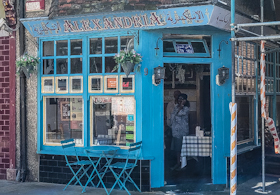
About 6 years ago, a husband and wife from Cairo (Egypt) set up a tiny restaurant on a corner plot in the old centre of Margate. It is called Alexandria Café. The owners chose the name not because they come from Alexandria, but because like the Egyptian city, Margate is by the sea.

Only open on Fridays, Saturdays, and Sundays at present, this restaurant serves beautifully prepared, tasty Egyptian dishes at very reasonable prices. We tried koshari, falafel, baba ganush, pickled tomato salad, and mint tea. Although these are all without meat, non-veg dishes are also available.

The tiny, comfortable eatery is decorated with photographs of Egyptian film stars. A small television screen was showing old Egyptian films.

A few doors away from the lovely Egyptian cafe, there is an ice cream parlour. What makes it special is that in 1866, Karl Marx stayed in the building.

We did not try the ice cream, but I can safely say that of all the places I have eaten in Margate, having visited the place many times, Alexandria is the best.

The artist Marc Chagall and a church in rural Kent

A TRAGEDY OCCURRED on the 19th of September 1963. Aged 21, Sara Venetia d’Avigdor Goldsmid lost her life in a sailing accident. She was the daughter of Major Sir Henry Joseph d’Avigdor-Goldsmid, (1909-1976) of the Jewish faith and his wife Lady Rosemary d’Avigdor Goldsmid, an Anglican. The family lived at Somerhill, a Jacobean mansion (now a school) near to the church of All Saints at Tudely (just under 2 miles east of Tonbridge). Lady Goldsmid and her daughter Sara used to worship in this small church, which dates to mediaeval times, if not before. Much of the existing structure was constructed in the 13th and 14th centuries, but it was heavily restored in the 18th century.

After Sara’s death, her parents wanted to do something to perpetuate her memory. They and others decided to restore the church. Part of this operation was to replace the existing plain glass east window with a commemorative window, which they asked the artist Marc Chagall (1887-1985) to design for them. This Jewish artist was chosen because Sara and her mother had admired Chagall’s stained-glass at an exhibition they had visited at the Louvre in Paris (France). These included some of the windows that Chagall had created for the synagogue of the Hadassah Medical Centre in Jerusalem (Israel). They were installed in 1962 after having been exhibited not only in Paris but also in New York City.

Chagall created the drawings for the windows, and they were translated into stained-glass by Charles Marq (1923-2006) of Rheims (France). When Chagall visited Tudely, and saw his window after it was installed and dedicated in December 1967, he was so satisfied with it that he offered to create stained-glass images for all the other windows in the church. His offer was accepted. He managed to complete this work, but it was some years before the congregation at Tudely finally agreed to replace the existing Victorian stained-glass windows in the church with those created by Chagall. It was only some time after the church warden, Kenneth Stinton, had seen the Chagall windows on display at the Royal Academy of Arts in Piccadilly in 1985 that the idea of replacing the Victorian windows with Chagall’s became acceptable. They were placed in the church by December 1985.

Many of Chagall’s windows at Tudely are rich in dark blue colouring. Entering the church and finding it suffused with predominantly blue light is like entering an underwater space. This might be intentional as poor Sara d’Avigdor Goldsmid’s life ended beneath the water of the coast near Rye (Sussex). If she saw anything at all as she sunk beneath the sea, it might well have been such a dark blue light. I have visited Tudely’s church several times, and each time the same thought occurs to me. My first visit must have been in the 1980s after December 1985, because I have never seen the church without all the Chagall windows installed.

The church is in a rural setting, surrounded by fields. It has become a tourist attraction, and is occasionally used to hold chamber music concerts, one of which I attended in the early 1990s when I was still practising dentistry in north Kent. Although a little remote, this gem of a church is well worth making an effort to visit it.

A sculptor who uses both her digits and digital technology

THERE IS AN EXHIBITION of sculptures by Lynda Benglis (born 1941) at the Turner Gallery in Margate (Kent). They are produced using a combination of traditional modelling and modern technology.

First, she makes small versions of these in clay. Then she scans them digitally. Using computer software, she magnifies the 3D (three-dimensional) scan. Next, she uses a 3D printer to create exact but greatly enlarged plastic replicas of the original clay models. These are then used to create the final metal casts – the sculptures seen at the exhibition.