
UNITY BUILDINGS IS a collection of low blocks near to Bangalore’s Town Hall. The buildings are arranged each side of a long Central avenue. I am not sure when they were built but my suspicion is that they were constructed in the 1970s.
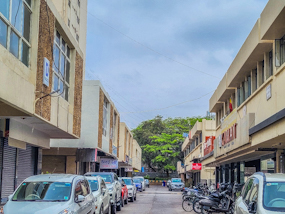
At one end of the central avenue, there is an older building, Haigh Memorial Hall, which was built in the 1920s. Constructed to commemorate a Wesleyan missionary, Reverend Henry Haigh, this grey coloured edifice houses an Air India office. Haigh arrived in India in 1875, and during his long stay there he did much work to produce publications in the Kannada language. He returned to England in 1903. The Unity Buildings complex stands on land owned by one of the churches in Bangalore.
We visit Unity Buildings for several reasons. First, there is a Kashmiri shop, where over the years I have bought excellent woollen Pullovers (sweaters). Another reason is to visit two shops that offer good selections of silk scarves and other garments. One of them is Janardhana Silk House and the other, the less costly Shobha Silks.
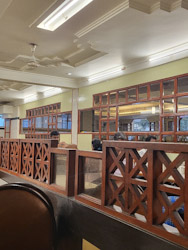
The third reason to visit the complex is to enjoy good South Indian filter coffee and vegetarian snacks a the Unity Buildings branch of Kamat. According to a sign within the restaurant, this Kamat company has been in business since 1948, when it was founded by Sri Rangappa Pandurang Kamat (1919-1993). Other branches of Kamats were established by Rangappa’s younger brother Sri Sheshagiri Pandurang Kamat (1926-2002). The Unity Buildings branch of Rangappa‘s company was opened in 1972, and maintains its original appearance, apart from new overhead lights.
Usually full of customers, Kamat in Unity Buildings was almost empty on Republic Day this year (2026). When we stepped inside, we were given a warm welcome by the manager, whom I imagine was pleased to see at least two customers on such a quiet day.
On normal working day, Unity Buildings is a bustling place, but never as busy as, say, Bangalore’s Commercial Street area and KR Market (City Market). However, it is a pleasant place to shop for various things.
 yamey
yamey 