
An artist who expanded the art of playing cards

GANJIFA IS A traditional art of decorating playing-cards. Ganjifa cards originated in Persia and spread to India. They can be rectangular but are often circular. Traditionally,  the Indian cards were decorated with scenes from the Ramayana.
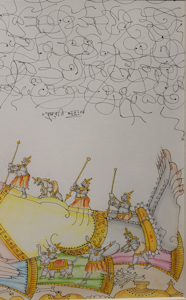
 

By Raghupati Bhat

In the 1980s, Indian artist Raghupati Bhat revived the Mysore tradition of ganjifa painting. The Victoria and Albert Museum in London has a set of his ganjifa cards. Images of these are projected on a wall of Kaash Space,  a gallery in Bangalore’s Berlie Street.  They form part of a superb exhibition of later works by Bhat, all of which are developments of his earlier ganjifa artworks.


Raghupati Bhat’s drawings and paintings depict  mythological stories from the Ramayana.  All of them are exquisitely executed and filled with minute details. A set of four painted miniatures are painted with dyes made from natural products, using single hairs from paint brushes to achieve the great detailing within them. In many of his line drawings, Bhat included delicate, beautiful ‘doodles’ in addition to the pictures’ main subjects. All in all, the exhibition includes a fine selection of the artist’s intricately executed creative interpretations of episodes and  characters in the Ramayana.


In addition to Bhat’s works, the exhibition includes three other artists’ works: some photographs, some paintings, and two beautiful inlaid wood panels. These other artists’ works were inspired by those of Raghupati Bhat.


This wonderful exhibition continues until 21 December 2025, and should not be missed if you happen to be in Bangalore.

Traditional inlaid metalwork used to make contemporary art

BIDRI WORK IS a method for creating decorative metal items. Its name derives from Bidar in Karnataka,  where this technique was developed and is still used. Objects are made by casting a black coloured alloy containing copper and zinc in the proportion 1: 16. Then, craftsmen use fine chisels to engrave often very intricate patterns on the surface of the cast alloy. These grooves are then filled by hammering fine silver wire into them. So, the resulting item is a dark metal object inlaid with silver.


Today, 8 February 2025, we visited the Kaash gallery, which is housed in a well-preserved traditional Bangalore bungalow. One of the three small exhibitions currently being displayed is a collection of Bidri art works. The artefacts were designed by Stephen Cox, a British artist, and were made by Abdul Bari, a Bidri craftsman. The resulting artworks are both unusual and beautiful.


The two other exhibitions at Kaash were: colourful contemporary seating made by weavers from Tamil Nadu and designed by David Joe Thomas,  and some sculptures and lighting by Italian artist Andrea Anastasio.


Our visit to Kaash was very satisfying. Although small, it is a place in Bangalore that art-lovers should not miss.

Ageing bungalows in Bangalore (Bengaluru)

BANGALORE IS A CITY which changes rapidly. Sadly, much of the change involves the demolition of buildings of historical interest – so-called ‘heritage’ structures.

So, it is wonderful to come across residences (bungalows) that have been standing for many years. Some of these bungalows appear neglected and will most likely be demolished soon to make way for architecturally indistinguishable office blocks and blocks of flats. Others are still being used as homes and can be seen in varying conditions of repair. And, fortunately, some have been beautifully restored and are either being used as dwellings or for a new purpose.

2 Berlie Street

One of the restored bungalows is number 2 Berlie Street in Langford Town. It is now being used as an art space (for exhibitions) by an organisation called Kaash. We visited it today (22nd November 2024) to view a temporary exhibition about contemporary designs of devotional objects, mainly diyas (oil lamps used on Hindu ceremonies) and also some almost abstract depictions of Devi created by Jayshree Poddar. The artworks were tastefully displayed in some of the rooms in the Bungalow. The other rooms contained folk art from various countries in Africa.

It would be great if most of the remaining heritage bungalows could be preserved, but this is unlikely because the land on which they stand can be sold for enormous sums of money.

All of the photos are of Kaash in Berlie Street unless otherwise labelled.