
Inspired by a novel by James Joyce

THE ARTIST ANSELM Kiefer was born in Germany a few weeks before the end of WW2 in Europe. He was brought up in a country devastated by warfare and with a shameful recent past. It is said quite reasonably that much of his artistic output has been influenced by the guilt-ridden environment in which he grew up.

Today, the 21st of June 2023, we visited the White Cube Gallery on Bermondsey High Street in south London. Until the 20th of August 2023, it is hosting a spectacular show of works created by Kiefer. To call it an exhibition is a bit of a misnomer – it is really an ‘immersive experience’. It occupies the gallery’s entire exhibition space as well as the long central corridor that links the various large display rooms.
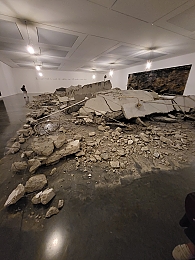
The long central corridor is lined with a large variety of ‘objets trouvés’, which some might well describe as ‘junk’. Together, they form a large-scale cabinet of curiosities like those which wealthy people used to create in the past, but few of the objects would have appealed to such collectors. Three large rooms can be entered from the corridor. The walls of each of these are lined with what at first sight look like enormous paintings. They are made of metal, often quite three-dimensional, and coloured with paint. Each one is both visually exciting and satisfying. In the middle of each room, there is an installation that suggests that it has formed after some apocalyptic event – maybe, an atomic bomb explosion or some similarly catastrophic event. In one room, the centre is filled with a pile of sand in which discarded supermarket trolleys have been abandoned. Another room is filled with what look like huge books damaged by flood waters. In the third and largest room, there are the concrete and rusted iron remains of what might once have been a modern building – it is a scene of horrendous devastation.

Throughout the ‘exhibition’, there are handwritten words, phrases, and sentences. These can be found on the walls, on the painting-like panels, and near objects stored in the corridor. A gallery attendant told us that each of them had been handwritten by Kiefer when he came to inspect the installation of his show. The words were not his but are all taken from “Finnegan’s Wake”, published in 1939 and written by James Joyce (1882-1941). Hence, the exhibition at the White Cube has been given the name of this novel.

Superb as this exhibition surely is, I found it oddly claustrophobic. Although it is a visual feast and a great feat of imagination and creativity, I found it slightly disturbing – that might have been the artist’s intention. But please do not let me put you off visiting this unusual and wonderful show.

Ulysses and the underground

THE IRISH AUTHOR James Joyce (1882-1941), author of “Ulysses”, “The Dubliners” etc., lived at number 28B Campden Grove in Kensington in 1931. While living in this flat, he worked on his novel “Finnegans Wake” (published in 1939) and married his long-term companion and muse Nora Barnacle (1884-1951). A blue plaque, which I had never noticed before during the 28 years I have lived in the area, on the house records his stay in Kensington. Joyce was not keen on this dwelling. In 1932, he wrote to Harriet Weaver Shaw:

“’I never liked the flat much though I liked the gardens nearby. That grove is inhabited by mummies. Campden Grave, it should be called. London is not made for divided houses. The little sooty dwellings with their backs to the railway line etc etc are genuine; so is Portland Place. But houses like that were never built to be run on the continental system and as flats they are fakes.” (quoted in http://peterchrisp.blogspot.com/2019/05/campden-grave-james-joyce-in-london.html

A few yards further west of Joyce’s temporary home, I spotted something else that I had not seen before and is relevant to what Joyce wrote.

The rear outer wall of number 1 Gordon Place is best viewed from near the end of Campden Grove just before it meets the northern end of Gordon Place. That rear wall is unusually shaped. Its windows are set into a concavely curved brickwork wall rather than the normal flat wall.

Today Gordon Place extends southwards, then briefly joins Pitt Street to run east for a few feet before making a right angle to continue southwards, crossing Holland Street and then ending in a picturesque cul-de-sac lined with luxuriant gardens. This has not always been its course. A map surveyed in 1865 shows Gordon Place as running between Campden Grove and Pitt Street. The section of today’s Gordon Place that runs south from Pitt Street to Holland Street was called ‘Vicarage Street’ and the cul-de-sac running south from Holland Street was then called ‘Orchard Street’. A map complied in 1896 reveals that Gordon Place was by then running along its present course. Vicarage Street had become renamed as part of ‘Gordon Place’.

Aerial views of the curved building, number 1 Gordon Place, show that its curved rear wall forms part of a deep opening that extends below the ground. Maps compiled from 1865 onwards show the presence of this hole and within it short stretches of railway tracks. The hole is a ventilation shaft for the Underground tracks, currently the Circle and District lines, that run just below the surface. Standing on Campden Grove close to the back of number 1 Gordon Place, one can hear trains clearly as they travel below the hole in the ground. How deep is the hole? The corner of Gordon Place and Campden Grove is 86 feet above sea level and High Street Kensington Station is at 43 feet above sea level.  The railway lines do not slope too much between the ventilation shaft and the station. According to Transport for London, between Notting Hill Gate and High Street Kensington, they descend by 12 feet (www.whatdotheyknow.com/request/70389/response/179967/attach/html/2/Station%20depths.xlsx.html). Using the information that we have, we can estimate the depth of the shaft to be at least 43 feet (i.e. 86-43 plus a little more because the rails are several feet below the surface).

The Metropolitan Railway that included the stretch of track between Notting Hill Gate and High Street Kensington stations was laid before 1868, and from the 1865 map, it was already present before the date when the map was surveyed. According to a detailed history of the area (https://www.british-history.ac.uk/survey-london/vol37/pp49-57), houses near the corner of Camden Grove and Gordon Place (and in other locations nearby) had to be rebuilt after the railway was constructed between 1865 and 1868.  The 1865 map shows no house at the site of the present number 1 Gordon Place. This building with its concave curved rear wall appears on a map surveyed in 1896. It would seem that the developer who constructed number 1 did not want to waste any of his valuable plot; he constructed the rear of the building right up to the circular edge of the ventilation shaft.

So, now we have an explanation for the curiously curved wall and for Joyce’s comments about houses with their backs to railway lines. Some friends of ours own a house with an outer wall that forms part of another ventilation hole on the District and Circle lines. They told us that should they need to make repairs to the outside of the wall that overlooks the tracks, they would need to get special permission from the company that runs the Underground and that many precautions would be needed to protect the workmen and the trains running beneath them.

Life is often far from straightforward, but London is endlessly fascinating. James Joyce preferred Paris to London, where most of his books were published. I hope that it was not his experience with trains running close to where he lived in Campden Grove that influenced his preference.

A brief video that I made gives another view of the ventilation shaft described above: https://youtu.be/js87XIWn1gU