A tower in Bath financed by sugar and slavery

I BECAME AWARE of William Thomas Beckford (1760-1844) in the late 1960s when my late friend Michael Jacobs and I were fascinated by the gothic revival that began sometime in the 18th century and continued with great vigour into the following century. Although I never read it, the ‘Gothic’ novel “Vathek” was written by Beckford, who also built the (now demolished) gothic revival style Fonthill Abbey. My interest in Beckford gradually drifted into the back of my mind and remained there until we made a visit to Bath (Somerset) in July 2024. Our hosts suggested that we visit the recently restored Beckford’s Tower, which is located on a hill just north of the Lansdown district of Bath. Kindly, they drove us there, and what we saw was interesting.

Beckford had a house in Bath’s Lansdown Crescent. It was set in extensive grounds that spread from his house to where the tower is located. The Italianate neo-classical tower was designed by the Bath-based architect Henry Goodridge (1797-1864), and completed for Beckford in 1827. It is 154 feet high and contains rooms that Beckford used as a library and living rooms. The grounds between Beckford’s house and his tower were landscaped to become Beckford’s Ride. Along the way, there is a manmade grotto, which has been recently restored.

After Beckford’s death, the tower and the land associated with it were donated to Walcot Parish, which used the area to create a burial ground. In 1931, the tower and the rooms at its base were badly damaged by fire. The cemetery was closed in 1992, and the following year, the site – tower and graveyard – were purchased by the Bath Preservation Trust, who have restored it. Between 1997 and 2000, extensive repair work was carried out on the tower. Further work was undertaken between 2022 and early 2024. This rendered the tower structurally sound and safe for it to be opened to the public. Before ascending the elegant spiral (helical, actually) staircase in the tower, the visitor can view exhibits relating to the life of Beckford in the rooms at the base of the tower. Amongst these, I spotted an early edition of “Vathek”, written it the language in which it was first published: French.

The author of “Vathek” was extraordinarily wealthy. His father, Sir William Beckford (1709-1770), was born in Jamaica, and later became Lord Mayor of London (1762-1769). His wealth, and therefore that of his son, was derived from his sugar plantations he owned in Jamaica. These were worked by the hundreds of slaves he owned. Thus, the tower was financed by the labour of these unfortunate unpaid labourers. Unlike several colonial apologists I have met and heard, the website of the restored tower, and many exhibits and notices within the edifice, emphasise the way in which the author of “Vathek” was able to pay for the tower and his extravagant lifestyle. The website (https://beckfordstower.org.uk/about/history/) includes the following:

“Through marriage and ruthless ambition over four generations, the Beckford family became one of the most powerful on the island of Jamaica. Their vast fortune was built on the profits of sugar plantations, directly created through the stolen labour of thousands of enslaved Africans.

William Beckford’s father, Alderman William Beckford, used the family’s wealth to rise through British politics, and was twice Lord Mayor of London. He presented himself as a hero of liberty for British citizens, whilst people on his plantations in Jamaica were trafficked and forced into slavery, stripped of their dignity, traditions, familial ties and African names, and given the surname Beckford.”

The Lord Mayor is commemorated by a statue in London’s Guildhall.

Professor Robert Beckford (born 1965), son of black Jamaican parents, wrote (https://www.theguardian.com/commentisfree/2023/sep/19/plaque-statue-slave-trader-murder-ancestors-william-beckford-london) in connection with this statue that it ought to be labelled as follows:

“William Beckford inherited 3,000 enslaved Africans in Jamaica, whom he mercilessly exploited to accumulate great wealth in Britain. His enslaved Africans were victims of routine sexual violence, torture, bodily mutilation and mass murder. Today, we recognise slavery as a crime against humanity and an unresolved stain on the national consciousness. We display this statue not because we wish to honour Beckford, but as a reminder of how we as a nation have sanitised, obscured and neglected racial capitalism and racial terror as foundational narratives of our modern history.”

In 1835, after the British Parliament had abolished slavery, former slave owners were compensated financially as the tower’s website explained:

“In 1835 following the abolition of slavery Beckford [author of ‘Vathek’] received a compensation payment of £12,803 (nearly £1.3 million today), the ‘value’ of the lives of 1,860 enslaved people.  He immediately acquired the neighbouring property at 19 Lansdown Crescent and embarked upon a further period of commissioning new furniture and interiors for his home and the Tower.”

Despite its association with slavery, the unusual Beckford’s Tower, is, like the Egyptian pyramids also built with slave labour, interesting both historically and architecturally. It has been beautifully restored. During the latest round of restorative work, care was taken to adapt the tower “… for sustainable energy use …” by installing some solar energy panels on the flat roof of the building that forms the lower part of the tower.

If you are visiting (or living in) Bath, a trip to see and enter Beckford’s Tower is well worth making. And when you are there, do not miss climbing the tower’s dramatic staircase to obtain a superb view of the city of Bath and the countryside beyond it.

Julia Margaret Cameron at the National Portrait Gallery in London

RECENTLY I PUBLISHED a book about the highly innovative Victorian photographer Julia Margaret Cameron (‘JMC’; 1815-1879). She married a British colonial administrator and lived during the heyday of the British Empire.  In my book, I tried to portray her sympathetically, but I do hint briefly that she was a ‘child of her times’ as far as he attitudes towards the colonised was concerned. Today, the 11th of July 2023, I paid a visit to London’s National Portrait Gallery (‘NPG’) to see how JMC and her works are currently presented.

JMC was a friend of the painter George Frederic Watts. His portrait of her hangs in the NPG. Another portrait by Watts hanging in the gallery depicts the historian and social commentator Thomas Carlyle (1795-1881). Nearby in another room, you can see Carlyle as portrayed in a photograph taken by JMC. This photograph is close to JMC’s photograph (see photo above) of Edward John Eyre (1815-1901). As British Governor of Jamaica, this gentleman was responsible for the brutal suppression of a revolt against British rule on the island. Under his command, 1000 homes were burned and 439 people were killed. Although this outraged many in Britain, it was defended by people such as Carlyle. Eyre’s portrait, made whilst he was awaiting trial, was, according to the NPG’s label, crafted by JMC to make him seem as if he was vulnerable and not:

“… a ruthless murderer but a sensitive man of duty.”

Another caption, next to a photograph of JMC by an unknown photographer suggests that her:

“… photographs are admired for their beauty and artistry. They also reflect the values of the Victorian era. Her portrait of Governor Eyre indicates her support for him following his violent suppression of the Morant Bay uprising.”

From what I have just written, you might get the impression that someone who composes the labels in the NPG is disapproving of JMC. Much as I feel that JMC’s apparent support for Eyre (and Carlyle) is not to my 21st century taste, one must remember that Cameron was living in a time when any uprising in the colonies would have been regarded as a dangerous – even apocalyptic – threat to the privileged life that she and her contemporaries enjoyed.

In all fairness to the NPG, they also have on public display one of JMC’s photographs of a less controversial sitter – the scientist Sir John Herschel (1792-1871). JMC met him in South Africa whilst she was convalescing from an illness she caught in India where she was living in 1837. It was Herschel who sparked off JMC’s enduring fascination with photography, which really ‘took off’ when she received her first camera in late 1863. She was then living on the Isle of Wight next door to her friend the poet Alfred Lord Tennyson.

JMC did not confine herself to taking photographs of defenders of colonialism. She made wonderful photographs of anyone she could find – both famous and completely unknown. What distinguished her work from that of her contemporaries is that, by experimenting with techniques in the studio and also in the darkroom, she created photographs that were works of art rather than slavish attempts to record real life accurately. Like great portrait painters, her photographic portraits give the viewer a sense of the sitter’s inner personality as well as his or her physical appearance.

My book is “Between Two Islands: Julia Margaret Cameron and Her Circle”. It is available from Amazon: https://www.amazon.co.uk/dp/B0BZFCVLX9/

A slave owner in central London

THE TALL GREY GRANITE drinking fountain that stands on the southeast corner of London’s Lincoln’s Inn Fields is no longer in use. The inscription carved on its base reads:

“In memory of Philip Twells. Barrister at law of Lincolns Inn and sometime Member of Parliament for the City of London. 8 May A.D. 1880”

Born the son of a banker John Twells (1776-1866), Philip (1808-1880) attended Oxford University and then was called to the bar at Lincoln’s Inn in 1834. His father was a partner in the private bank of Spooner Attwood & Co. In 1863, that bank was taken over by Barclay, Bevan & Tritton & Co, a precursor of the modern Barclays Bank. It was then that Philip became a partner in the enlarged banking concern. He was MP for the City of London from 1874 to 1880.

A website (www.layersoflondon.org/map/records/philip-twells-mp-banker-and-slave-owner-of-stoke-newington-church-street) recorded that Philip Twells owned 252 slaves in Jamaica, and added:

“The Slavery Abolition Act of 1833 had made the ownership of slaves illegal within the British Empire although servitude was replaced by ‘apprenticeship’ for at least five years. The 1837 Slave Compensation Act provided compensation to owners for the loss of their business assets.”

Another website (http://wwwdepts-live.ucl.ac.uk/lbs/person/view/46210) noted that Philip Twells was:

“Awarded part of the compensation for the Islington estate in St Mary Jamaica with his brother Rev. John Twells …”

The slave-owner compensation awarded to Philip was £4207, which is worth well in excess of £300,000 in today’s money. On his death, Pholip left a substantial fortune to his wife.

The fountain commemorating Twells in Lincoln’s Inn Fields was a gift of his widow, and was erected in 1882. Sadly, this memorial to a former owner of slaves can no longer refresh the passer-by. However, during weekdays, food and drinks can be obtained at a café in the middle of Lincolns Inn Fields. And while you are in the area, do not miss seeing the magnificent Sir John Soane’s Museum on the north side of the Fields.

The slave owner who helped abolish slavery

BLOG HOLL LATE 246

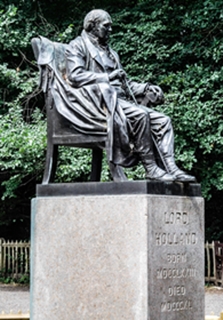
SEATED IN A CHAIR ON A STONE PLINTH, surrounded by a small pond and often with a pigeon on his head or shoulder, Henry Vassall-Fox, 3rd Baron Holland (‘Lord Holland’; 1773-1840) gazes benevolently towards the ruins of his home, which was destroyed by German bombs during WW2. The fine cast metal statue was sculpted by George Frederic Watts (1817-1914) with technical assistance from Joseph Edgar Boehm (1834-1890). I have walked past this statue innumerable times and never given it much of a thought apart from being amused when I have seen pigeons resting on the crown of Holland’s head. A friend of ours pointed out that the sculptor has included, unusually, a depiction of Holland’s wedding ring, a memorial to his marriage which was to prove very interesting with regard to his political activities. Today, the 20th of June, I walked past it yet again, but with the recent interest in statues and their subjects’ relationships with the slave trade, I wondered whether Lord Holland had any connection with it. What I have discovered is somewhat surprising.


Lord Holland was the nephew of the Whig statesman Charles James Fox (1749-1806). According to the British History Online website:
“On the death of his uncle … Lord Holland was introduced into the Cabinet as Lord Privy Seal; but the strength of the Whig portion of the Government had then departed, and the only measure worthy of notice in which his lordship co-operated after his accession to office was the Bill for the Abolition of the Slave Trade.”
This suggests that Holland was an abolitionist.


However, things are never so simple. When visiting Florence (Italy) in 1793, he fell in love with Elizabeth Vassall, wife of Sir Godfrey Webster, 4th Baronet. She and Webster divorced and then Elizabeth married Lord Holland. The “Oxford Dictionary of National Biography” (‘DNB’) records that in 1800
“… Holland assumed the additional name of Vassall to safeguard his children’s right to his wife’s West Indian fortune.”
When her first husband died in 1800, Lord Holland became the owner of the Vassall plantations in Jamaica. By accident, the abolitionist became an owner of slaves.


According to a website published by the Portobello Carnival Film Festival 2008:
“By all accounts, the Hollands were humane and improving proprietors who supported anti-slavery measures against their own financial interests. It can even be argued that he was more use to the abolitionist movement as a slave owner than he would have been as a mere politician. Nevertheless, in perhaps the defining local paradox, the finest hour of Holland House as the international salon of liberal politics was financed by the profits of slave labour.”
The site continues by pointing out that after his uncle died, Lord Holland:
“… was on the committee that framed his uncle’s bill for the abolition of the slave trade. Meanwhile Lady Holland founded the area’s multi-cultural tradition by employing Afro-Caribbean, Spanish and Italian servants – in order to enhance the foreign image of her political salon.”


VE Chancellor wrote in his article “Slave‐owner and anti‐slaver: Henry Richard Vassall Fox, 3rd Lord Holland, 1800–1840” that Holland regarded a slave:
“…not as mere chattel, but as an individual with feelings and abilities no less than those of other men …”.
However:
“… he justified the continuing history of slavery in the British Empire in Whiggish terms of the right to property and the need to obtain the consent of those who owned slaves before Abolition could be achieved…”
So, it seems that Holland, an avowed Abolitionist and ‘accidental’ owner of slaves, was placed in a difficult position. Chancellor records that the great Abolitionist William Wilberforce (1759-1833) regarded Holland as:
“… a ‘most zealous partisan’ of slave trade abolition …”,
And the DNB relates:
“Holland himself was an equally keen supporter of the abolition of slavery in 1833, despite its adverse effect on his West Indian income.”
Holland gave his full support for the Slave Trade Abolition Bill when it passed through the House of Lords. The passing of the Bill was accompanied by sizable tax relief to sugar producers in the West Indies. Lord Holland benefitted from these, as the University College London ‘Legacies of Slave Ownership’ website notes:
“Lord Holland, awarded part of the compensation for under three awards for the enslaved people on his estates in Jamaica…”
Chancellor wrote that Holland, who had benefitted financially from the tax relief concessions:
“… learnt the lesson that those called on to make sacrifices in a good cause do so the more willingly when potential loss is compensated.”


So, now returning to the statue covered with bird droppings in Holland Park, what are we to think? No doubt, Lord Holland became an owner of slaves, but by an accident caused by one of Cupid’s arrows. Had he married someone else, he might not have become the inheritor of Caribbean plantations with slaves. If William Wilberforce was happy to regard him as a bona-fide Abolitionist, that is for me a favourable contemporary character reference for Lord Holland. Some, including me, looking at his statue with hindsight, might ask why he, an avowed Abolitionist, did not emancipate his slaves as soon as they came into his possession. I am willing to believe that the answer to this is far from simple.

[For reference to Chancellor, see: https://www.tandfonline.com/d…/abs/10.1080/01440398008574816]