
A statue iņ Ahmedabad and a friend in Bangalore

I FIRST CAME ACROSS the name Indulal Yagnik when I was researching my book (“Indian Freedom Fighters in London:1905-1910”) about the less well-known Indian Freedom Fighter, Shyamji Krishnavarma (1857-1930). Indulal Yagnik (1892-1972), who was a writer and political activist, published a biography of Krishnavarma in 1950. Yagnik wrote many other things, amongst which were the first 30 chapters of Gandhi’s autobiography that were dictated to him by the Mahatma whilst they were both imprisoned in Yeravada jail.


Between 1915 and 1947,  Yagnik was active in the Indian struggle for freedom. Amongst his many activities,  he carried the first tricolour Indian flag from Germany to India. This flag had been designed by Madam Cama, a leading proponent of Indian independence, and had been displayed to the world (for the first time) at a meeting of socialists in Stuttgart (Germany). Yagnik was imprisoned by the British at least twice on account of his anti-British activities and publications.


After Independence, in 1956, Yagnik led the Mahagujarat Movement for a separate Gujarat state, which led to the separation of Gujarat from Maharahtra that occurred in 1960.
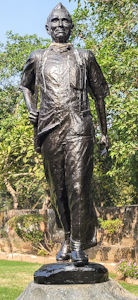
 

Close to the east end of the Nehru Bridge in Ahmedabad, the city in which Yagnik died, there is a small, well-maintained  park in  which there is a fine statue of Indulal Yagnik. It was created by the late Kantibai B Patel, who also made many other statues of well-known Gujarati people, including many of Mahatma Gandhi.  The statue of Yagnik depicts the man striding forward, his shirt pocket filled with a spectacles case and a pen.


I was keen to view the statue not only because I had read Yagnik’s biography of Krishnavarma  but also for another reason. His nephew,  who lives in Bangalore,  is a good friend, whom we got to know because his wife is related to members of my wife’s wider family.


Even if you do not have the sort of ‘connection’ we have with Indulal Yagnik’s nephew, the statue is worth seeing because it is a good piece of sculpture.
Kutch from kingdom to district

MY WIFE’S COUSIN lives in a part of the Indian state of Gujarat called Kutch (‘Kachchh’). He and his wife have a lovely farmhouse near the port city of Mandvi, where you can watch huge wooden dhows being constructed along the riverbank. Although Kutch is now a part of the state of Gujarat, it has not always been. The people of Kutch (‘Kutchis’) speak a language quite distinct from Gujarati. The Kutchi language has closer similarity to Sindhi than to any other Indian language (Kutch is bordered to its north by Sindhi speaking people*). It is a spoken language, but not written. Even though Kutchi people can speak and write in Gujarati, they will proudly inform you that they are Kutchis and definitely not Gujaratis. During our several visits to Kutch, my wife’s cousin’s driver, who can speak good Gujarati, insists on speaking to my wife in Kutchi, which she cannot speak as well as Gujarati.

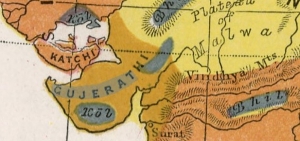
Many people with whom I have discussed my travels, look puzzled when I say that we have been to Kutch. Just in case you are wondering, it is the furthest west part of India. Most of the north of the region is bordered by Pakistan, from which it is separated by the arid Rann of Kutch. To the south and separated from it by the Gulf of Kutch (a part of the Arabian Sea) is the peninsula of Saurashtra – now also a part of Gujarat.

Until 1947, Kutch was a kingdom founded by unifying three separate kingdoms, ruled by branches of the Jadeja family, in the 16th century. In 1819, having suffered a military defeat (at The Battle of Bhuj in March 1819), the Kingdom of Kutch accepted the sovereignty of the British East India Company. Under the watchful eyes of the British, members of the Jadeja family continued to rule Kutch – it became one of India’s many ‘Princely States’. On the 16th of August 1947, one day after India became independent, Kutch voluntarily acceded to the new Indian state.

Kutch became a state of India. In November 1956, as a result of the State Reorganisation Act (1956), Kutch ceased to be a state in its own right, but became a part of the then huge Bombay State. The latter was effectively a bilingual region, most people were either speakers of Marathi or of Gujarati. The Marathis and the Gujaratis began to clash. In 1956, the Mahagujarat Movement began campaigning for a state for Gujaratis, which was separated from that for Marathis. The movement was spearheaded by Indulal Yagnik (1892-1972). His nephew, who lives in Bangalore is a family friend, whom we meet whenever we are in the city. As the Gujaratis clamoured for their own state, so did the Marathis, Blood was shed, and much property was damaged. On the 1st of May 1960, the old Bombay state was divided along linguistic grounds. The states of Maharashtra and Gujarat were formed. The latter includes the Gujarati speaking district of Saurashtra as well as the northern part of the former Bombay State, and also Kutch. And that is how it remains today.

Since 2017, we have made several enjoyable visits to Kutch, from which my wife’s maternal ancestors hail, and enjoyed many fascinating experiences there. Some of these can be found in my new book – a collection of true stories about life in India seen through my eyes. The book (also Kindle) is available from Amazon websites including https://www.amazon.co.uk/HITLER-LOCK-OTHER-TALES-INDIA/dp/B0CFM5JNX5/

*When Lord Napier conquered Sindh *which neighbours Kutch) in 1843, he is reputed to have sent a single word message to London in Latin “Peccavi”, which means ‘I have sinned’.