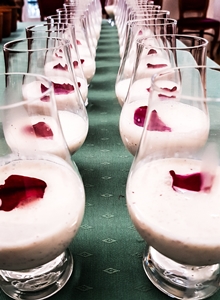
Drink a glass of lassi:
It will refresh you
In an Indian way

Drink a glass of lassi:
It will refresh you
In an Indian way
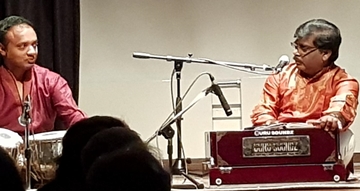
I enjoy attending events at the Nehru Centre, the Indian High Commission’s cultural centre in London. However, the audience can become quite unruly occasionally.
Only afew days ago, I attended a concert of Bengali and Hindi songs pertformed by an excellent Bengali male vocalist, Soumyen Adhikari who accompanied himself on a harmonium. He was also accompanied by a superb tabla player.
The audience was, as is often the case, restless. People arrived late throughout the performance. Others kept moving from one seat to another or leaving the auditorium only to return a few minutes later. All around us people in the audience were chatting to each other loudly whilst the musicians performed. They would not be silent even after having been asked repeatedly. All of these disturbances are quite normal amongst Indian audiences and are more or less tolerable.
What really upset me at this particular concert was the ignorant comments shouted by some members of the audience. After the singer had sung several beautiful songs in Bengali, some people began shouting things like “Sing something in Hindi”, “we can’t understand Bengali”, and “enough of Bengali songs”.
I cannot understand either Hindi or Bengali, but that does not detract from my enjoyment of songs sung in these languages. What is important to me is that the singer has a good voice and that the musicians play well. Just the lovely sounds of the songs and the music is a great pleasure for me. It upset me that so many of those around me lacked the ability to appreciate the beauty of what was being played. Their approach was so parochial that all they wanted was something familiar, which they had heard over and over many times before. I felt sorry for the singer, who is clearly a masterful performer whom I would happily hear again.
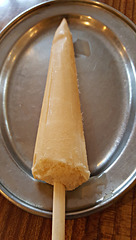
Kulfi: an Indian sweet,
Frozen joy:
Exquisitely enjoyable
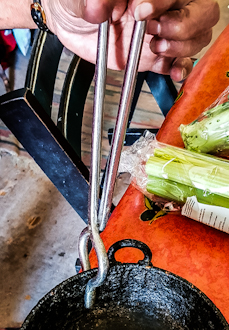
Just in case you have not got one in your kitchen, here is an implement that is extensively used in Indian kitchens and tea stalls.
The sandasi (pronounced roughly like ‘sun-er-see’ said fast), which is is also known as a pakad (from the verb ‘to hold’ in Hindustani) or a chimta (from the verb ‘to pinch’ in Hindustani), is essentially a pair of sturdy hinged metal (stainless steel) tongs. The handles of the implement are several times as long as the gripping elements. This means that quite heavy things may be lifted with the beaks of the tongs without any risk of them slipping out of their grip.
The sandasi’s long handles also mean that the user’s hands can be kept at a safe distance from the hot cooking vessels that are lifted with this pair of tongs. For example, the tea maker can lift and manipulate with ease the huge pots containing several litres of a bubbling, boiling mixture of milk, tea, and spices.
I find the sandasi very useful for gripping the edges of large casseroles when I am stirring hot food like stews or curries.
Cooking tongs are, of course, available in countries other than India, but the sturdy construction and long handles of the sandasis have much to reccommend them.
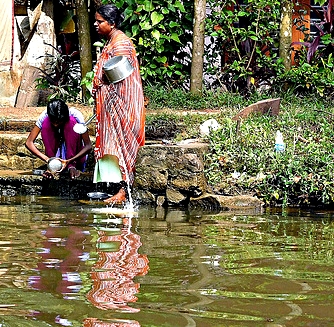
Women washing bowls
In water flowing past:
Peace reigns in Kerala
Photo taken near Alleppey, Kerala, India
 yamey
yamey 